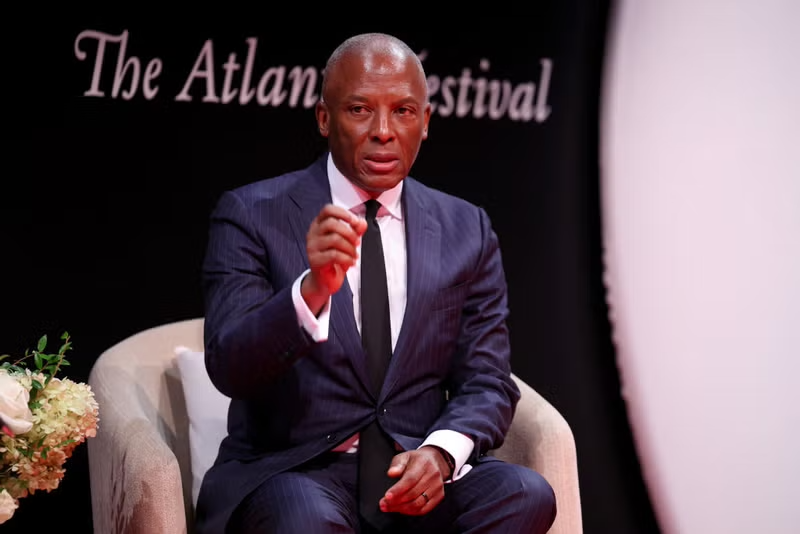
Most executives climb by mastering one thing. Not Womack. After joining Southern Company in 1988, he bounced through government affairs, communications, HR, power generation. Along the way, he developed an unusually broad view of how the energy business actually works.
Over more than 35 years, he touched coal, gas and hydro generation, regulatory affairs, people management. Then, in 2023, he became CEO of Southern Company. The company now serves about 9 million customers and businesses nationwide. Womack didn’t rise on one specialty. He rose by learning nearly every corner of the industry.
Taking Control When Vogtle’s Risk Was Still Rising
Womack became chairman and CEO of Georgia Power in June 2021. Plant Vogtle Units 3 and 4 were still unfinished at the time. He didn’t start the nuclear project. His defining move was simpler: he took accountability for finishing it.
Two months in, Georgia Power revised the schedule again. Its share of project capital costs jumped by $460 million, landing at $9.2 billion. Only $7.3 billion had been approved for recovery by the Georgia Public Service Commission. Every extra month of delay chipped away at the company’s return.
Womack stayed focused on getting it done. He never let that focus slide into cutting corners on safety or quality.
The results speak for themselves. Unit 3 went commercial on July 31, 2023. Unit 4 followed on April 29, 2024. Together, the two reactors added roughly 2,234 MW of capacity, enough to power about a million homes and businesses. Plant Vogtle is now the largest clean energy generator in the country.
Own the Problem, Change the Method, Share the Risk
Own the problem in front of you.
Accountability starts where your authority starts, whether you inherited the problem or not. As Womack put it at Georgia Tech’s Tech Talks Business in 2024: he can’t point to others, the responsibility is his.
Vogtle was already a mess before Womack took over Georgia Power. His job wasn’t to explain the past. It was to manage what was left.
Change the mechanism when it stops working.
Protect the goal, not the process. Speaking at Jackson Spalding’s Meaningful Conversations in 2024, he described being challenged to change anything that wasn’t working.
His own career follows that logic. He didn’t stay a policy specialist. He moved through people management, communications, generation, regulation, picking up new tools for harder problems along the way.
Share irreversible risk.
Big strategic bets shouldn’t mean shouldering every tail risk alone. At the Reuters NEXT Global Energy Transition conference in June 2024, he talked about needing to make investments while also pulling others in as partners.
After Vogtle, he pushed for something specific: government-backed protection against cost overruns, and more industries sharing the load on future nuclear builds.
The Win That Rewrote His Risk Model
Vogtle earns its place on Womack’s résumé precisely because finishing it doesn’t erase what went wrong.
The project landed more than seven years behind schedule. Associated Press calculations put the owners’ capital and financing costs at roughly $31 billion. The original projection was about $14 billion.
Here’s the interesting part. Womack still believes in nuclear. But his vision for the next generation of plants comes with a condition: better risk-sharing from the start.
The takeaway isn’t “never give up.” It’s sharper than that. Even a strategically valuable asset can be financed or structured badly.
His Power Network Is Institutional
Backers. Vogtle shows the scale of institutional muscle behind Womack’s world. The U.S. Department of Energy handed the project’s owners up to $12 billion in loan guarantees.
Strategic access. Womack holds leadership or board seats at the Edison Electric Institute, Electric Power Research Institute, Invesco and the Georgia Ports Authority. That puts him close to utility policy, energy research, capital markets, and infrastructure-driven economic development, all at once.
Copy This — Build a 360-Degree Operating Map
Figure out the four functions that could kill your business: operations, capital, customers, regulation or distribution.
Over the next quarter, learn one critical metric, one decision-maker, and one major failure mode for each.
Womack’s career makes the point well. The edge isn’t knowing more than every specialist in every function. It’s knowing enough about each one to see how a single decision ripples through the whole system.