

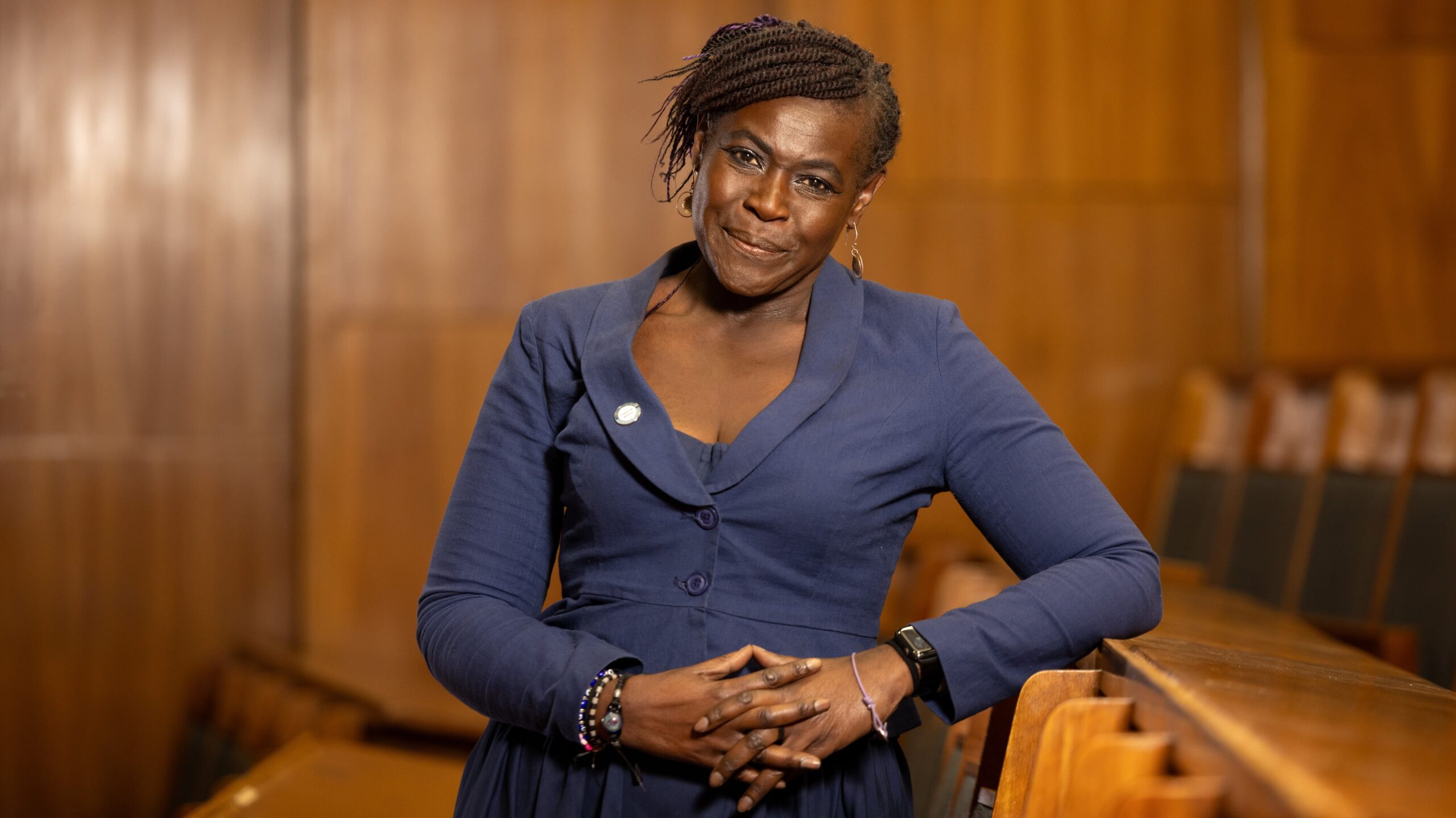
Dame Maggie Aderin’s 2026 David Attenborough Award and Lecture recognizes public engagement with science as a substantial achievement in its own right. The Royal Society’s citation credits her work in widening participation and reshaping public understanding of space science. Her documented career connects that public role with years of scientific and engineering practice.
The distinction is useful because a familiar television presence can conceal the work behind an explanation. Aderin’s institutional record includes technical training, instrument development, broadcasting and educational leadership. Read together, those activities offer a more complete account of professional distinction than visibility alone.
The award’s defined purpose
The Royal Society describes the Attenborough award as recognition for outstanding, sustained public engagement with science. Its 2026 winner page names Dame Dr Margaret Aderin. The Society’s wider awards announcement uses Maggie Aderin, while earlier biographies identify her as Maggie Aderin-Pocock.
Those are the names attached to the institutional records considered here, rather than different people or separate achievements. This account uses Maggie Aderin, as the University of Leicester did in its August 27, 2026 announcement of the award.
The Society’s citation describes outreach reaching millions. That language conveys the awarding body’s assessment. It is not an independently measured audience total established by this article, and it should not be converted into a claim that a known number of people entered scientific careers because of her work.
What is firmly established is the recognition itself and its stated basis. A learned society has identified public explanation and participation as worthy of a named award. That makes it possible to examine communication as part of scientific professional life rather than assume it is simply a by-product of other work.
A technical foundation for explanation
The Royal Institution’s biography records a physics degree at Imperial College London in 1990 and a mechanical-engineering doctorate in 1994. It also describes work on scientific instruments, including a high-resolution spectrograph for the Gemini telescope and observation instruments associated with the Aeolus satellite.
These records matter because they place her public role alongside experience of how scientific tools are made and used. They do not establish that every communication technique follows directly from a particular engineering project. They provide the background against which that connection can be considered.
An instrument and an explanation have different purposes. One helps produce an observation; the other helps someone understand a question, a method or a result. A practitioner who works across those activities must decide what detail belongs in an account and which simplifications preserve its meaning.
That is the craft worth investigating. The reader does not need an unsupported claim that a presentation transformed a classroom to appreciate the difficulty of making a complex subject intelligible. The question is how accuracy, curiosity and accessibility can coexist in the same explanation.
Recognition across institutions and years
Aderin’s 2026 award follows an earlier professional recognition. The Institute of Physics lists her as the 2020 recipient of its William Thomson, Lord Kelvin Medal and Prize, citing services to science education and physics communication, including work with school students and broadcasting.
The two awards belong to different institutions and different years. Together, they document repeated recognition of public engagement. They do not, by themselves, measure learning outcomes or establish which medium has been most effective.
The distinction protects the achievement from exaggerated claims. A medal is a record of an institution’s judgment. A programme evaluation would be a different kind of evidence, addressing defined participants and changes over time. Both can be valuable without being interchangeable.
For a publication concerned with Black achievement, that precision is particularly useful. It allows the specific work to carry the story, without relying on an unsupported superlative or a generic declaration of inspiration. The Royal Institution’s biography explicitly identifies Aderin as Black; her inclusion is grounded in that public identification.
Leadership as well as broadcasting
The University of Leicester records that Aderin became its chancellor in 2023. Its August 2026 award announcement places her work as a scientist, broadcaster and author alongside that institutional role.
The same announcement includes her response to the recognition. She describes making science simple and engaging for the public as a continuing mission. This is her published statement through the university, rather than an interview conducted by Black Elites.
The stated aim gives an important boundary to the analysis. Simplicity is a communication objective; it need not mean that the underlying subject is simple. The quality of an explanation depends on what it enables an audience to understand, and on whether the essential qualifications remain intact.
A fuller reported account could examine a particular explanation in detail: the scientific problem, the choice of language or demonstration, the audience’s response and what changed afterward. It could bring an educator’s assessment alongside Aderin’s account of her intentions. Those are opportunities for further reporting, not experiences invented for this profile.
The institution-building implication
Her documentary record also raises a question for scientific organizations: how should the work of public engagement be recognized and sustained? Named awards, educational roles and institutional platforms make that work visible. Evidence about the activity itself would help distinguish a compelling appearance from a continuing contribution.
For younger readers, the useful model is a career with more than one form of professional practice. Technical study, engineering work, public explanation and leadership appear in the records. That does not mean every scientist should follow the same path or that broadcasting is the measure of a successful research career.
Aderin’s achievement is more specific. Her work has earned recognition for connecting people with science, supported by a documented technical background and a continuing public role. The 2026 award gives that contribution a clear institutional marker. The next question is how to explain its methods and assess its effects with the same care that the science itself demands.


