
Something worth paying attention to just happened in the Carolinas. Optus Financial Corporation, based in Columbia, South Carolina, and M&F Bancorp out of Durham, North Carolina, have signed a definitive merger agreement — and the resulting bank will carry $1.27 billion in total assets across 10 branches in both states.
This isn’t just two regional banks deciding to save some money on overhead. It’s arguably one of the more important moves for Minority Depository Institutions (MDIs) in recent memory, bringing together two of the country’s most established Black-owned banks to tackle a problem that’s dogged this sector for decades: they’ve never had the balance sheet to match their ambitions.
Who’s Steering the Combined Bank
Leadership was one of the first things settled once the deal was announced. James H. Sills III, who currently serves as president and CEO of M&F Bancorp, is set to take the CEO seat at the combined holding company and bank. Paul Mitchell, chairman of Optus Financial and Optus Bank, stays on as chairman of both entities going forward. James A. Stewart, M&F Bancorp’s chairman, framed the deal as a continuation of the bank’s founding purpose, saying it lets the institution honor its legacy while giving it more resources to serve its communities. Mitchell, for his part, called the tie-up a defining moment for mission-driven banking in America.
That leadership split is worth noting on its own: rather than one bank absorbing the other’s management, the new structure keeps a senior voice from each side at the top, which tracks with how both sides have framed this as a partnership rather than an acquisition.
The Real Problem MDIs Have Been Fighting
Black-owned banks have always carried more mission than muscle, in a sense. They show up for communities that bigger banks often overlook, but they’ve had to do it without the scale that lets larger institutions absorb regulatory costs, build out fintech infrastructure, or write big commercial loans without blinking. That mismatch has quietly limited what these banks could actually do, no matter how strong their intentions were.
Putting Optus and M&F together starts to close that gap in a few concrete ways:
Bigger loans, kept in-house. Legal lending limits are tied directly to a bank’s capital base, so a bigger balance sheet means the combined bank can now underwrite larger commercial real estate and corporate deals on its own, rather than watching those deals go elsewhere or having to syndicate them out.
Less duplicated overhead. Running two separate compliance departments, two tech stacks, two administrative teams — that’s expensive, and it eats into margins that were already thin. Consolidating into 10 branches frees up capital that can actually go toward growth instead of just keeping the lights on.
Room to actually invest in technology. Competing on digital banking and treasury management takes capital most single MDIs simply don’t have. A $1.27 billion asset base changes that math.
How the Two Banks Stack Up
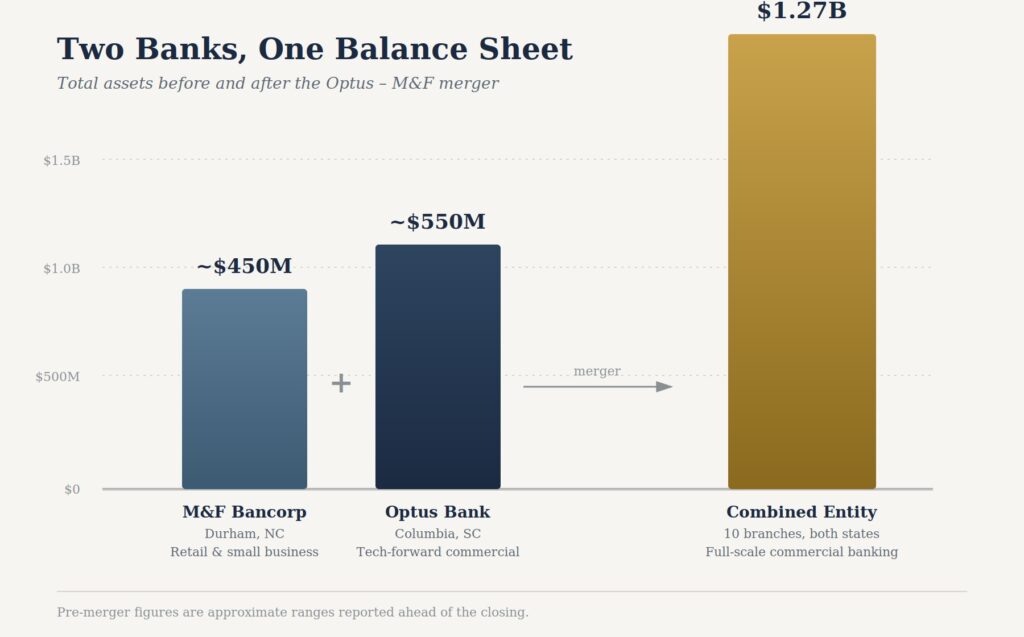
The two institutions bring genuinely different strengths to the table, which is part of what makes this pairing interesting rather than redundant.
Why Bigger Deposits Are the Real Prize Here
Here’s a dynamic that doesn’t get talked about enough: over the past few years, a number of Fortune 500 companies have pledged to move real money — tens of millions of dollars — into Black-owned banks as part of their ESG and corporate responsibility commitments. It’s a meaningful gesture, but there’s a catch that often goes unmentioned.
A corporation can’t responsibly drop a $50 million deposit into a bank with only $200 million in total assets. The concentration risk is too high, for the bank and for the depositor. So in practice, a lot of that pledged capital has struggled to actually land where it was intended.
A $1.27 billion institution doesn’t have that problem. It can absorb larger institutional deposits without putting itself at risk, which means it can finally capture the kind of low-cost, patient capital that’s been earmarked for MDIs but hasn’t always found a home. That liquidity, in turn, can be put to work as higher-yield commercial lending.
What This Signals Going Forward
If there’s a bigger takeaway here, it’s that consolidation might be the path forward for MDIs that want to genuinely compete rather than just survive. Going up against national banks with trillion-dollar balance sheets requires real scale, and that’s hard to build organically when your core customer base is often underserved and undercapitalized to begin with.
What Optus and M&F are attempting is proof that a bank can grow into real competitive scale without losing the community-first mission that got it there in the first place. Whether other MDI pairs follow this same playbook in the next few years is probably the question worth watching.