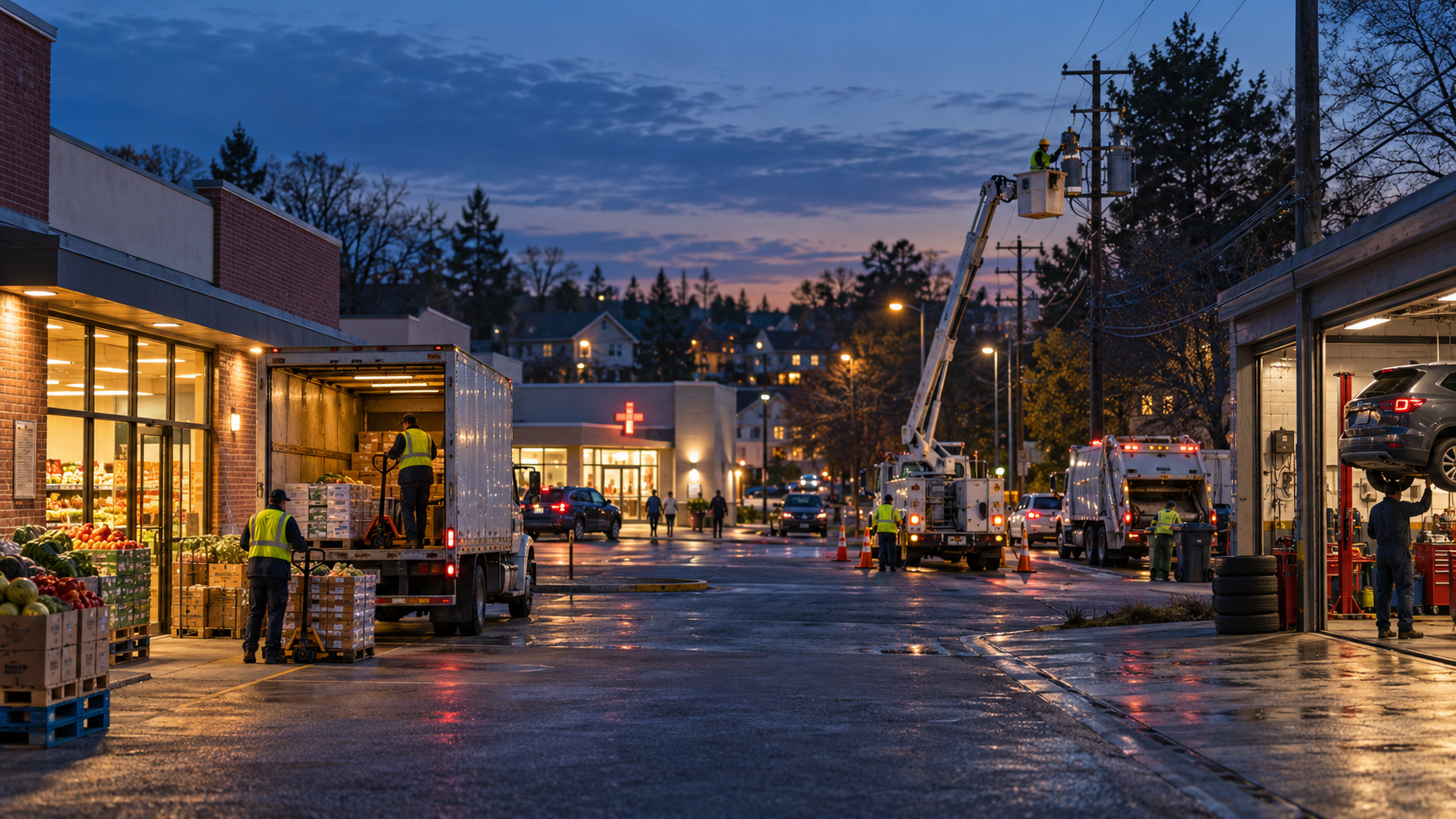
These essential American businesses turn unavoidable needs, recurring demand, and operational barriers into durable revenue.
A homeowner facing a $250 plumbing bill will often complain about the price. The same homeowner, watching a pipe leak into the basement for another week, will pay it without much more discussion. That gap — between the annoyance of a bill and the cost of doing nothing — is where most of this essay lives.
Americans can put off a vacation, cancel a streaming account, or keep last year’s phone for another cycle. Food, prescriptions, car repairs, electricity, and garbage pickup don’t leave that kind of room. Skip them and the effects show up within days: the fridge empties, the medicine runs out, the trash piles up, the car doesn’t start.
That doesn’t automatically make the companies selling these things good investments. Regulators cap what utilities can charge. Labor costs eat into repair-shop margins. Grocery chains compete on pennies per item. What holds across the category is narrower than “essential businesses are safe” — it’s that the demand underneath them rarely disappears outright. It gets rerouted: to a cheaper brand, a different provider, a delayed but still-necessary repair.
The companies worth paying attention to are usually the ones sitting on something hard to duplicate — a landfill permit, a pharmacy network, a transmission line, a bay full of trained mechanics. Necessity gets you in the door. Owning the bottleneck is what keeps you there.
Groceries
Costco’s membership fee arrives before a single item goes in the cart. That’s not an accident — it’s an admission that selling groceries directly barely pays the bills.
Grocery margins run thin enough that a chain can ring up billions in sales and still struggle to turn much of it into profit. Inventory spoils, shoplifting eats into thin margins further, and customers notice a ten-cent price difference on milk in a way they’d never notice it on a jacket.
Walmart, Kroger, and Costco sell the same milk and bread as a corner grocer. Their advantage sits in the machinery behind the shelf: thousands of stores letting distribution and technology costs spread across billions of transactions. Those same stores double as fulfillment hubs for pickup and delivery, something a pure e-commerce grocer would have to build from nothing, at enormous cost, to match.
Households under financial pressure don’t stop eating; they just change what and where. Restaurant meals become home-cooked ones. Name brands lose shelf space to store brands. Multiple trips become one big one. The dollars move within the category rather than leaving it, and that’s exactly why grocery chains have started treating the food aisle as a loss leader for retail media, pharmacy counters, and private-label margins layered on top.
The real diagnostic isn’t top-line growth. It’s inventory turnover, shrink, and whether a chain can pass rising supplier costs on to customers without sending them to the store across the street.
Utilities
Forty-one percent. That’s the share of U.S. electricity that came from natural gas in 2025, according to preliminary EIA data — with renewables at 24%, nuclear at 18%, and coal making up the rest.
None of that generation mix matters much to the business model, because the thing that actually protects a utility sits underneath the power plants: the wires, substations, and pipes that would cost a fortune and years of permitting to duplicate. Nobody is quietly building a second grid down the street.
The same structure that protects utilities from competition also limits what they can earn from it. Public commissions decide which capital projects get approved, how fast the utility recovers the cost, and what return it’s allowed to keep. A transmission project can be badly needed for the grid and still be a headache for shareholders if it runs over budget or financing gets expensive halfway through.
Demand is about to climb sharply — data centers, EV charging, reshored manufacturing, and grid modernization are all pulling on the same infrastructure at once. Not every utility executive is convinced the numbers being thrown around will hold up. Constellation Energy CEO Joe Dominguez told analysts on the company’s May 2025 earnings call:
I just have to tell you, folks, I think the load is being overstated. -Joe Dominguez
Whether the coming decade is good for utility investors depends less on how much power actually gets consumed and more on whether management can execute large capital programs without letting costs — or overly optimistic load forecasts — run away from them.
Health Care
CVS Health doesn’t just sell you a prescription anymore. It might also be your insurer, your pharmacy-benefit manager, and the company deciding whether the drug your doctor prescribed gets covered.
That kind of vertical reach is a bet on the fact that illness doesn’t wait for a good economy. People delay elective surgery or switch to a generic when money is tight, but a dialysis schedule or a chronic prescription doesn’t have much flex in it. Spending gets split across household income, employer insurance, Medicare, and Medicaid, which cushions the industry from a straight collapse in consumer spending — while exposing it instead to reimbursement policy, claims risk, and politics.
Hospitals can run full and still lose money to labor costs. Insurers can underprice a risk pool for a year and pay for it the next. Pharmacies fill more prescriptions while collecting less per fill, squeezed by pharmacy-benefit managers on one side and drug manufacturers on the other. People keep getting sick regardless of who’s managing the balance sheet at CVS or UnitedHealth — that consistency shows up in patient volume, not necessarily in the numbers shareholders see at the end of the quarter.
Waste Collection
Republic Services owned or operated 207 active landfills at the end of 2025, holding an estimated five billion cubic yards of remaining disposal capacity, per its SEC filing. Tipping fees paid by third parties dumping at those sites made up roughly 12% of the company’s 2025 revenue.
Nobody is opening a new landfill next quarter to compete with that. Environmental review alone can take years, before construction or local opposition even enters the picture — which means existing sites function as infrastructure for the whole industry, not just their owners.
The collection side runs on similarly unglamorous math. A truck serving a hundred tightly packed stops spreads fuel and labor across all of them cheaply; a truck driving long distances between scattered customers can lose money on the route entirely. Density is most of the business. Most contracts run for years at a stretch — municipal agreements, commercial deals, exclusive local franchises — and switching offers a customer so little upside that low enthusiasm for the provider coexists easily with high retention.
Waste Management pushed further into recycling, renewable natural gas, and medical waste, the last through its Stericycle acquisition — new revenue running through trucks and facilities the company already owned.
Even a business this insulated moves in cycles. Republic Services CEO Jon Vander Ark, discussing the recycling and industrial-waste market on the company’s Q2 2026 earnings call, put the recent stretch bluntly:
We’re coming out of a period of nearly four years of negative growth in recycling and waste. -Jon Vander Ark
Landfill ownership determines who profits once the material shows up. It doesn’t determine how much material shows up in a given year.
Vehicle Repair
What do you do when your car won’t start on a Tuesday morning and you have to be at work by nine?
You don’t shop around. You call whoever can get you a part and a mechanic the fastest. That single fact shapes an entire industry: the average light vehicle on U.S. roads was 12.8 years old in 2025 from reports, and vehicles seven years or older made up roughly 43% of the fleet, according to AutoZone’s annual report. Cars that old are past their factory warranties and need more parts, more often, right as new-car prices make replacement look worse by comparison.
The operators who do well here have figured out how to be both a trusted local shop and a national parts network at once — inventory systems and store density matter as much as the mechanic’s reputation, because a customer whose car is dead isn’t comparing prices. They’re finding out who has the part in stock right now.
Connectivity
Try paying your rent, filing for unemployment, or making a doctor’s appointment without an internet connection. For a growing share of essential life administration, that option barely exists anymore.
Customers downgrade a data plan or switch carriers all the time — competition here looks nothing like the local monopoly a utility enjoys. But almost nobody drops connectivity entirely, which gives providers a durable revenue base even without pricing power to match a utility’s. Fiber networks, once installed, build long customer relationships that last for years; wireless carriers spread network costs across subscriber bases in the tens of millions.
Subscriber growth on its own says little. A carrier adding customers through steep discounts can end up worse off than one holding a smaller, stable base at full price — the difference shows up in churn, average revenue per user, and how much cash is left after the network gets its upgrade budget.
What Nonuse Actually Costs
Grocery volumes can hold steady while margins get crushed. A utility can lose a rate case. An insurer can misjudge a year of claims. A waste hauler can lose a contract to a competitor with tighter routes. None of that fits comfortably under “recession-proof,” which oversells what these businesses actually offer.
A better question: what does skipping the purchase actually cost the customer? Health, a paycheck, property, a legal obligation, the ability to get to work — if any of those are on the line, the demand underneath the business has a floor. Pair that floor with a provider that also owns something scarce — a permit, a hard-won contract, a decade of route density — and the demand tends to show up eventually as cash flow.
It’s also worth looking past whoever’s name is on the receipt. The technician, the landfill operator, the distributor who gets the part there first — sometimes the better business is standing behind the one the customer actually sees.
For more on companies positioned behind other businesses’ revenue streams, see our coverage of firms supplying the AI data center buildout.
Frequently Asked Questions
What keeps getting bought in a recession? Groceries, utilities, prescriptions, waste collection, car repairs, and internet service. Travel and dining out get cut first.
Is “essential” the same as “recession-proof”? No — margins can still get squeezed even when volume holds. A grocer selling just as much bread can still watch profit shrink if commodity costs rise faster than prices do.
What actually creates a moat in these industries? Permits, physical networks, and long-term contracts that take years and real capital to build. A landfill, a transmission grid, and a decade of delivery routes all qualify. A product being necessary doesn’t create a moat by itself — Amazon didn’t need a moat to sell books, until it built one out of logistics.
Why do investors like waste management specifically? Route density lowers the cost of serving each new customer, and owning a landfill means competitors need your permission — or years of permitting — to dispose of anything nearby. Environmental liability and acquisition debt are the things that can go wrong underneath that advantage.
Does an aging car fleet actually help repair businesses? Cars averaging 12.8 years old need more parts and labor once the warranty runs out. Combine that with expensive new cars, and repair becomes the default choice for a lot of owners rather than a last resort.
What should show up on a checklist before buying an essential-business stock? Recurring revenue, pricing power, debt load, and regulatory exposure, for a start. Then the harder question: who actually eats the cost when inflation hits — the company, or its customers? A grocer with too much debt and a weak private-label lineup can underperform a boring regional utility with none of the growth story but a clean balance sheet and a regulator that lets it earn a fair return.