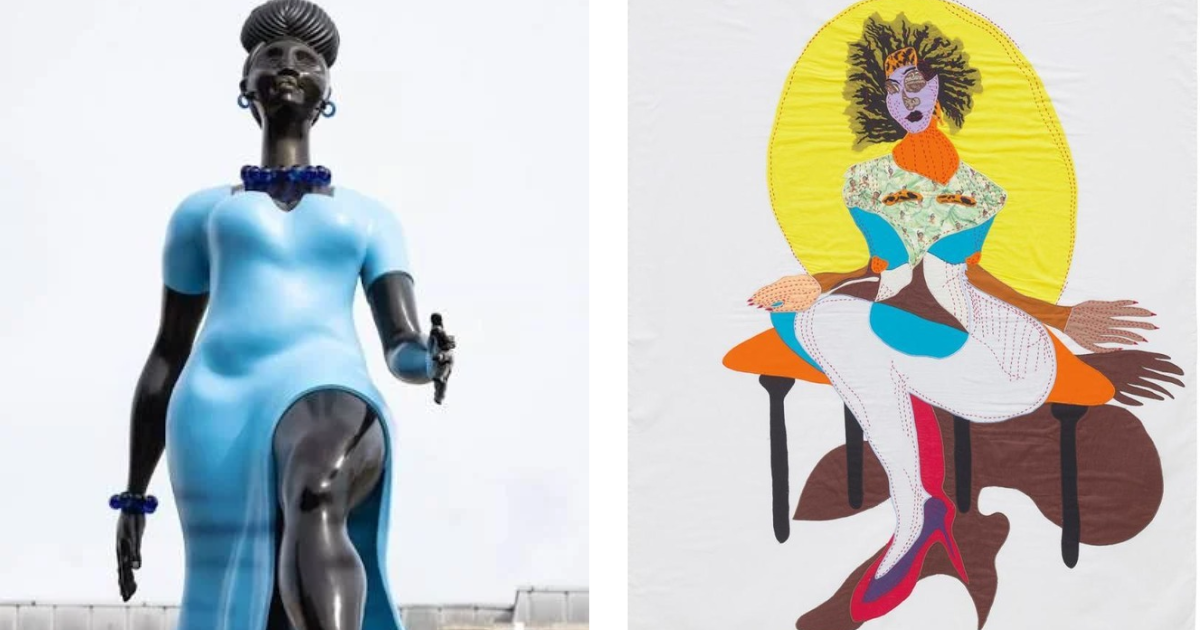
There is a new face looking out over Trafalgar Square. She isn’t a monarch, a military commander or a politician. She’s a woman in a blue dress, caught in mid-stride. The figure is Lady in Blue, a bronze sculpture by American artist Tschabalala Self. It was unveiled on London’s Fourth Plinth on September 10, 2026, bringing one of Self’s unmistakable figures into a square better known for its monuments to Britain’s past.
For Self, the unveiling adds another chapter to a career that has already attracted considerable attention from collectors. Her auction record was set six years earlier, in February 2020, when her 2017 painting Princess sold at Phillips for £435,000. The auction house had estimated it would fetch between £150,000 and £250,000.
What connects them is the growing reach of her work. Once seen mainly in galleries and private collections, Self’s figures now occupy major public spaces, raising questions about who gets represented in art and who benefits when that art becomes valuable.
A Woman In Blue Takes Her Place In London
The Fourth Plinth has hosted contemporary art commissions since 1999. Self’s contribution looks familiar at first glance: a woman in a dress and jewelry, walking forward.
City Hall calls her a contemporary “everywoman.” Her dress is painted a vivid blue, while her jewellery is coloured to resemble lapis lazuli. She mentioned;
My work Lady in Blue will bring to Trafalgar Square a woman that many can relate to.
— Tschabalala Self
Self was selected for the commission in March 2024 by the independent Fourth Plinth Commissioning Group. Public feedback on the shortlisted proposals formed part of the decision-making process.
The program receives funding from the Mayor of London, with support from Arts Council England and Bloomberg Philanthropies. Self’s London gallery, Pilar Corrias, also helped with the sculpture’s production.
City Hall hasn’t disclosed how much Self was paid or the contractual terms of the commission.
Those details would help establish what a project of this scale means financially for an artist. A sculpture in Trafalgar Square brings extraordinary exposure, but exposure and payment are different things. Without the agreement, there is no way to determine the fee, ownership arrangements or rights Self retained.
The sculpture is expected to remain on the Fourth Plinth until 2028, after which it will move to Fornebu, Norway.
How Fabric Became Part of Self’s Language
Long before she began making monumental sculptures, Self was experimenting with what paint and fabric could do together.
Her mother sewed clothes and reused materials, a part of her upbringing that Self discussed in a 2018 interview with BOMB. Those early experiences eventually found their way into her artistic practice.
Rather than treating fabric as decoration, she uses it to construct people. Pieces of cloth become bodies, limbs and clothing. Paint, printed surfaces and stitching work together, sometimes producing figures that seem to push beyond the boundaries of the canvas.
Some look assured. Others seem guarded or caught in private moments. Their proportions can be exaggerated, their expressions difficult to read. Self has resisted the expectation that images of Black women must always present an idealized version of their subjects.
In her conversation with writer Sasha Bonét, she put the problem plainly:
The problem with creating a perfect figure is that you’re creating another myth.
— Tschabalala Self
That idea runs through much of her work. Her subjects are allowed to be complicated. They aren’t required to represent every Black woman or provide an uncomplicated image for an audience.
With Lady in Blue, the same approach moves into a different setting. A figure that might once have confronted visitors inside a gallery now stands above one of London’s busiest public squares.
The Whitney Museum of American Art and the Studio Museum in Harlem are among the institutions holding Self’s work. Their collections help preserve it and make it available for study and exhibition.
But acquiring an artwork and owning the right to reproduce it are separate matters. That distinction becomes important when a work begins circulating through catalogues, merchandise, publications and other commercial uses.
The £435,000 Sale that Put a Price On the Market’s Interest
Self’s auction history offers a useful picture of how collector interest developed. In March 2019, Phillips sold Lilith in London for £125,000. Its estimate had been £40,000 to £60,000.
Less than a year later came Princess. The 2017 painting was offered at Phillips in February 2020, carrying an estimate of £150,000 to £250,000. It ultimately sold for £435,000, establishing a new auction record for Self.
It was an impressive price for a work by an artist still relatively early in her career. But there is something that auction headlines rarely explain: the amount reported for a sale isn’t necessarily money paid to the artist.
In the secondary market, a painting is ordinarily being sold by someone who already owns it. The proceeds go to the seller, subject to auction fees and other applicable charges. Depending on where a transaction takes place, an artist may qualify for a resale royalty.
The United Kingdom provides an Artist’s Resale Right for eligible transactions. There is no equivalent general resale royalty under US federal law. That leaves two different financial stories.
One concerns the market value of Self’s paintings, measured through what collectors are prepared to pay when works come up for sale. The other concerns what Self herself receives through primary sales, commissions, royalties and any other agreements governing her work.
The first is relatively easy to follow because auction houses publish results. The second is harder to establish without access to private contracts. A £435,000 painting tells us something about collector demand. It doesn’t tell us the artist’s earnings that year.
Who Benefits When Black Art Becomes More Valuable?
This question extends beyond Self. As Black artists gain visibility through museum exhibitions, acquisitions and major commissions, their work can attract attention from collectors who previously had little exposure to it. An acquisition may place a piece in a permanent collection. A public commission can introduce an artist to an audience far larger than the typical gallery crowd. An auction result gives buyers and sellers a price they can use when discussing other works.
Yet those forms of recognition don’t necessarily produce the same financial benefits for the people making the art. Consider a painting bought early in an artist’s career and resold years later. If its market price has risen substantially, the owner may realize a profit. Whether the artist receives anything from that resale depends on the law and the circumstances of the transaction.
Copyright raises another set of issues. Buying a painting generally doesn’t mean buying the copyright attached to it. A collector may own the object without having the unrestricted right to reproduce its image.
For artists whose work attracts wider commercial attention, those distinctions can become consequential. They also explain why the growing market for Black art deserves scrutiny beyond record prices. Sales results are public and easy to celebrate. Agreements covering ownership, licensing and resale income are usually much less visible.
Self’s career offers a particularly interesting example because her work is moving through several parts of the art world at once: commercial galleries, museum collections, auction rooms and public commissions.
Each operates differently, with its own arrangements for payment, ownership and access.
From London Galleries To a New Exhibition In New York
London has played an important role in Self’s career. She has described the city as the location of her first institutional exhibition and her first major gallery exhibition.
Her representation now extends across three major art markets. Pilar Corrias represents her in London, Galerie Eva Presenhuber in Zurich, and Petzel in New York. Her work has also entered collections including the Whitney Museum of American Art, the Studio Museum in Harlem, the Hammer Museum and the Brooklyn Museum.
The next stop on her exhibition calendar is New York. Petzel is scheduled to open Tools of Worship on November 5, 2026, marking Self’s first solo exhibition with the gallery. According to the gallery, the show will feature new paintings alongside her first sculptures made in concrete.
Prices for the works have not been publicly announced. The exhibition offers another opportunity to see how Self’s practice is changing. Fabric and paint remain central to her artistic identity, but sculpture is giving her new ways to explore form, scale and the human body.
The move into concrete is particularly notable after Lady in Blue, although the two projects differ in materials, purpose and setting. Neither a gallery exhibition nor a public commission guarantees a higher auction price. Both, however, can broaden the audience for an artist’s work and shape how it is discussed by collectors and institutions.
What the Record Means Now
In 2020, Princess gave Self a new auction benchmark. In 2026, Lady in Blue brought her work into one of Europe’s best-known public squares. Those achievements belong to different parts of her career, and neither should be mistaken for the other.
The auction result tells us what a buyer paid for a painting. The Fourth Plinth commission tells us that a public arts program selected Self to make a work for Trafalgar Square. There are still financial questions neither milestone answers, particularly around contracts, resale income and ownership.
For now, London has something that can’t be reduced to an auction figure: a woman in blue walking forward, with no famous name or historic victory to justify her place above the crowd. She will be there until 2028.
Frequently Asked Questions
Did Tschabalala Self break an auction record with Lady in Blue?
No. Lady in Blue is a public art commission, not an auction sale. Self’s £435,000 auction record was established in February 2020 when Phillips sold her 2017 painting Princess.
What is Tschabalala Self’s Lady in Blue sculpture?
It is a bronze figure of a woman in a vivid blue dress, unveiled on the Fourth Plinth in London’s Trafalgar Square on September 10, 2026. The sculpture is scheduled to remain there until 2028 before moving to Fornebu, Norway.
Who commissioned Tschabalala Self’s Fourth Plinth sculpture?
Self was selected by the independent Fourth Plinth Commissioning Group in March 2024. The programme is funded by the Mayor of London, with support from Arts Council England and Bloomberg Philanthropies.
How much is Tschabalala Self’s most expensive painting?
Her highest publicly documented auction result in the records reviewed for this article is £435,000 for Princess, sold by Phillips in February 2020. The price reflects that particular auction transaction, not a fixed valuation of all her work.
Does an artist earn money when a painting is resold?
Not necessarily. Secondary-market proceeds generally go to the seller after applicable fees, although artists may receive resale royalties where qualifying laws apply. The UK has an Artist’s Resale Right, while US federal law has no comparable general provision.
Why is museum recognition important for Black artists?
Museums can preserve artworks, exhibit them to new audiences and include them in future scholarship. Such recognition may contribute to an artist’s professional standing, but it doesn’t automatically establish how much the artist earns or which commercial rights remain under their control.