Two months. That’s how long Unconventional AI existed before it closed one of the largest seed rounds in tech history — $475 million, at a $4.5 billion valuation, for a company that had shipped no product, disclosed no revenue, and was proposing to solve its problem with physics rather than code. Andreessen Horowitz and Lightspeed co-led. Lux Capital, Data Collective Venture Capital (DCVC), Databricks, and Jeff Bezos personally all wrote checks. Naveen Rao, the CEO, put in $10 million of his own money on the same terms as everyone else. The pitch, in essence, was that the entire AI industry is about to hit an energy wall, and that the fix isn’t a faster chip — it’s a different physical substrate for computation altogether, one built to behave like neurons instead of like transistors pretending to be neurons.
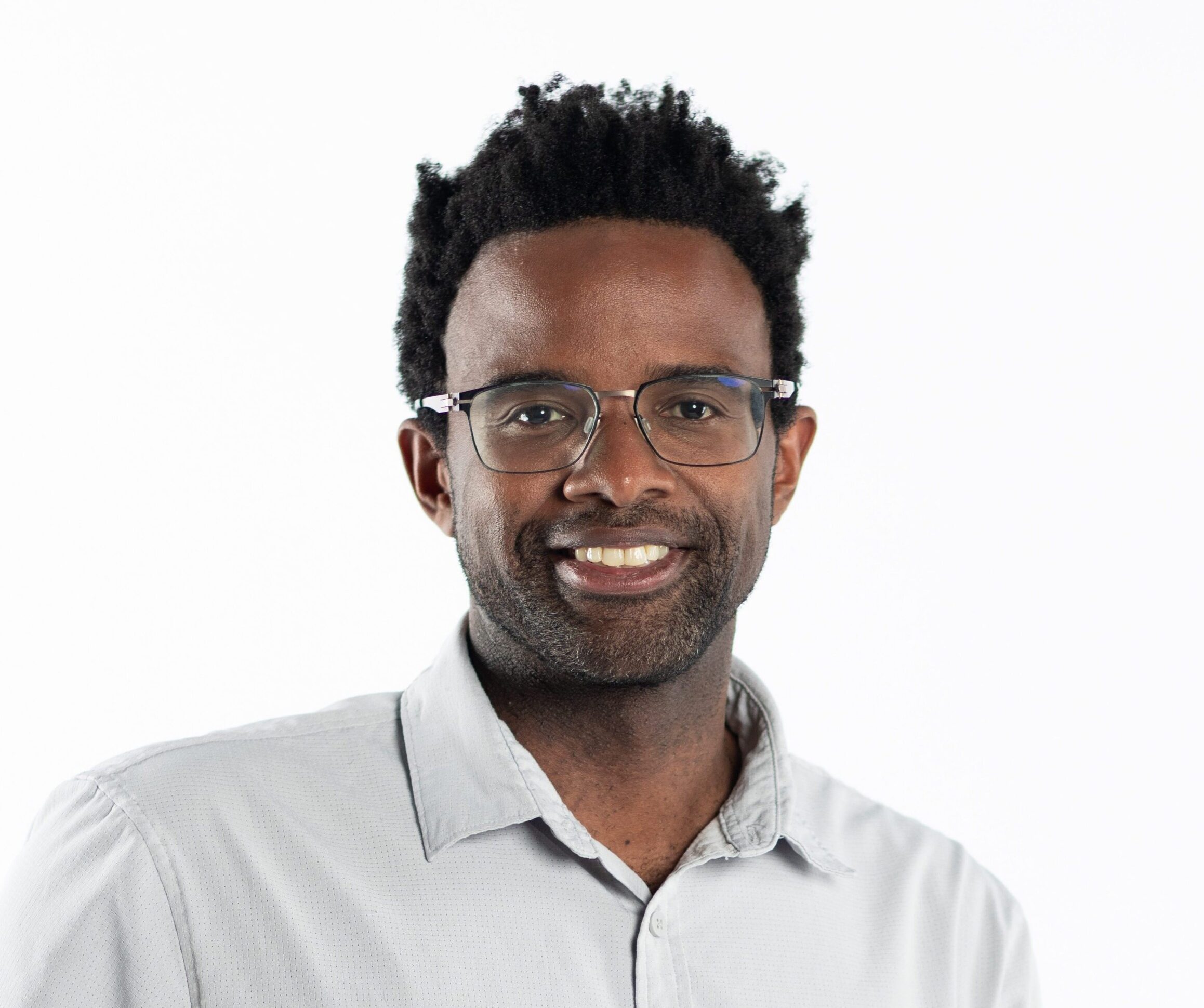
Michael Carbin is the reason that pitch had any right to be taken seriously. He’s an MIT associate professor who runs the Programming Systems Group at CSAIL, and on paper that makes him an odd co-founder for a hardware moonshot. But the specific risk investors were pricing wasn’t Rao’s operating chops — Rao already had one $1.3 billion exit (MosaicML, sold to Databricks in 2023) and one $350 million exit (Nervana, sold to Intel in 2016) on his record. The risk was theoretical: could you actually build a chip that computes the way brains do — using roughly 20 watts to do what today’s AI clusters need a small power plant to do — and trust the output? That’s a question about verification and reliability under uncertainty, not about silicon fabrication, and it happens to be the exact research problem Carbin has spent his career on. HPCwire’s framing of the raise was blunt: will it work? Nobody knows yet. The money moved anyway, on the strength of the theory.
A Decade Betting on a Theory Nobody Wanted
That’s the pattern with Carbin, going back further than this raise. His research career is built on a single, unfashionable idea: that a system doesn’t need to be exact to be trustworthy — it needs to be provably reliable within a defined margin of error. In the 2010s, when the rest of computer science was chasing raw scale, Carbin was publishing work on “approximate computing” — deliberately letting programs run on unreliable hardware or skip computation, then mathematically proving how often they’d still get the right answer. It read, for years, like an academic curiosity. Then two things happened. First, in 2018, he and his PhD student Jonathan Frankle published the Lottery Ticket Hypothesis, showing that a dense neural network usually contains a much smaller subnetwork — a “winning ticket” — that trains just as well on its own. It reframed how the entire field thinks about pruning and efficiency, and it’s now standard citation in model-compression research. Second, the industry ran headlong into the energy bottleneck Carbin had been implicitly betting on for a decade. Suddenly “how do we make this reliable at 10% of the size?” wasn’t a curiosity. It was the only question that mattered.
You can see the same instinct running underneath both of his companies. At MosaicML, where he was a founding advisor, the stated goal — reduce the time, cost, energy, and carbon impact of training — wasn’t about building a bigger model. It was about building smaller, reproducible, well-verified recipes that got you most of the performance for a fraction of the resources. Carbin said as much when the company launched its open tooling: he wanted the work to make strong, reproducible baselines more accessible to the research community, not just faster leaderboard wins. At Unconventional AI, the same logic has just moved from software to silicon. The founders describe the approach as building “a silicon wind tunnel” — designing hardware the way F1 teams refine aerodynamics, through disciplined iteration against a physical constraint, rather than trying to brute-force the problem with more chips.
The Network Behind the Bet
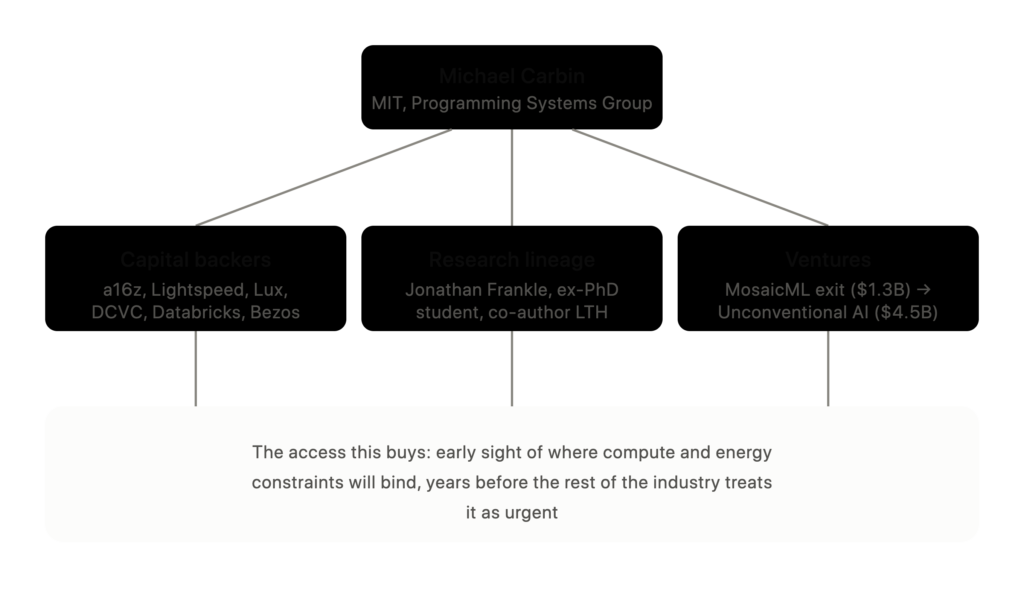
There isn’t a clean flameout in Carbin’s record — no failed startup, no near-bankruptcy, no bad hire he’s talked about publicly. His crucible is quieter and, in a way, harder: a decade spent making a theoretical bet that the field ignored, with no guarantee it would ever become commercially relevant. The behavioral change that came out of it isn’t dramatic. It’s that he never let the unfashionability of “unreliable hardware” research push him toward chasing whatever was popular that year. When the market finally moved to where his research already was, he had a decade’s head start and a former PhD student — Frankle — who’d gone on to become Chief AI Scientist at Databricks through the MosaicML acquisition, giving Carbin a direct, trusted line into one of the largest AI infrastructure buyers on the planet.
That’s really the shape of his network now. On the capital side, he’s one call away from a16z, Lightspeed, Lux, DCVC, and Bezos directly — investors who’ve already underwritten one of his bets and are now underwriting a second, riskier one. On the talent side, Frankle is the clearest protégé, but the broader pattern is that Carbin’s MIT lab has functioned as a pipeline: people trained on his approximate-computing and pruning research keep ending up inside the companies trying to solve AI’s efficiency crisis commercially. What that network actually buys him is early sight of where the industry’s compute constraints will bind before they show up in anyone else’s roadmap — he’s not reacting to the energy bottleneck other founders are now scrambling to address; he was doing the underlying math on it in 2013.
If there’s one thing to borrow from how Carbin operates, it’s this: before you throw more resources at a problem, ask what the smallest verified subset of the system actually has to work. That’s the lottery ticket logic applied outside a neural network — audit your stack, your team, your process for the “dense network” you’re brute-forcing through headcount or compute or spend, and go look for the smaller subnetwork already buried inside it that would perform just as well in isolation. Most organizations never run that audit because scaling up is the default instinct. Carbin’s entire career says the harder, more valuable move is proving how much you can strip away.
Frequently asked questions about Michael Carbin and Unconventional AI
Who is Michael Carbin?
Michael Carbin is an Associate Professor of Electrical Engineering and Computer Science at MIT, where he leads the Programming Systems Group at CSAIL. He’s best known academically as co-author of the Lottery Ticket Hypothesis, and commercially as a founding advisor to MosaicML and a co-founder of Unconventional AI.
What is Unconventional AI?
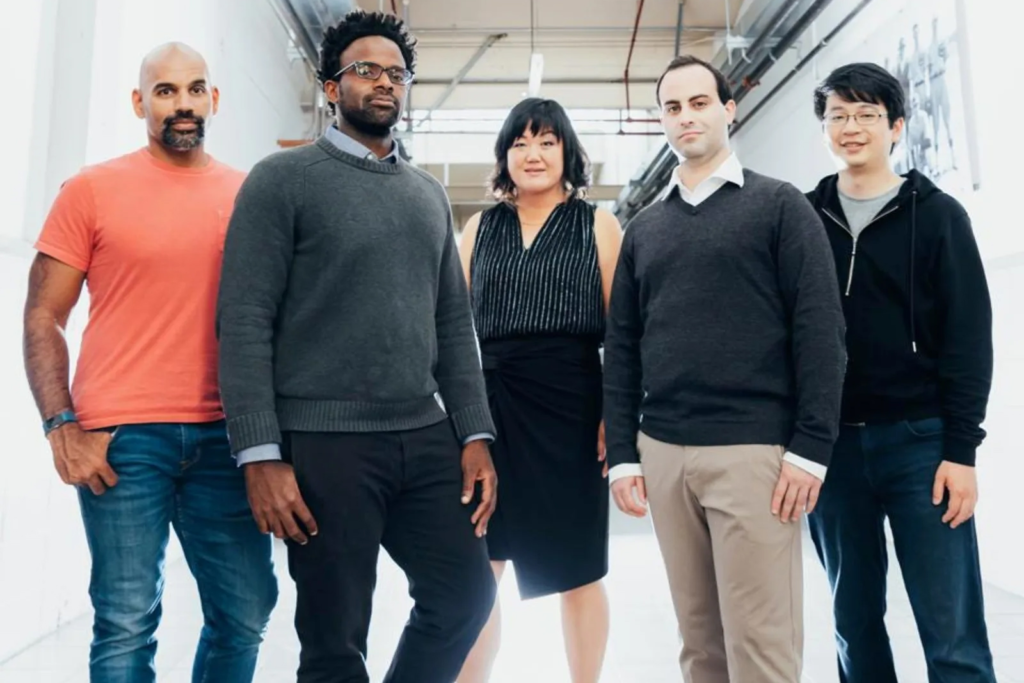
Unconventional AI is a startup co-founded by Naveen Rao, Michael Carbin, Sara Achour, and MeeLan Lee that’s building energy-efficient computer hardware for AI, inspired by how the human brain computes using only about 20 watts. The company raised $475 million in seed funding at a $4.5 billion valuation in December 2025.
What is the Lottery Ticket Hypothesis?
The Lottery Ticket Hypothesis, published by Michael Carbin and his PhD student Jonathan Frankle in 2018, is the finding that large neural networks contain much smaller subnetworks — “winning tickets” — that can be trained in isolation and reach the same accuracy as the full network. It became a foundational idea in model compression and efficiency research.
What was Michael Carbin’s role at MosaicML?
Carbin was a founding advisor at MosaicML, an AI infrastructure company focused on reducing the cost, time, and energy impact of training AI models. MosaicML was acquired by Databricks in 2023 for $1.3 billion.
Who invested in Unconventional AI?
The seed round was co-led by Andreessen Horowitz and Lightspeed Venture Partners, with participation from Lux Capital, DCVC, Databricks, and Amazon founder Jeff Bezos.
Why is Michael Carbin’s work considered a bet on AI’s energy crisis?
For over a decade, Carbin’s research focused on building computer systems that remain reliable while running on approximate or unconventional hardware — a niche academic problem until the AI industry’s power demands made computational efficiency a commercial priority. Unconventional AI’s $4.5 billion valuation reflects investors’ confidence in that long-standing thesis.