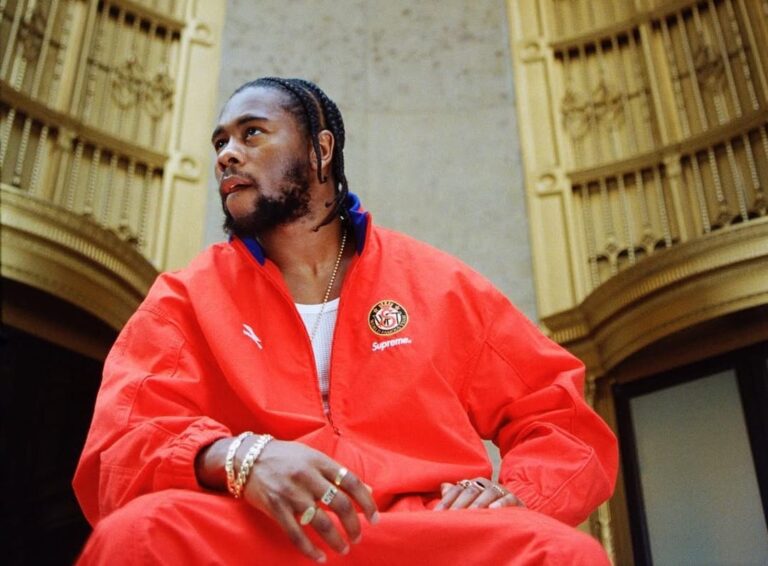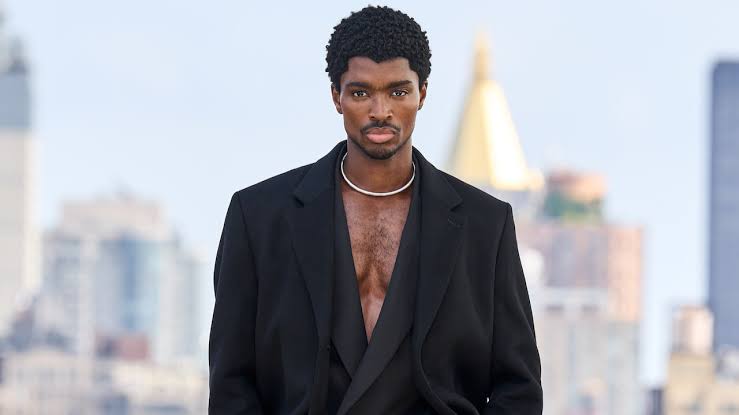
The scene includes Rome. A room, no music. Alessandro Michele sitting there, presumably deciding whether this kid from New York is worth a contract. And Alton Mason — broke, tired of castings, basically at the point where most people would just play it safe — does the opposite thing. He dances. No track, nothing. Just moves.
That’s the moment the whole strategy becomes visible.
He flies back to New York and his agents call: Gucci wants him exclusively. Which, sure, sounds like a nice story about “believing in yourself” — but that’s not really what happened here. What happened is Mason stopped selling the thing every model sells (height, bone structure, the ability to not fall over in heels) and started selling something nobody else in the room had. Movement. Presence. A whole performance.
Gucci ran with it — the Pre-Fall 2017 “Soul Scene” campaign, dance-driven, all-Black cast, and suddenly the bet paid off in a way you could actually point to. And then it just kept compounding. Karl Lagerfeld put him on the Chanel runway in December 2018 — first Black male model to walk for the house, which was a huge thing. Virgil Abloh basically hands him the mic at Louis Vuitton in 2019 and tells him to improvise, and Mason ends the show with backflips. Backflips. LV later made sculptures based on the inverted pose. Sculptures! Of a guy flipping.
By August 2026, Models.com had him logged at 486 entries total — 181 shows, 89 ad campaigns, 45 covers. He’s back in a Gucci campaign under Demna this year too, which feels almost like the story looping back on itself.
The Actual Strategy
Make Your Difference Legible
Mason’s strategy is quite interesting because it’s basically an economics problem: when the market treats you as interchangeable, you have to package the thing that can’t be copied and display it in front of the people who decide who gets hired.
He learned this the hard way. Early on his agent told him the uniform — black tee, black pants, and not stand out. And he did it. So did everyone else. Twenty castings a day, he’s said, and basically nothing to show for it. Money gone, time gone, no traction. At some point he just stopped. Started showing up in a rasta tank top, a thrift-store fur coat, leather trousers. Whatever felt like him instead of felt like “hireable.”
His own words on it, from a 2024 Family Style interview: “Once I started making decisions based on how I truly felt,” things changed. That’s it. That’s the pivot.
And the Gucci audition wasn’t him just fitting the clothes well — it was him proving he had a whole separate skill (trained dancer) that the brand could turn into content, into a campaign, into value they couldn’t get from literally anyone else in that casting pool.
When Someone Gives You Room, Take More Than They Offered
This is the part I find genuinely instructive, not just a nice anecdote. Abloh tells him to improvise at Louis Vuitton. Mason doesn’t do a little improvising. He does backflips that end up defining the whole show’s imagery. His own recollection:
The next thing I know, the Louis Vuitton sculptures were made.
— Alton Mason
Casual sentence for something wild.
Same thing during the pandemic — everyone’s shoots collapsing, brands mailing clothes directly to talent because nobody could get in a studio. Zara lets Mason self-produce. He styles himself. His sisters shoot the photos. He hands back finished work and it gets approved. That’s not “model,” that’s photographer-stylist-creative-director all rolled into one person, and he just absorbed the job because the opportunity was sitting there.
The lesson: when someone gives you more creative room, don’t just fill the space. Expand what they believe you’re capable of.
Build the Side Skills Before You Need Them
Mason trained in dance and acting before modeling was even paying his bills. Those weren’t hobbies, turns out — they were access points waiting to be used.
Baz Luhrmann meets him after a GQ Australia speech in 2019, finds out (almost by accident) that the guy can sing, and less than 24 hours later — per W — offers him Little Richard in Elvis. No acting résumé. None. Just the guy could sing and Luhrmann saw it. He told GQ in 2023,
I’m going to experiment. I’m going to be daring, I’m going to be willing to try new things. — Alton Mason
Which sounds like a platitude until you look at the actual sequence: dance got him fashion, fashion got him visibility, visibility got him film. Each thing made the next thing worth more. That’s not luck, that’s stacking.
Where It Went Sideways First
Before any of the good stuff, there was the conformity phase — and honestly this is the part that makes the rest of it credible, because it means he actually tried the “normal” path first and it just didn’t work.
Yeezy Season 3 gave him real visibility. And he still went home “pretty broke,” his words to GQ. He’d assumed the job was: learn the rules, follow the rules, look employable. Wear the black-on-black. Hit twenty castings a day. Grind.
It produced activity. Not money. Not callbacks. Just… motion, going nowhere.
So he flipped it. Less sameness, more memorability. Changed the clothes, changed how he moved in a room, let more personality show through in an industry literally designed to standardize everyone who walks in. Sometimes the advice that’s supposed to help you fit in is the exact thing limiting you — because the actual problem was never “not employable enough.” It was “too replaceable.”
Mason’s Network
People love to talk about “networking” like it’s collecting business cards. Mason’s version is different — it’s a chain of gatekeepers, each one bumping him up a level. Michele → Gucci exclusivity. Lagerfeld → the Chanel milestone. Abloh → creative authorship, not just runway walking. Jerry Lorenzo trusts him with the closing look at Fear of God’s Hollywood Bowl show. Luhrmann turns public visibility into an actual film role.
And then there’s this loveable detail: Angela Missoni sees him dancing on a shoot, finds out he’s also writing music on the side, and just connects him to Quincy Jones. That’s not random celebrity small talk. That’s someone spotting a complementary skill and deciding it was worth opening a door over.
Currently, per Models.com, he’s repped by Society in New York and THE FRNTAL in London. And apparently — per GQ — younger models are being told by their own agents to study how Mason operates. Not his look. His approach.
Steal This
Here’s the practical version, stripped of the fashion-industry gloss: go look at what every credible competitor in your field already offers. All of it. Then find the one complementary thing — distribution, storytelling, data, sales, whatever — that isn’t technically required but that the people paying you would actually value. Build it in before you need it, not after.
Mason went from “model who happens to dance” to “performer who occasionally models.” Small phrasing shift, huge practical difference — because it changed what people could actually use him for. Differentiation turned into access. Access turned into trust. Trust turned into scope — until he was no longer being hired simply to model, but to perform, create and shape the work itself.
Frequently Asked Questions about Mason
What was the actual breakthrough?
Yeezy Season 3 got him seen. Gucci is the one that mattered, because that’s where he deliberately used dance and personality to get an exclusive deal, not just a paycheck.
When did the Chanel moment happen?
December 4, 2018 — Métiers d’Art show at the Met. First Black male model to walk for the house.
How do you even measure “longevity” for a model?
Models.com’s August 2026 numbers: 181 runway shows, 89 ad campaigns, 102 editorials, 45 covers. Five straight years (2018–2022) winning their industry-voted Male Model of the Year, then a Readers’ Choice win again in 2025 with 37.5% of the vote.
What could actually go wrong from here?
Honestly — overextension. He’s talked about wanting to act more, make music, creative-direct, eventually launch his own line. Fine goals. But there’s a real difference between all of that becoming one coherent platform versus just… more stuff happening. That’s the open question.