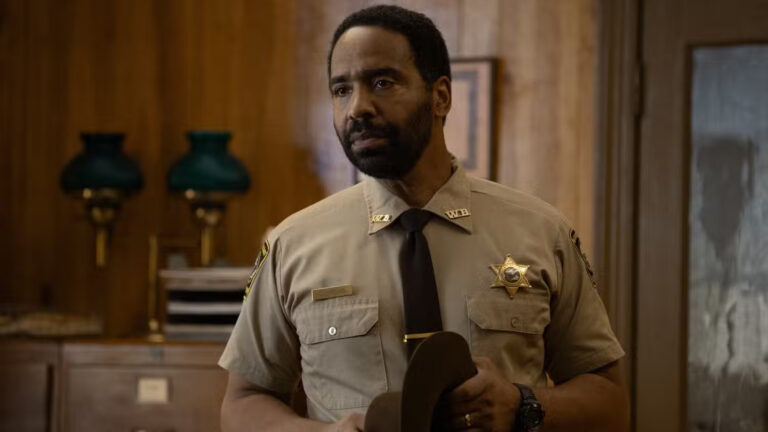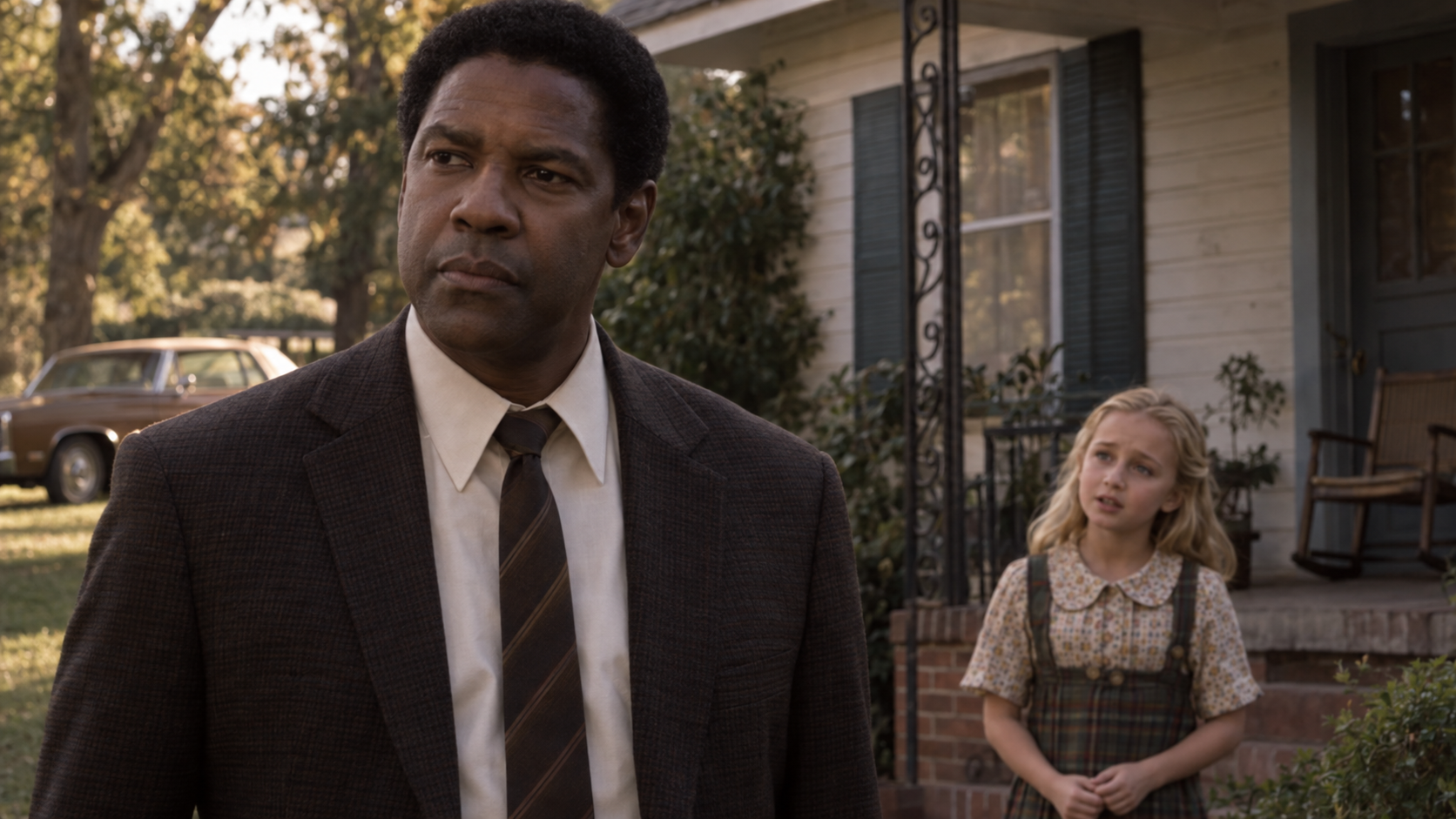
Herman Boone is speaking to a group of Black players in the T.C. Williams gym when Bill Yoast arrives with the white players and several members of his former coaching staff. Their entrance changes the room immediately. Boone may have been appointed head coach, but the boys behind Yoast still look to the man who coached them before the schools and football programmes were combined.
Enter Hayden Panettiere’s Sheryl Yoast. At nine years old, Sheryl doesn’t carry the racial baggage, political resentment, or wounded pride of the adults in Alexandria. She evaluates Herman Boone through a single, uncomplicated metric: the quality of the football. While the adults around her stumble over institutional shifts, Panettiere’s performance provides the spine of the film’s message—showing how cross-racial respect begins when you judge a leader’s competence before you’ve learned the social reasons to discount them.
Denzel Washington lets Boone study the interruption before responding. His voice remains controlled as he explains the arrangement to Yoast. There is room for him on the staff, although the Titans will operate as one team under one head coach.
Washington carries that tension through much of the film. Boone watches people closely and hears uncertainty in the smallest hesitation. He has taken charge of a programme in which players, parents and school officials expect immediate results. Some already resent his appointment. A defeat could give them the result they want.
The pressure shows in Boone’s posture. He rarely appears relaxed at camp, even when the players begin responding to him. Washington also resists the easy version of the character. Boone can be perceptive one minute and needlessly hard the next. He understands what racial division could do to the team, yet he sometimes treats reasonable concern as an attempt to weaken him.
Will Patton’s Bill Yoast is more difficult to read. The disappointment is obvious, but Patton seldom pushes it into open hostility. Yoast built the programme and expected to lead it. He knows the players, their families and the small differences in temperament that Boone has not had time to learn.
His decision to remain as defensive coordinator helps protect the prospects of players who had threatened to boycott. It also leaves him close to the position he lost. For a while, the white players can obey Boone while continuing to regard Yoast as the coach whose judgment matters most.
Washington once described the coaches through the quality they shared:
But they both had a strong desire to win. They were both winners. -Denzel Washington
Winning gets them through the first practices. Trust takes longer.
Camp
Boone chooses the bus seats before the team leaves. Black and white players sit together. At camp, he assigns roommates across racial lines and orders everyone to learn something about a teammate from the other group.
The boys hate the arrangement. That is partly why Boone insists on it. They arrived as separate groups wearing the same uniform, and ordinary practice had done little to disturb the division.
Gerry Bertier is an established leader among the white players. Julius Campbell holds a similar place among the Black players. Their first serious confrontation comes when Julius challenges the way Gerry exercises that leadership.
Gerry demands commitment from Black players while overlooking weak performances from his white friends. Wood Harris plays Julius with anger that feels long accumulated. He is tired of being judged by standards that do not seem to reach everyone else. Ryan Hurst allows Gerry to resist the accusation before he begins to hear what Julius is saying.
The exchange does more for their relationship than the friendlier scenes that follow. Julius does not ask Gerry to like him. He asks him to account for the people he protects.
Gerry later removes Ray from the team after Ray deliberately misses a block and leaves a Black teammate exposed. Ray is Gerry’s friend and expects that history to shield him. Gerry refuses.
There is little ceremony around the decision. Julius now knows that Gerry is prepared to apply the same demands to his own circle. It gives the two players somewhere to begin.
Ronnie “Sunshine” Bass remembered the real team in less dramatic language:
I think that’s where most of the kids’ minds were. We were just trying to play football. -Ronnie “Sunshine” Bass
That recollection fits the smaller details of the film better than its grand speeches. The players are competing for places and trying to win games. Racial division becomes immediate when a missed block puts somebody at risk or when a captain excuses poor effort from one group.
Boone keeps pushing these conflicts into the open. His methods sometimes help, and sometimes Yoast has good reason to object. Boone drives exhausted players beyond their limits and dismisses warnings that he regards as softness. Yoast understands when a particular boy needs another approach.
Their arguments become more productive once Boone stops hearing every objection as insubordination. He takes some of Yoast’s advice, usually without acknowledging the concession. Yoast, for his part, learns to raise concerns without behaving as though he remains the final authority.
Hayden Panettiere’s Sheryl appears around the edges of these developments. She follows football closely and has no trouble forming opinions about the men coaching it. When she approves of Boone’s camp, she is responding to what she sees on the field. The team looks more disciplined.
Her reaction is useful precisely because it remains small. Sheryl does not establish Boone’s right to lead. Washington’s performance and Boone’s work with the players carry that part of the story. She merely shows that affection for Yoast does not have to become resentment towards the man who replaced him.
Her father cannot look at Boone without also seeing the job he lost. Sheryl has no such history to overcome. Panettiere plays that difference lightly, with the certainty of a child who thinks the football should speak for itself.
The Semifinal
The conflict between Boone and Yoast changes during the semifinal. Officials repeatedly make biased calls against the Titans, and Yoast realises that the game is being manipulated. He has already been told that Boone’s dismissal could return him to the head-coaching job and improve his Hall of Fame prospects.
Patton does not play the confrontation with the officials as a moment of sudden enlightenment. Yoast is furious about what is happening to the team. He threatens to expose the scheme, the officiating changes and the Titans win.
Only afterwards does the personal cost become clear. His Hall of Fame opportunity is gone.
The conspiracy was created for the screenplay. There is no evidence that officials tried to engineer a Titans defeat during the real 1971 season. Within the film, the incident brings Yoast’s divided loyalties into one place. He can allow the scheme to help him, or he can use his influence to stop it.
The real Yoast later described how the season affected him:
Working with Herman and the young men I worked with then, my attitude towards race relations changed forever. -Bill Yoast
The word “changed” is important because Yoast does not enter the season free of resentment. His respect for Boone develops while they work together, disagree and watch the players respond to the demands placed on them.
Similar struggles occur whenever someone takes charge of a group that still feels loyal to a previous leader. The resistance may be quiet. People continue seeking approval from the old authority or delay committing themselves until they know whether the new arrangement will last. A leader who senses this may tighten control, which can create another round of suspicion.
Boone and Yoast spend much of the film caught in that cycle. Boone expects to be undermined. Yoast sometimes behaves in ways that justify the expectation, even when he believes he is protecting the players. Their progress comes in practical adjustments. Boone accepts information he does not have. Yoast stops acting as a second head coach.
The players go through their own version of this. Gerry’s standing among the white players initially reinforces the split. Later, he uses the same influence to confront conduct he had previously tolerated. Julius responds because the change affects what happens on the field.
Respect in the film is rarely a feeling announced aloud. It can be seen in whose instruction is followed, who is held accountable and what happens when loyalty to an old friend conflicts with the safety of a teammate.
The History Outside the Screenplay
T.C. Williams had begun desegregating before the 1971 season. The immediate disruption came from Alexandria consolidating three high schools and their football programmes. Players who had been secure on separate teams suddenly had to compete for fewer positions.
The real Titans were also much stronger than the movie’s underdog framing suggests. They finished 13–0, recorded nine shutouts and ended the season ranked second nationally.
Boone did take the players to Gettysburg. The predawn run and his battlefield speech were written for the film. The semifinal officiating conspiracy was fictional too.
Sheryl Yoast was a real person, although the film simplified her family. Bill Yoast had four daughters. Concentrating the family scenes around Sheryl gave the screenplay one child who could remain close to the football programme without introducing the rest of the household.
Washington’s portrayal captured part of Boone rather than the whole man. Bass said the actor reflected Boone’s discipline, perfectionism and temper. Boone believed the film left out much of his warmth. The harder version suited a drama built around a team under pressure.
The liberties are worth acknowledging because Remember the Titans is still frequently treated as a record of the season. Gregory Allen Howard’s screenplay reshaped events to bring its conflicts into sharper focus. Its strongest material survives the comparison with history because the actors make those conflicts specific. Boone’s severity, Yoast’s wounded pride and the argument between Julius and Gerry never feel interchangeable.
Panettiere contributes something quieter. Sheryl watches the adults struggle with a change that she accepts far more quickly, then returns her attention to the game.
A Few Things Readers Ask
Was Sheryl Yoast an only child?
No. Bill Yoast had four daughters. The film concentrated the family story around Sheryl because of her interest in football.
Did Boone make the Titans run through Gettysburg before sunrise?
The team visited Gettysburg, but the early-morning run and Boone’s cemetery speech were created for the screenplay.
How closely did Denzel Washington resemble the real Herman Boone?
Ronnie Bass believed Washington captured Boone’s discipline, temper and perfectionism. Boone thought the portrayal overlooked his warmer side.
Did officials really try to make the Titans lose?
There is no historical basis for the semifinal conspiracy. It gave the film a situation in which Yoast had to choose between helping Boone and benefiting from his removal.
Were Gerry Bertier and Julius Campbell friends in real life?
Yes. They played significant roles on the team and remained friends after the 1971 season. The film altered some details while making their relationship central to its account of the Titans.
Did Boone and Yoast continue working together?
Yes. Their professional relationship continued after the championship season, although the film simplified the circumstances surrounding their partnership.