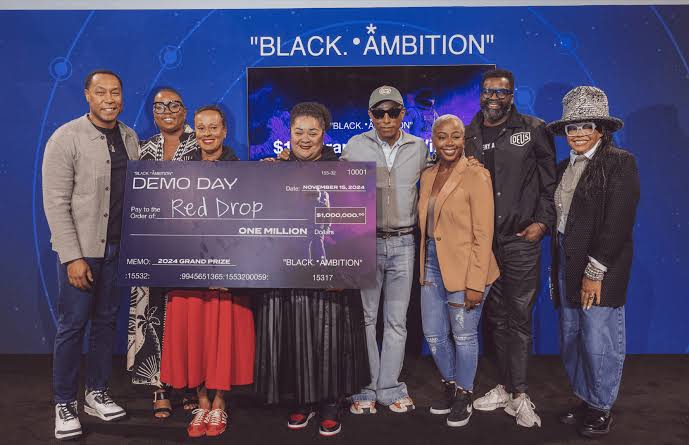
On November 15, 2024, eight founders pitched their companies in New York before judges from Carol’s Daughter, Slutty Vegan, Visa and Base Ventures. By the end of Black Ambition’s fourth Demo Day, 30 founders had received awards worth more than $2.7 million. Individual prizes ranged from $25,000 to $1 million.
The awards also came with six months of coaching and introductions to corporate partners. For the founders, the bigger question was what that support could help them do next: find customers, grow revenue and retain a meaningful share of their companies.
One Award Pool, Different Needs
Black Ambition is a nonprofit founded by Pharrell Williams in 2020. The organisation described the 2024 recipients as Black and Hispanic entrepreneurs. Their businesses worked in fields including AI, consumer products, health care, media and technology.
RedDrop’s Dr. Monica Williams and Dana Roberts received the largest award, $1 million. GRIND, a sports technology company founded by Thomas Fields, received $250,000. The company uses its products to encourage children in underserved communities to explore engineering and technology careers. Black Ambition’s announcement put the total awards above $2.7 million.
The prize amounts varied widely. A rough average of more than $90,000 per recipient hides that spread. For a small company, $25,000 might pay for a production run, compliance work or a key hire. It may not cover the costs of reaching repeat sales. A seven-figure award gives a company more room to expand, though the founder still has to turn that money into a lasting business.
Black Ambition said recipients would have six months of support. The programme included town halls with Williams and senior brand partners, investor office hours, and advice on marketing, operations and brand management. Winners could also attend retail-partner meetings and take part in wellness and executive coaching.
The competition had General and HBCU Prize tracks. It also offered a separate $25,000 public-vote award. These parts of the programme were designed to address different needs, from raising capital to meeting people who might help a company reach customers.
Williams described the programme’s larger aim in Black Ambition’s announcement. He said the organisation wanted to create more opportunity and wealth for Black and Brown communities.
Hearing the stories and seeing their products as they pitched on Demo Day reaffirmed that Black Ambition is needed. — Pharrell Williams
RedDrop’s Route to Retail
RedDrop began with a specific customer in mind. Founded by educator Dana Roberts and physician Monica Williams, the company makes period kits and products for tweens, along with educational resources for girls and families. Its products address needs that adult-sized period care may not meet.
The company later rebranded as Scarlet by RedDrop and expanded its product range beyond first-period kits. By 2025, it had entered more than 350 Ulta Beauty stores. In September of that year, the brand said it had reached more than one million tweens and teens with its products and puberty education materials.
Scarlet by RedDrop was also named one of Pepperdine Graziadio Business School’s 14 “Most Fundable Companies” in 2025, selected from more than 2,300 applicants. That recognition signals investor readiness; it does not mean the company received financing.
In an October 2025 interview with the Atlanta Business Chronicle, Williams said the business had grown largely through bootstrapping outside the Black Ambition award. She credited the funding with helping transform the company, including its rebrand, and said that building a category-defining brand still required capital.
The move into Ulta gave Scarlet by RedDrop a much wider retail presence. It also brought new costs. The company has to manage inventory and replenishment, meet retailer terms and keep enough working capital available as it reaches more customers. Whether the new distribution leads to repeat sales and healthy margins will shape what comes next.
We have grown this business pretty much bootstrap, outside the Pharrell Williams opportunity. — Monica Williams
The company’s growth raises a question that runs through the feature: who gains when a product finds a larger market? For Scarlet by RedDrop, the next measure is whether wider distribution can support profitable growth while its founders retain meaningful control.
Different Companies, Different Hurdles
AskSAMIE received $50,000. Founded by occupational therapist Dr. Brandy Archie, the platform first helped older adults find adaptive equipment and care that could help them remain safely at home. Therapists then asked Archie for tools to build their own local practices.
Archie said the company wanted to become a nationwide brand and needed resources to keep growing. In April 2026, Startland News reported that AskSAMIE had joined Techstars with a separate $220,000 investment. The company had brought its co-founder and CTO on full time, released subscription tools for occupational therapists and signed up more than 500 therapists to its platform. Archie identified clinician adoption as the next hurdle.
That investment and product development show continued activity after Demo Day. They should be kept separate from the Black Ambition award. Startland News tracked AskSAMIE’s progress, including the challenge of getting more clinicians to use its tools.
Puzzles of Color faced a different test. The Texas-based company reached Macy’s and Nordstrom’s websites and later appeared in select Barnes & Noble stores. In 2025, co-founder Ericka Chambers told the Associated Press that the founders were reassessing how to expand as some retailers scaled back diversity initiatives. They were considering how to reach new customers while preserving the company’s identity.
The company’s experience shows how much a consumer brand can depend on retailers’ decisions. Capital may help a business prepare for growth; it cannot ensure a store will continue to stock its products.
When Introductions Lead Somewhere
Black Ambition paired its awards with access to companies such as Visa, Comcast, Louis Vuitton, Adidas and the Lennar Foundation. Those relationships could lead to a buyer, supplier or adviser. Whether they did so for individual founders is harder to establish. An invitation to a meeting, for example, does not show that a company received an order.
The preparation began before Demo Day. Black Ambition said 250 semifinalists took part in a three-month mentorship programme. Fifty finalists received pitch coaching and design support. About 3,000 entrepreneurs entered the competition.
There are broader figures, too. Black Ambition reported that its network generated more than $265 million in revenue by the end of 2024. Its 2025 five-year update put the cumulative figure above $348 million and said the organisation had awarded about $14 million to more than 157 startups since 2020.
Those totals cover multiple cohorts. They do not show how much revenue the 2024 recipients generated, or what portion of their sales came through Black Ambition’s network. Revenue measures sales before expenses; it cannot show profit or how much wealth founders retained. The totals also do not measure the return on the $2.7 million distributed at the fourth Demo Day.
Follow the Company’s Next Constraint
The founders’ needs differed by industry. A product company may need money for inventory; a health-care startup may face regulatory work; a media business may need rights or distribution. The award amounts alone cannot show which problem was solved.
Black Ambition could make the program’s results clearer by following each company after the six-month support period. Did the funding lower production costs or help secure repeat customers? Did a meeting lead to an order, and what happened to the founders’ ownership as the company raised more money?
Mentorship and introductions can help founders get in front of people who may be able to help. They cannot replace a buyer, a lender with suitable terms or a reliable supplier. The company still has to make the relationship work commercially.
Scarlet by RedDrop’s rebrand and entry into Ulta show how a prize and wider visibility can accompany a retail push. Williams’s account of bootstrapping also shows that the company continued to need capital after receiving the award.
Two years after Demo Day, the most useful record would link the prize to what each business did next: how it used the money, what support it received and whether the company gained customers or follow-on funding. That would show more clearly where the program helped and what its founders still had to solve.
FAQs
What is Black Ambition?
Black Ambition is a nonprofit founded by Pharrell Williams in 2020. It supports entrepreneurs from backgrounds underrepresented in venture capital through prize funding, mentorship and connections to investors, industry leaders and corporate partners.
How much did Black Ambition award in 2024?
The organisation announced more than $2.7 million in awards for 30 founders. Prizes ranged from $25,000 to $1 million. RedDrop won the $1 million grand prize, and GRIND received $250,000 as the second-place winner.
What support came with the 2024 awards?
Black Ambition said winners would receive six months of support, including investor and executive office hours, invitations to retail-partner meetings, wellness and executive coaching, town halls with Pharrell Williams and senior brand partners, and networking events.
What happened to RedDrop after Demo Day?
RedDrop rebranded as Scarlet by RedDrop, expanded its product line and entered more than 350 Ulta Beauty stores. The company said it had reached more than one million tweens and teens with its products and puberty education materials by September 2025.
Did the award make the companies profitable?
The available network revenue figures cover multiple cohorts and do not establish whether an individual recipient became profitable. Revenue is sales before expenses, so it does not show a company’s costs or the share of its value retained by its founders.