Few people thought an airport needed reinventing. In 2009, in the bleak aftermath of the global financial crisis, London’s Gatwick Airport was put up for sale. A Competition Commission order had forced the British Airports Authority to dismantle its monopoly, and investors largely viewed Gatwick as a dependable but unremarkable utility. The prevailing wisdom in infrastructure was simple: buy it, hold it, and collect the yield.
Bayo Ogunlesi believed that exact mindset was why Gatwick was so deeply undervalued. Against the backdrop of the worst economic downturn since the Great Depression, Ogunlesi’s Global Infrastructure Partners (GIP) wrote a £1.455 billion ($2.3 billion) check for a regulated asset facing intense political scrutiny and operational bloat. If his “active management” thesis failed, GIP would be stuck with an underperforming utility, limited exit options, and massive reputational damage for a fledgling firm.
Instead of collecting checks, Ogunlesi unleashed a contrarian playbook. He embedded specialized operational teams directly into Gatwick’s management. His engineers conducted granular studies of the air traffic control systems and discovered a massive hidden asset: by simply changing the sequencing of how planes moved through taxiways, they could increase runway capacity from 50 to 55 movements per hour. The cost? Less than $1 million in capital expenditure.
The math was staggering. Each additional movement at peak times was worth roughly £1 million. By squeezing out those extra flights, GIP created hundreds of millions in incremental enterprise value without firing a single worker or building a new runway. They redesigned terminals, slashed security wait times, and poached premium long-haul carriers.
The market eventually caught on. In 2019, GIP sold a 50.01% stake in Gatwick to VINCI Airports for £2.9 billion—nearly doubling the original investment while retaining a 49.99% management interest. That single deal proved that industrial-style operational management could transform “passive” infrastructure into high-performance cash machines.
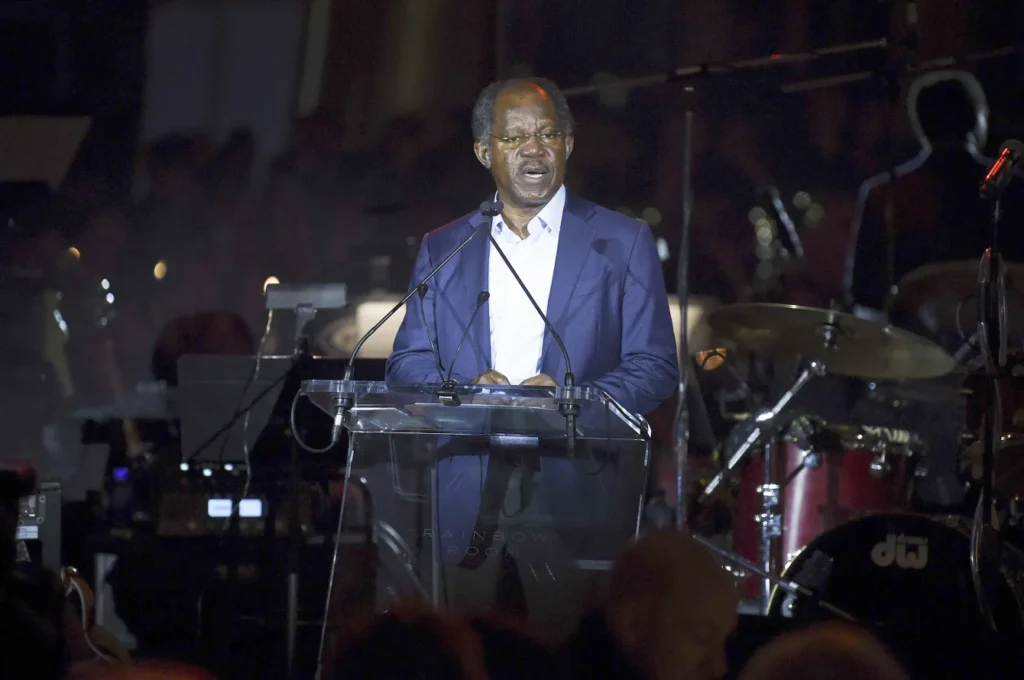
“You are much better off paying a higher price for a higher-quality asset than paying what you think is a great price for a lower-quality asset.” – Adebayo Ogunlesi
The Bayo Playbook: Turning Concrete into Gold
Ogunlesi’s success isn’t an accident; it is the result of a ruthless, highly specific investment philosophy built on three core tenets.
1. Run It Like a Great Business, Not a Bond Proxy
Ogunlesi refuses to treat infrastructure as a passive financial asset. When GIP buys a company, they don’t just send in MBAs; they send in General Electric (GE) factory managers and Six Sigma Black Belts. At London City Airport, GIP operators discovered that bags were being misrouted because 12 baggage carts were trying to serve 14 gates. The solution wasn’t a massive tech overhaul; it was spending £2,000 to buy two more carts so every plane had dedicated equipment. Lost bags vanished, and turnaround times plummeted. Ogunlesi’s philosophy is simple: apply industrial tools and customer service discipline to assets that everyone else is ignoring.
2. Pay Up for Greatness
While value investors hunt for bargains, Ogunlesi hunts for quality. “You are much better off paying a higher price for a higher-quality asset than paying what you think is a great price for a lower-quality asset,” he has noted. When GIP sold London City Airport in 2016 for £2 billion, critics balked at the alleged 28x EBITDA multiple. But the buyers—a consortium led by the Ontario Teachers’ Pension Plan—understood the asset’s DNA. They immediately approved a £344 million expansion because the underlying quality of the asset justified the premium. Superior assets generate superior returns, regardless of the entry multiple.
3. Everything Is For Sale
GIP targets 5-to-7-year holding periods, but Ogunlesi is fiercely opportunistic. He forces his team to justify continued ownership at every review cycle. “If we are not selling, then we are underwriting it at the current value,” he explains. By treating every asset as if it’s on the block, GIP avoids the emotional attachment that causes private equity firms to hold onto declining assets, ensuring they exit when valuations peak.
The Disaster That Forged the Strategy
Ogunlesi’s current obsession with “monopoly characteristics” was born out of a spectacular failure. In GIP’s first fund, they acquired Biffa, a UK waste management company. The thesis was brilliant on paper: capitalize on EU regulations forcing the UK to shift from landfills to waste-to-energy plants. GIP even built the UK’s largest anaerobic digestion facility. But Biffa was a disaster. It went into administration, resulting in a total loss.
The post-mortem revealed fatal flaws. Biffa collected industrial waste, meaning its biggest customers were construction companies and restaurants—sectors that completely collapsed during the 2008 financial crisis. Waste volumes plummeted 25%, the company couldn’t service its debt, and the investment died.
Ogunlesi extracted two brutal lessons from the ashes of Biffa, which now form the bedrock of GIP’s strategy:
- Never invest without high barriers to entry. Monopolistic characteristics are non-negotiable. If a competitor can enter the market tomorrow, walk away.
- Avoid transformation stories. Too many external macroeconomic factors escape your control. Stick to regulated monopolies with natural barriers and predictable demand.
The Inner Circle: Moving Billions
To execute a strategy at this scale, Ogunlesi has cultivated an unmatched ecosystem of capital, operators, and political access.
The Capital Arsenal: GIP’s launch in 2006 was seeded by Credit Suisse and co-backed by General Electric, which brought vital operational expertise. Today, GIP is backed by the world’s most sophisticated sovereign wealth and pension funds, institutions willing to write $2 billion to $5 billion co-investment checks alongside GIP.
The Lieutenants: Ogunlesi doesn’t just hire financiers. He hires operators like Scott Stanley, a GE veteran who actually ran an auto parts manufacturing plant. Stanley and a roster of “Master Black Belts” in strategic procurement are embedded across portfolio companies to drive the gritty, operational improvements that bankers miss.
The Unfair Advantage: Ogunlesi’s rolodex is arguably his greatest asset. As a Lead Independent Director at Goldman Sachs since 2014, he has deep ties to Fortune 500 CEOs. His advisory roles—serving on President Trump’s Strategic and Policy Forum and President Biden’s National Infrastructure Advisory Council—give him a front-row seat to global privatization trends. Furthermore, his 2025 appointment to the OpenAI board positions him at the absolute forefront of the AI infrastructure boom, ready to finance the data centers and energy grids of the future. Through the Africa Finance Corporation, which he chairs, he also controls the pipeline for emerging market deals across the continent.
This network guarantees early deal flow on mega-privatizations and the ability to write $10 billion equity checks that guarantee meetings with global CFOs and heads of state.
Steal the Playbook: How to Apply the Ogunlesi Method
You don’t need to be buying airports to use Ogunlesi’s framework. Whether you are acquiring a business, managing a portfolio, or running a department, implement this operational audit:
- Map the Customer Journey: Ogunlesi once discovered Biffa internally referred to its customers as “debtors.” That single word revealed a toxic culture. Audit how your business refers to and treats its users. If you aren’t obsessed with their experience, you are leaving money on the table.
- Deploy Operators, Not Just Bankers: At your next acquisition or project review, bring in the people who actually run the machinery. Have them spend 90 days identifying process inefficiencies that the financial models completely missed.
- Test for True Monopolies: Before investing time or capital, ask: “What physically, legally, or financially prevents a competitor from doing this tomorrow?” If the answer is just “we have good relationships,” you are in a value trap. Look for regulatory moats, massive capital requirements, or physical constraints.
Your Move for Tomorrow: Pick one asset or project in your portfolio. Calculate what a 10% improvement in operational efficiency would be worth. Now, identify one specific, granular process where a minor investment (the equivalent of Ogunlesi’s £2,000 baggage carts) could unlock that value. Assign an operator—not a financier—to solve it within 30 days.
The Architecture of a $100 Billion Empire
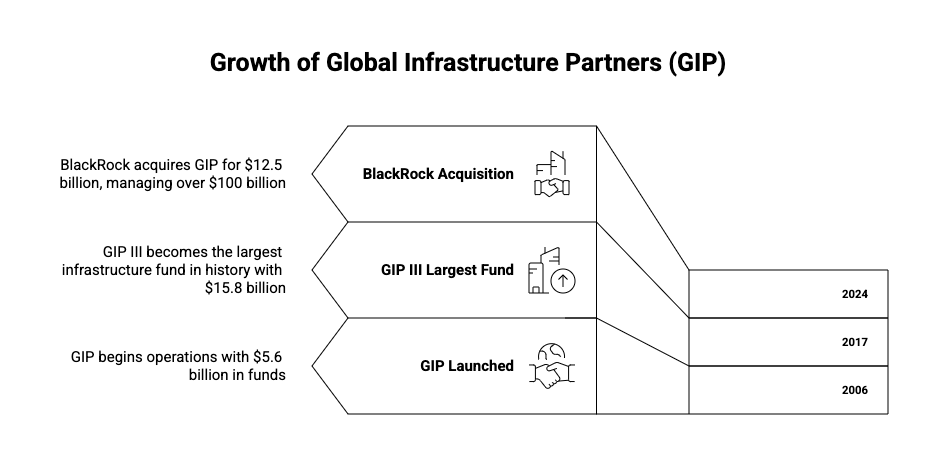
The results of Ogunlesi’s philosophy are etched in the scale of his funds. GIP launched in 2006 with $5.6 billion. By 2017, GIP III had swelled to $15.8 billion, the largest infrastructure fund in history at the time. Today, following BlackRock’s $12.5 billion acquisition of GIP in 2024, the platform manages well over $100 billion.
Look at the Gatwick waterfall to understand the magic: A £1.455 billion entry price, augmented by £30 million in annual operational gains and massive capacity upgrades, resulted in a partial exit that implied a £5.8 billion enterprise value. GIP created over £4.3 billion in value on that single asset—a 3x multiple on invested capital—while keeping half the upside for the future.
Bayo Ogunlesi didn’t build a $100 billion empire by treating infrastructure as a financial spreadsheet. He built it by looking at the world’s most boring, essential assets and seeing them for what they truly are: operational challenges waiting to be solved.