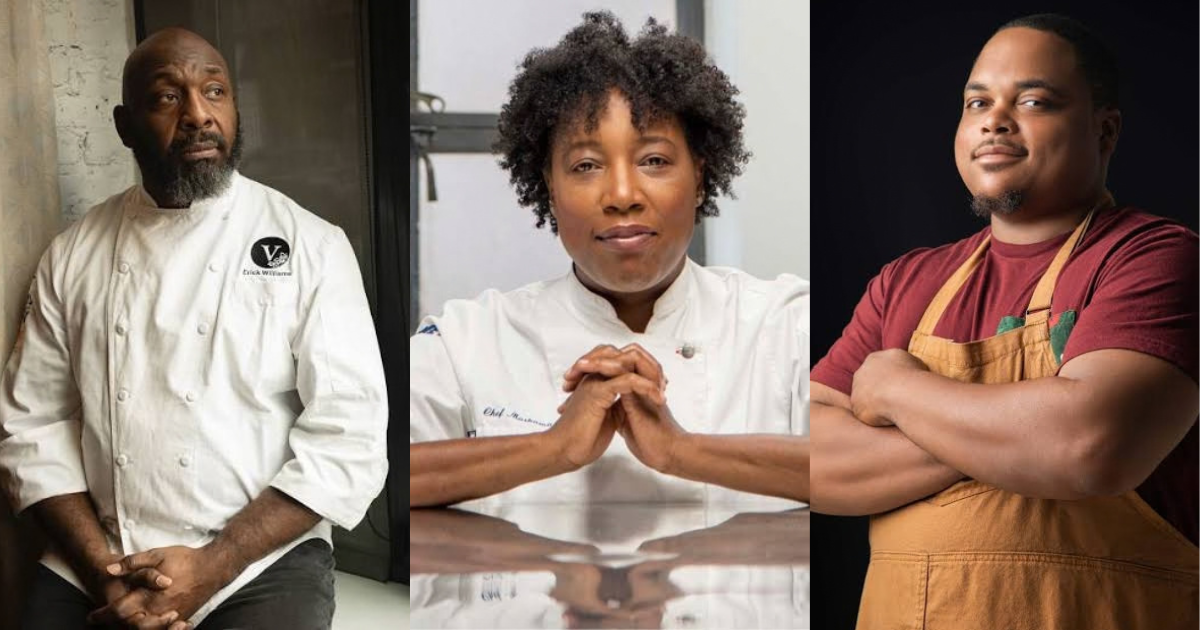
When Virtue opened in Chicago’s Hyde Park in November 2018, chef-owner Erick Williams pushed back on the idea that it was simply a soul-food restaurant. “Cooking American southern food expands far beyond the soul food category,” he told Eater Chicago.
The label matters. It shapes what diners expect before they see a menu, and where they place a restaurant in American cooking. Soul food is central to Black American food history. It is not the whole story. When one tradition stands in for all of Black cuisine, other histories—and what Black people cook and eat now—can disappear from view.
The eight chefs in this feature approach that question from different places. Williams cooks in Chicago; Mashama Bailey connects Savannah and Paris; Robert Butts calls his approach “international Southern food.” Kwame Onwuachi’s restaurants draw on Afro-Caribbean and diasporic cooking. Ope Amosu built ChòpnBlọk in Houston around West African food. Cleophus “Ophus” Hethington leads an Afro-Caribbean kitchen in Los Angeles. In Philadelphia, Omar Tate and Cybille St.Aude-Tate have built Honeysuckle around Black food traditions and contemporary eating.
These are examples. Their restaurants make different histories visible, while their changes in format show the business decisions behind the menus.
A History Wider Than One Menu
The Smithsonian’s National Museum of African American History and Culture uses “foodways” for the growing, preparing and sharing of food. The term includes more than recipes: knowledge, labor, migration and family ties shape what people eat.
Southern rice cultivation drew on West African knowledge. Along the East Coast, African Americans gathered, grew and sold oysters. During the Great Migration, families brought food traditions to cities such as Chicago and Philadelphia, where they adapted them to new ingredients and customers. These histories overlap, but they are not one history. Nor is every Southern dish exclusively Black.
In Jubilee, food historian Toni Tipton-Martin draws on Black cookbooks to document cooks and their social worlds across time and class.
The South, Rewritten
At Virtue, Williams has served gumbo, dirty rice and greens alongside dishes that do not fit neatly under a narrow soul-food label. In a WTTW interview, he described the range he expects Southern cooking to hold:
If I’m going to cook Southern food, then I need to be able to use the whole palette. — Erick Williams
In 2022, Williams became the first Black chef to win the James Beard Foundation’s Best Chef: Great Lakes award. He has since built Virtue Hospitality Group into a portfolio of five concepts: Virtue, Mustard Seed Kitchen, Daisy’s Po-Boy & Tavern, Top This Mac N’ Cheese and Cantina Rosa. The group also runs a leadership-development program for young adults of color. The portfolio spans full-service dining, a bar and more casual formats, though public information does not show which concept performs best.
In Savannah, Bailey’s restaurant occupies a former segregated Greyhound bus terminal. Its history is part of The Grey’s setting; Bailey’s cooking draws on the food of her mother, aunts and grandmothers. She and business partner Johno Morisano took the concept to Paris in September 2025, opening L’Arrêt by The Grey, an American bistro in the 7th arrondissement.
In 2026, Bailey joined the TIME100 and received North America’s Best Female Chef award from The World’s 50 Best Restaurants. The Paris opening marks entry into another market; the awards measure recognition, not financial performance.
Butts also looks beyond a single label. The southwest Atlanta native calls his food “international Southern,” pairing regional ingredients with influences from elsewhere. After culinary school, he spent time in France and returned home. He is now executive chef and co-owner of Auburn Angel, in the former space of a civil-rights-era food landmark in historic Sweet Auburn.
Butts is a founding member and creative director of The New South, a collective of Black Atlanta chefs. Its dinners and projects create shared visibility and professional ties. That can help chefs find an audience, but each restaurant still has to make its own numbers work: it needs capital, staff and customers who return.
The Diaspora as a Frame
Kwame Onwuachi has restaurants in New York and Washington. In May 2026, he opened Maroon, a Caribbean steakhouse at SAHARA Las Vegas. The restaurant takes its name from Jamaica’s Maroons, who escaped slavery and established independent communities in the mountains.
Onwuachi’s path has included a sharp early setback. The Shaw Bijou, his first restaurant, closed in January 2017, roughly two and a half months after opening. The closure sits beside his later high-profile ventures, but available reporting does not support a single-cause explanation. A chef’s reputation and a restaurant’s staying power are different measures.
Ope Amosu was born in London to Nigerian parents and raised in Houston. He left the energy sector to build ChòpnBlọk around West African food. The business began as a pop-up, moved into a stall at POST Houston, then opened a Montrose restaurant on Nigerian Independence Day, October 1, 2024. Its menu includes palm butter chicken and Liberian-braised greens.
Amosu was a James Beard semifinalist for Emerging Chef in 2024 and Best Chef: Texas in 2025. Moving from pop-up to a permanent restaurant changed the scale of the operation and brought longer commitments to a site, staff and overhead. ChòpnBlọk introduces Houston diners to West African food while keeping it distinct from African American food traditions.
In Los Angeles, Cleophus “Ophus” Hethington leads Lucia, an Afro-Caribbean restaurant that opened in 2025 with Jamaican-born chef Adrian Forte. Hethington later succeeded Forte. Before cooking, the Miami native and Navy veteran studied public health. In 2022, he was a James Beard Emerging Chef finalist for his work at Asheville’s Benne on Eagle.
At Lucia, Hethington cooks across African, Caribbean, Afro-Latino and Black American traditions. He has said he once avoided dishes he thought people might connect to stereotypes about Black food. Now, he calls all of it soul food. The menu draws links through ingredients and technique without claiming that the cultures behind them share the same history.
Food From the Present Tense
Omar Tate and Cybille St.Aude-Tate have made the case that Black food includes what people eat now. In a PBS interview, Tate pointed to a Honeysuckle hoagie: its roll was made with West African benne seeds and einkorn flour.
We do need to include not just Southern food and soul food, but also the food that we’re eating now in these stores. — Omar Tate
Their Philadelphia business has changed shape. In 2022, they opened Honeysuckle Provisions, a grocery-café and community space in West Philadelphia. The Philadelphia Inquirer reported that the economics of that model were not working. The shop closed in 2024, making way for a full dining concept.
Honeysuckle opened on North Broad Street in April 2025, with a different format and location. The customer came for a planned multi-course dinner rather than the earlier mix of café service, groceries and takeout.
The tasting-menu restaurant made Bon Appétit’s 2026 Best New Restaurants list and received a Michelin recommendation. Tate and St.Aude-Tate were 2026 James Beard nominees for Best Chef: Mid-Atlantic; Jesse Ito of Royal Sushi & Izakaya won. The honors show recognition, not earnings. Public information does not establish the financial result of either Honeysuckle model.
Frequently Asked Questions
What Is Black Cuisine?
It is not one fixed menu. The term covers food shaped by Black history, region, migration, family and cultural exchange. Soul food and Southern cooking are part of that picture, alongside local, diasporic and contemporary traditions.
Is Soul Food the Same as Black Cuisine?
No. Soul food is central to African American cooking, but it does not represent every Black food tradition. Regional histories, cookbooks and contemporary restaurants document a much wider range of dishes and practices.
Are African and Caribbean Foods Part of Black American Cuisine?
African, Caribbean and Black American food traditions have distinct histories. They meet in U.S. communities and restaurants, and chefs may bring them into conversation. That does not make the traditions interchangeable.
Why Does Restaurant Ownership Matter?
Ownership affects who controls the brand, bears risk and receives returns. A chef may lead the kitchen while investors, partners or landlords hold other rights. The structure has to be checked restaurant by restaurant.
What Happened to Honeysuckle Provisions?
The Philadelphia grocery-café and community space opened in 2022 and closed in 2024 after its economics proved difficult. Omar Tate and Cybille St.Aude-Tate later opened Honeysuckle, a North Broad Street tasting-menu restaurant, in 2025.
What Has Changed About Black Cuisine in 2026?
These restaurants bring more regional, diasporic and contemporary food traditions into public view. Their awards and openings show visibility, but they do not establish sector-wide profitability or tell us which business models are financially strongest.