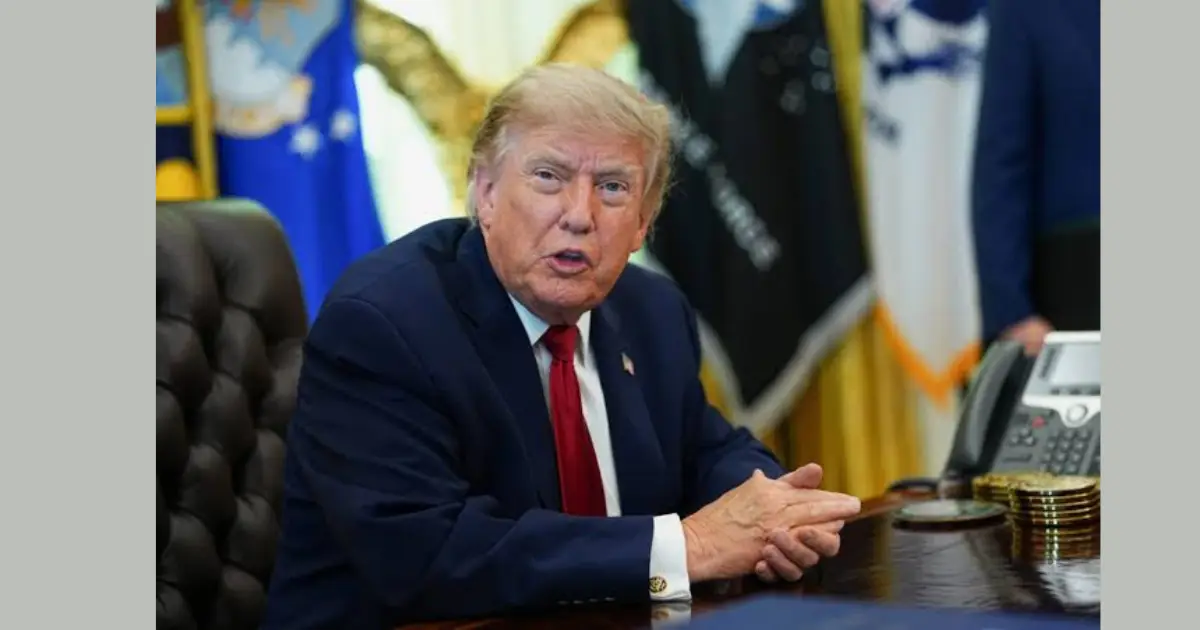
President Donald Trump’s latest financial disclosure paints a vivid picture of how wealth is being generated in America today. It shows that income comes from crypto, personal branding, licensing, legal settlements, and global real estate. The 2025 annual disclosure, which the U.S. Office of Government Ethics released on June 30, 2026, reveals that Trump’s financial empire has expanded beyond the traditional image of towers, golf clubs, and hotels. It now occupies a vital role in a new economy where influence, digital assets, and brand loyalty can create significant income.
Crypto Became the New Power Engine
The filing makes it clear that cryptocurrency has become one of Trump’s main sources of wealth. It reports over $1.4 billion in income from family-related crypto ventures in 2025, including nearly $800 million from World Liberty Financial and $635 million from sales of Trump meme coins. World Liberty Financial alone made more than $520 million from crypto token sales and over $250 million from selling business interests.
This change is noteworthy because Trump built his public persona on real estate. However, the filing suggests that the fastest-growing part of his wealth is now more than just physical property. It includes digital, political, emotional, and brand-driven elements.
Branding Is Now an Asset Class
Trump’s disclosure also highlights how personal branding functions as a business model. The Trump name is now linked not only to buildings but also to tokens, meme coins, watches, Bibles, licensing deals, and global property partnerships.
For instance, Trump-branded watches generated $4.7 million, while his larger licensing and overseas property deals produced tens of millions of dollars. Reuters pointed out that Trump received $52 million for licensing his name to overseas property developers, mostly related to Middle Eastern deals.
The larger takeaway is that modern wealth is increasingly created by turning attention into ownership, loyalty into transactions, and identity into a marketplace.
Real Estate Still Matters
Despite the rise in crypto, Trump’s traditional businesses are still performing well. His golf and resort facilities saw a 15% increase in revenue, surpassing $500 million in 2025. Mar-a-Lago, one of his most prominent properties, grew to $77 million in revenue, up from $50 million in 2024.
However, the figures reveal a clear hierarchy. Real estate continues to hold value, while crypto has delivered dramatic growth.
The Conflict-of-Interest Question
The White House has dismissed concerns about conflicts. According to reports, White House deputy press secretary Anna Kelly said, “Neither the president nor his family has ever engaged—or will ever engage—in conflicts of interest.” She added, “All actions by President Trump and his administration are taken in the best interest of the American people.”
Trump has defended his earnings, saying, “We’re all profiting. I’m profiting because I have a lot of money and a lot of cash.”
Yet, ethics experts contend that the scale and nature of the income raise serious governance questions. Don Fox, a former acting head of the federal ethics office, noted, “Every president since Watergate has handled his finances as if he were subject to conflicts of interest. With Trump, those norms are just totally out the window.”
Why It Matters
Trump’s disclosure tells more than just the story of a billionaire president. It offers insight into the future of wealth.
In the past, wealth came from land, factories, buildings, and inheritance. Now, it can be created from networks, tokens, licensing rights, audience trust, and cultural influence. Trump’s 2025 disclosure illustrates how swiftly a political brand can evolve into a financial ecosystem.
For business leaders, creators, and investors, the message is clear: ownership matters. In today’s world, the most valuable asset may not be a building. It could be attention, belief, and the platform that converts both into capital.