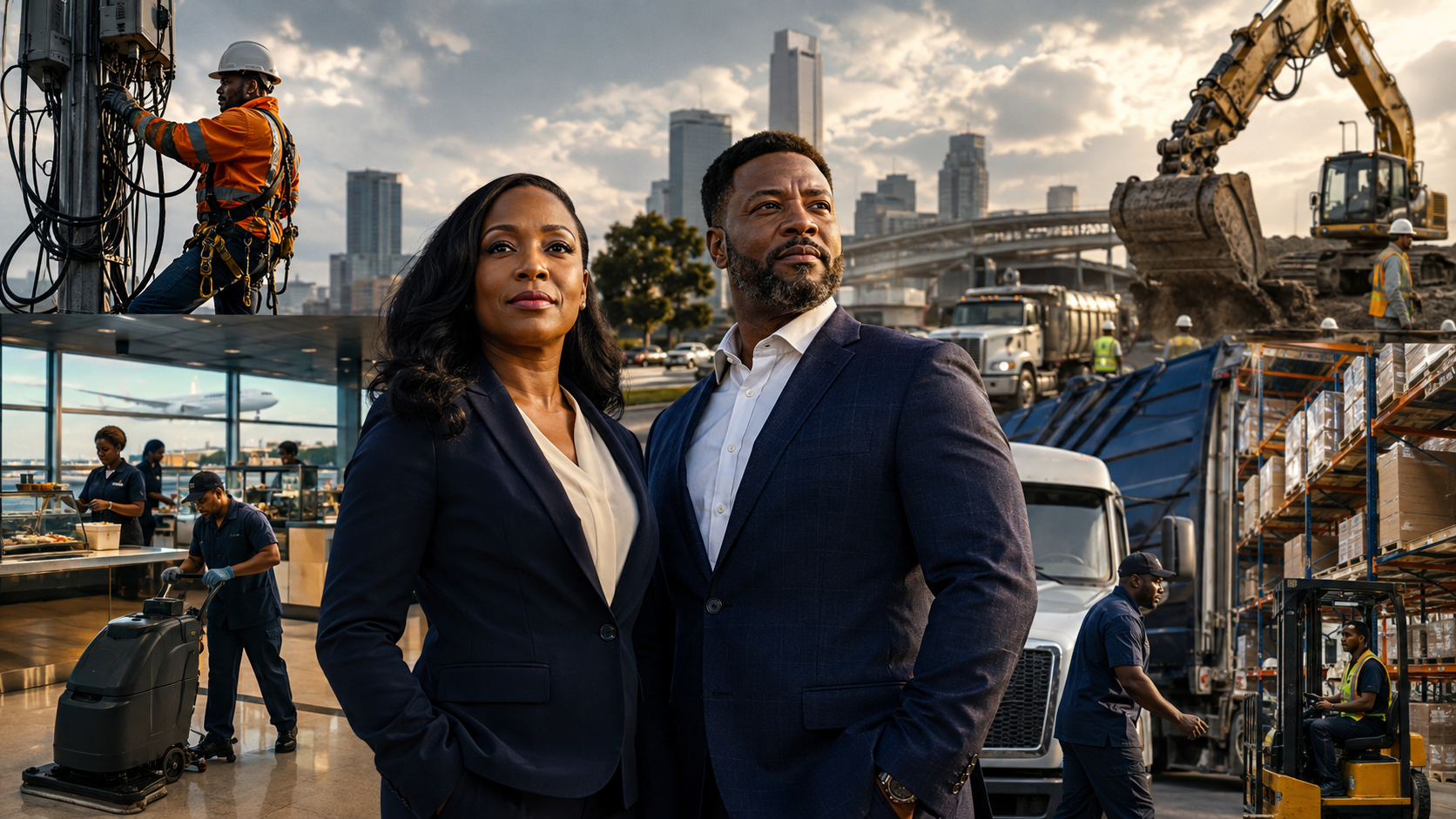
The businesses that dominate social media are easy to picture: restaurants, fashion labels, beauty brands and apps. The businesses that quietly create the conditions for durable wealth look different. They clean offices, lay fiber underground, distribute hardware, service fleets and move food through warehouses.
Black business ownership in America is growing. Pew Research Center, using Census Bureau data, counted 194,585 majority Black-owned employer firms in 2022, up from 124,004 in 2017. Their combined gross revenue rose from $127.9 billion to $211.8 billion over that period. But the bigger wealth question is not how many companies exist. It is which business models can compound.
The pattern is unglamorous: recurring demand, contracts, specialized capability, barriers to entry and ownership.
1. Fiber optics and telecom infrastructure
America’s broadband economy depends on crews that trench, splice, install and maintain physical networks.
Freddie Figgers built Figgers Communication after receiving a telecommunications license to serve parts of Florida and Georgia. Reporting on his early years describes him installing fiber-optic cable and helping build his first tower himself.
The attraction is not simply broadband growth. Fiber work rewards technical skill, equipment and relationships with carriers, municipalities and prime contractors. Once a company proves it can complete infrastructure work safely and on schedule, it becomes harder to replace.
The wealth sits in becoming a trusted infrastructure operator, not merely selling internet subscriptions. The physical network has to be installed, repaired and upgraded regardless of which consumer-facing telecom brand gets the attention.
2. Commercial janitorial and facility management
Cleaning sounds easy to enter. Commercial facility management is different.
Corporate campuses, hospitals, schools and government buildings require scheduled labor, compliance, supervision, supplies and measurable service standards. Contracts can renew for years.
John W. Barfield offers an early example of how far an apparently ordinary service business can go. After working as a custodian at the University of Michigan, he started Barfield Cleaning Company in Ypsilanti. The company eventually employed about 200 people, according to The HistoryMakers. He later sold the cleaning business and went on to establish companies including what became the Bartech Group.
Recurring contracts can become a platform for workforce management, procurement and institutional selling. The scalable asset is the operating system: managers, crews, scheduling, quality control and retention.
3. Civil engineering and heavy highway construction
Roads, airports, utilities and public infrastructure are expensive, regulated and technically demanding. That is why established operators can build defensible businesses.
Wilbur Milhouse III founded Milhouse in 2001. It has grown from an engineering firm into a multidisciplinary enterprise spanning engineering, construction, program management and infrastructure services across transportation, aviation and utilities.
“When I started the company, I envisioned us not only focusing on engineering but also on construction,” Milhouse said in a 2025 company interview.
That sentence captures the wealth mechanism. Engineering creates expertise. Construction expands contract size. Program management deepens client relationships. Related services allow a company to capture more of the project lifecycle.
The barrier to entry is part of the value. Technical licenses, bonding capacity, safety records and previous project experience cannot be created overnight.
4. Commercial auto dealerships and fleet management
A dealership is easy to mistake for a retail business. At scale, it is a portfolio of franchises, property, inventory financing, service bays, parts operations and recurring customer relationships.
Thomas Moorehead built Sterling Motorcars into a major luxury dealership group. He became the first African American dealer for several high-end automotive brands, with Johns Hopkins identifying him as the first Black luxury dealer for Lamborghini, McLaren and Rolls-Royce in the Mid-Atlantic region. Profiles of Sterling Motorcars have reported annual revenue above $600 million.
Vehicle sales create volume, while service, parts and fleet accounts bring repeat business. Real estate and franchise rights can hold strategic value.
The wealth is in controlling the distribution and service platform, not simply earning a margin each time a car leaves the showroom.
5. Government IT logistics and enterprise hardware supply
Few Black-owned companies show the power of institutional procurement better than World Wide Technology.
David Steward founded WWT in 1990 as a small government contractor. Today the company describes itself as the largest Black-owned company in the United States and says it has more than 14,000 employees globally.
In July 2026, WWT announced a 12-month, $230 million U.S. Army agreement with Cisco. The contract covers enterprise software, technical support, infrastructure modernization, training and asset management.
Enterprise technology is more than consumer apps. It includes procurement, integration, configuration, cybersecurity, support and vendor relationships.
Once embedded inside a large institution, a capable supplier can become difficult to replace. Contracts expand, services layer on top of products, and logistics capability becomes strategic infrastructure.
WWT is perhaps the clearest example on this list of a boring starting point becoming enormous enterprise value. Steward did not begin by chasing consumer fame. He built around institutional technology problems customers were willing to pay to have solved repeatedly.
6. Waste management, demolition and environmental remediation
Trash, contaminated soil, asbestos and demolition debris are not glamorous. They are also not optional.
Environmental work can be attractive because regulation creates demand while competence creates barriers. Companies need trained crews, permits, insurance, specialized equipment and compliance systems.
Texas-based Lone Star Remediation and Demolition, founded by Reginald Powell, provides environmental remediation, abatement, demolition and consulting services. The company identifies itself as an African American Business Enterprise, while Powell brings more than two decades of environmental-remediation experience.
The model becomes more valuable as capabilities stack. A contractor that can assess contamination, remove hazardous material, demolish a structure and manage disposal captures more of the project budget.
Equipment ownership matters, too. Trucks, containers, demolition machinery and specialized remediation equipment can become productive assets when utilization rises.
7. Airport concessions and airport retail management
Airport restaurants look like hospitality businesses. Economically, they are closer to contracted infrastructure.
Herman J. Russell and partners launched Concessions International in 1979. Russell later purchased his partners’ interests, turning it into a family-owned company. By 2025, Concessions International said it operated nearly 40 locations across eight airports while serving more than 30 national, regional and proprietary brands.
Airport entry itself is a barrier. Operators navigate bidding, security, construction requirements, rent structures and long approval processes.
Airport-industry publisher Ramon Lo described the challenge this way:
You have to go through a lot of layers. Source: Concessions International, quoting Airport Revenue News publisher Ramon Lo.
That difficulty becomes an advantage after entry. Strong operators can add concepts and expand across terminals and airports around captive passenger demand.
8. Commercial fire, security and low-voltage wiring systems
Every large building needs systems occupants rarely notice: fire alarms, access control, cameras, structured cabling, emergency communications and monitoring.
Unlike one-off electrical jobs, the commercial model can generate revenue at several points. A contractor designs and installs a system, then returns for inspections, repairs, monitoring, upgrades and replacement.
Established fire and security operators commonly combine installation with maintenance, testing and 24-hour monitoring. That changes the economics. The original construction project becomes the door into a longer customer relationship.
The moat is qualification. Customers are not simply buying wire. They are buying code compliance, system reliability and documentation. Commercial buildings cannot casually ignore fire and life-safety requirements.
For an owner who can build technician capacity and win multi-site commercial accounts, one installation can become years of service revenue.
9. Fast-food and service franchise clusters
One franchise can buy an owner a job. A cluster of franchises can become an operating company.
Junior Bridgeman became the defining example. After retiring from the NBA, he built a restaurant portfolio that eventually exceeded 500 franchise locations, including large Wendy’s and Chili’s holdings. The Wall Street Journal reported that by 2016 Bridgeman Foods had become the world’s second-largest Wendy’s franchisee.
Years earlier, Wendy’s itself announced a transaction that brought Bridgeman’s total or partial ownership to 196 Wendy’s restaurants, calling him its second-largest franchisee at the time.
His advantage was replication: training, site selection, purchasing, finance and supervision repeated across hundreds of units.
Bridgeman later explained his entrepreneurial drive simply:
I just wanted to prove to myself that I could do something else in life. Source: The Wall Street Journal.
Scale changes purchasing power, management depth and financing options. It lets the owner move from operating stores to allocating capital.
10. Commercial towing, freight and cold-chain logistics
Logistics becomes more valuable when the cargo cannot wait.
Food, pharmaceuticals and time-sensitive freight require dependable warehousing, routing, fleet capacity and sometimes temperature control. Commercial towing can work on similar economics when operators secure municipal, fleet, insurance or roadside contracts instead of depending on random consumer calls.
Warren Anderson’s Anderson-DuBose Company shows what scale can look like on the food-distribution side. The wholly Black-owned company has supplied hundreds of McDonald’s restaurants across several states and was named McDonald’s USA Supplier of the Year in 2021. More recent reporting places the company above $500 million in annual revenue and describes a distribution network serving McDonald’s and Chipotle locations.
The company does more than move boxes. It manages procurement, warehousing, quality control and distribution.
That creates switching costs because failure can disrupt hundreds of restaurants. Wealth compounds when the owner controls the relationship, distribution infrastructure and enough volume to make the network more efficient.
The real business behind the “boring” business
These companies do not share one industry. They share an economic structure.
Demand repeats. Contracts create visibility. Regulation, licensing, expertise or capital requirements keep casual competitors out. Scale improves purchasing and labor utilization. Most importantly, ownership lets the entrepreneur retain the upside created by those systems.
Revenue alone is not wealth. Durable wealth comes when cash flow is reinvested into equipment, contracts, acquisitions, real estate and technology that make the enterprise more valuable.
That distinction is especially important when discussing Black entrepreneurship. Black-owned companies generated an estimated $211.8 billion in gross revenue in 2022, yet Black Americans remain substantially underrepresented among owners of employer businesses. Moving into industries where contracts, assets and scale can compound therefore matters beyond entrepreneurship statistics. It affects who owns productive pieces of the American economy.
The most important businesses are not always the ones people talk about. Sometimes they are the companies underneath the economy, doing work that has to happen.
Frequently asked questions
Why are “boring” businesses often good wealth builders?
Because many solve recurring operational problems rather than chasing discretionary attention. A building still needs cleaning, a network still needs maintenance, food still needs distribution, and infrastructure still needs repair. Predictable demand can support hiring and reinvestment.
Does a large revenue figure mean the owner is wealthy?
No. Revenue is not profit, and company value is not personal net worth. Debt, ownership percentage, margins, and reinvestment matter. That is why the strongest evidence here is business scale, contracts and ownership, not assumptions about personal wealth.
Are government contracts the main reason these businesses scale?
Not necessarily. Government procurement matters in sectors such as IT, infrastructure, environmental services and facilities management, but private institutional contracts can be equally powerful. The important feature is repeat business with customers large enough to support scale.
What connects the strongest examples?
Recurring demand, institutional customers, meaningful barriers to entry, repeatable operations and ownership. The entrepreneurs who scale them build systems that can keep producing cash flow beyond the founder’s labor.
The gap between revenue and wealth is often the gap between earning from a business and owning the assets that make it valuable. A durable business owns contracts, infrastructure, distribution, systems, and customer relationships.
Over time, that is where scale becomes equity, and equity becomes wealth.