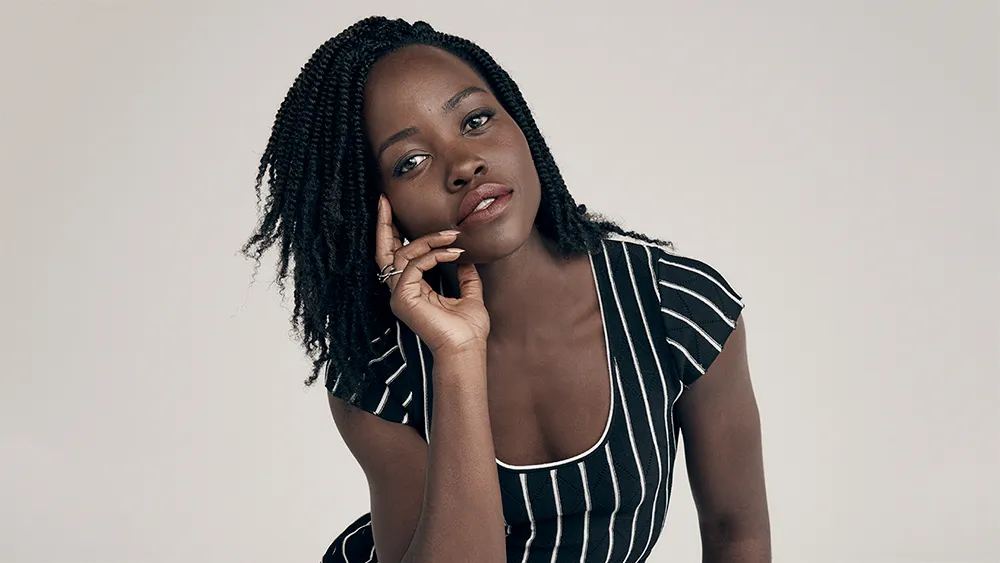
Right before Lupita Nyong’o’s big press tour for 12 Years a Slave, she almost torpedoed her own moment. On purpose.
She’d spent years at Yale training herself to sound American. Two accent coaches. Real money, real time. Because — and this is the part that stings — she genuinely believed there was no room in this industry for a Kenyan accent. Not paranoia. Just math she’d done based on what she was seeing around her.
Then a friend, a Ghanaian-British woman who also worked as her agent, basically called her out. Asked her why she’d be walking onto the biggest stage of her career sounding like she was ashamed of where she came from. And Nyong’o… just decided. Told her team she was going back to her real voice, effective immediately. She wanted people to know that being African was already enough.
That’s not a small risk. She’s making that call right as Hollywood is deciding, in real time, what kind of actress she’s allowed to be. One perception, locked in early, could have shaped the trajectory that followed.
She did it anyway.
A few months later she won the Oscar. For her first movie role. Lancôme signed her in 2014. De Beers made her their first-ever global ambassador in 2022. Chanel followed in 2024. And her film résumé since then is honestly kind of absurd — Black Panther pulled in $1.347 billion worldwide, Us made $256 million off a $20 million budget (that’s the kind of ratio studios dream about), The Wild Robot did $334.5 million, and by mid-2026 Nolan’s The Odyssey had crossed $1.29 billion globally.
None of this proves the accent thing caused any of it. Correlation isn’t causation. But what it does prove is something almost more interesting: the things she was told were liabilities turned out to be completely compatible with being one of the most in-demand actresses on the planet. Maybe even part of the draw.
The Strategy Here
Build from what is scarce, not from what you lack
Nyong’o put it plainly in a 2018 Vogue sit-down, she said,
I don’t think of what I don’t have; I think of what I do, and use that to get the next thing.
— Lupita Nyong’o
Simple. But most people don’t actually run their careers that way.
Think about it like resource allocation. A lot of performers spend years trying to smooth themselves out, sound more American, look more conventionally “castable,” chase roles that already have a track record. And Nyong’o had every reason to do exactly that. As a teenager auditioning in Nairobi, she was flat-out told her skin was too dark for TV. She’s talked about how, growing up, she saw her complexion as something to overcome, not something that was working for her.
So watch what happens next. L’Oréal’s 2014 annual report framed the Lancôme deal around embracing uniqueness and diversity — basically inverting the exact premise that got her rejected as a teenager. De Beers made her their first global face. Chanel turned a relationship that started back around 12 Years a Slave into a full ambassadorship a decade later.
The industry’s narrowness didn’t disappear. What changed is she stopped letting that narrowness define her own strategy.
Don’t let the Oscar become a cage

Here’s the thing about awards: win for playing a specific kind of role, and suddenly that’s all anyone offers you. Nyong’o hit this immediately. She said in a 2026 Elle interview that after playing Patsey, she kept getting sent scripts for more enslaved women. Her word for it: disappointing, not surprising.
So she built a portfolio instead of a lane. Star Wars. The Jungle Book. Queen of Katwe. Back to theater for Eclipsed. Marvel with Black Panther. The double-lead grind of Us. Voice work carrying The Wild Robot. Then Nolan casting her as both Helen of Troy and Clytemnestra in The Odyssey — two women, one actress, one film.
This tracks back to something Oprah told her years earlier — to figure out her actual intention. Nyong’o’s answer, roughly: she wants to make sure certain stories get told, period.
I think I can make a difference by having certain stories be told.
— Lupita Nyong’o
The alternating pattern is obvious if the projects are lined up. Eclipsed — a Liberian war drama, entirely female cast, playwright, and director — made about $5.74 million and picked up six Tony nominations. Not a blockbuster number, but a prestige number. Then Black Panther drops her into a $1.347 billion franchise. Then Us puts her at the center of a $256 million horror film carrying two roles at once.
Prestige opens doors. Scale keeps her bankable. The hard, specific roles protect the craft itself. All three, running at the same time.
When Hollywood won’t build it, build it yourself
This is maybe the most slept-on part of her whole arc. Nyong’o keeps stepping out of “hired talent” and into ownership. She bought the screen rights to Chimamanda Ngozi Adichie’s Americanah back in 2014, partnering with Brad Pitt’s Plan B. She wrote Sulwe, a kids’ book dealing with colorism, and it landed on the New York Times bestseller list. In 2024, she launched her own podcast, Mind Your Own, producing it herself. Her own description of what it’s for is pretty blunt — her business, in her words, is African stories.
That’s a form of vertical integration. If the system isn’t consistently making the thing you want, you can acquire the rights, shape the development and create your own channels for getting it out.
The Strategic Bet Behind Americanah
Because access alone doesn’t guarantee execution. Nyong’o got the rights in 2014, planned a film first, and it eventually became a 10-episode HBO Max series — Danai Gurira writing and running it, Nyong’o starring and producing, Uzo Aduba and Corey Hawkins attached. Real momentum.
Then Covid hit. Production stalled. The delay created a scheduling conflict, Nyong’o exited, and HBO Max quietly dropped the whole thing in 2020.
It wasn’t a bad idea, but a dependency problem. Big partners, real talent, a straight-to-series order — and it still couldn’t survive one calendar disruption tied to one person’s availability. Years of development, gone because of a scheduling conflict nobody could’ve predicted.
What came after was publishing, podcasting, formats with way less production overhead than prestige TV.
The Network behind the Leverage
None of this happens in isolation either. Plan B gave her early producing infrastructure. Gurira’s been a recurring collaborator across three different projects. Disney and Marvel gave her franchise-level reach. Nolan and Universal/DreamWorks extended that into animation and event cinema. Lancôme, De Beers, Chanel tied her cultural visibility to global luxury money. CAA handles her books, and Simon & Schuster published Sulwe. Snap Studios, KQED, and Lemonada built the machinery behind her podcast.
It’s less a capital stack, more a web of relationships she can move an idea through — books, Broadway, franchise film, TV development, audio, global ad campaigns. That’s capital too. Just not the kind that shows up on a balance sheet.
Steal this
The lesson isn’t some vague “just be yourself” poster quote. It’s more specific than that.
Look at whatever thing you’re spending disproportionate energy hiding — an accent, a background, a skill, whatever — because you’ve decided the market finds it inconvenient. Then actually ask yourself: does hiding it make you more valuable long-term? Or does it just make you easier to compare to everyone else in the room?
Nyong’o didn’t abandon adaptability — she can still do accents, obviously. She stopped confusing adaptability with assimilation.Get flexible enough to walk through the door. Just don’t sand off the exact thing that makes you worth letting in.
Questions People Ask about Lupita
What was her breakthrough role, really?
Patsey, in Steve McQueen’s 12 Years a Slave. Her literal first film role. Won her the Oscar for Best Supporting Actress in 2014.
How’d she actually turn identity into leverage?
Picking roles deliberately, buying up story rights, writing books, producing, running her own podcast, landing global brand deals. It’s not that being who she is was magic. It’s that she kept converting it into actual, differentiated work. Over and over. That’s the part people miss.
Did Americanah ever get made?
No. HBO Max had a 10-episode series in the works, then Covid delays created a scheduling conflict, Nyong’o exited, and they shelved the whole project in 2020.
So what’s the strongest proof of how big her reach actually is?
She’s playing in two different worlds at once — huge commercial stuff and prestige work. Black Panther did about $1.347 billion worldwide. The Odyssey had hit roughly $1.29 billion by mid-2026. Worth saying again though: that’s what the films made, not what landed in her pocket personally.