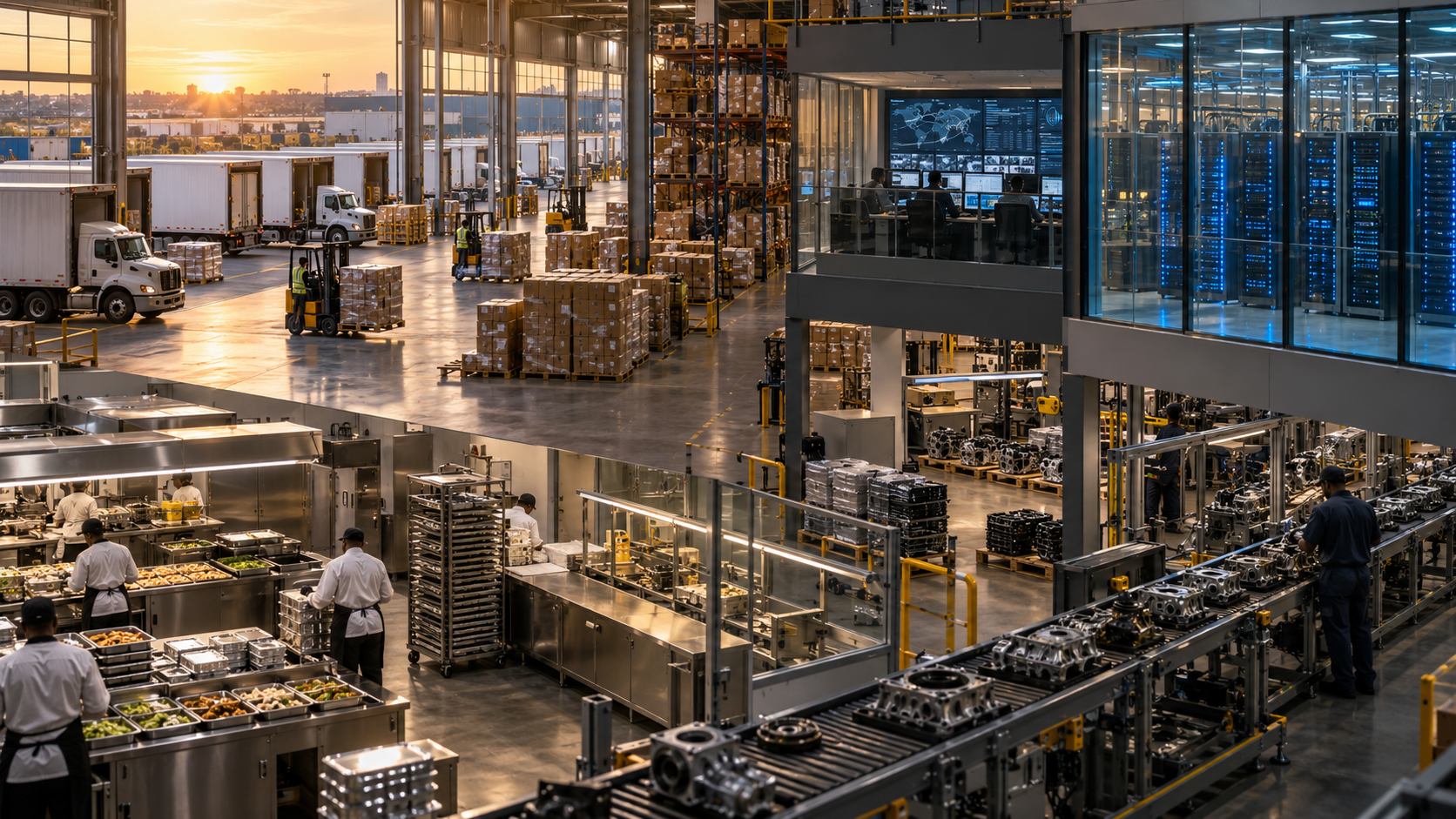
At lunchtime, customers see the McDonald’s counter. Behind it sits a distribution system expected to deliver the right quantity of food and packaging before anyone notices what’s missing. Anderson-DuBose Company is the one running that system for McDonald’s and Chipotle in several states.
The other four companies in this piece don’t have anything to do with lunch. World Wide Technology assembles technology systems for large organizations. ActOne Group manages workforce operations. Global Automotive Alliance supplies automotive manufacturers. Thompson Hospitality feeds and maintains institutions while also running its own restaurant brands. What they share is less a business model than an address: all five sit somewhere their customers rarely look, and all five are Black-owned.
Anderson-DuBose Grew Inside McDonald’s Distribution Network
Warren Anderson and Wendell DuBose entered food distribution through an established system. In 1991, they acquired a 51 percent interest in a Martin Brower operation serving McDonald’s restaurants. Four years later, they owned the business outright.
Quick-service restaurants depend on regular deliveries of perishable food, packaging, and promotional materials, and forecasting has to account for both ordinary traffic and limited-time offers whose demand can shift sharply from one week to the next. A temperature failure can destroy a truckload of inventory. A late delivery can leave several restaurants without an essential item during their busiest hours of the day.
The company has supplied McDonald’s and Chipotle locations in several states, and McDonald’s has named it U.S. Supplier of the Year. Recent business rankings have estimated its annual revenue at approximately $700 million, though the privately held company doesn’t release audited results.
Food distribution rarely gets the attention paid to restaurant brands, in part because competent distributors make their work invisible — customers only notice the system when a freezer fails or a delivery doesn’t arrive. McDonald’s supplier network measures performance through detailed operational standards, and Anderson-DuBose has stayed inside it for more than three decades by handling a piece of the restaurant business that most customers never think to ask about.
World Wide Technology Found Its Market Between Technology Vendors
David Steward and Jim Kavanaugh founded World Wide Technology in St. Louis in 1990. It doesn’t manufacture Nvidia chips, Cisco networking equipment, or Dell servers — it works between technology producers and organizations trying to make products from several vendors function as one system. The company has grown to roughly $20 billion in annual revenue and more than 12,000 employees, and it’s widely identified as the largest Black-owned company in the United States.
WWT’s engineers help clients design systems, test configurations, and manage deployment. Inside its Advanced Technology Center, a customer can model an infrastructure project before committing it to a hospital, bank, telecommunications network, or government agency. An incompatibility discovered before installation is an engineering problem; the same incompatibility discovered across thousands of employees can become a costly interruption.
Federal work shows one slice of this. Washington Technology recorded approximately $471.8 million in federal contracting revenue for WWT in 2024, including $386.3 million connected to defense agencies — a fraction of the company’s much larger commercial business.
Cyberattacks have gone up over 100 percent, so our security practice has skyrocketed. -David Steward
ActOne Expanded Beyond Filling Vacancies
Janice Bryant Howroyd opened a small staffing operation in Los Angeles in 1978 with about $1,500, a fax machine, and support from her family. Temporary job placements generated the early revenue. ActOne Group now works across recruitment, background screening, procurement, and workforce management, and says it operates in 47 countries, serves more than 28,000 clients, and employs approximately 2,600 people. Outside estimates have placed its annual revenue above $2 billion; as a privately held company, ActOne doesn’t publish audited figures.
A large employer might use several staffing firms across different offices, each with its own rates and records, leaving headquarters with little visibility into total spend or whether every vendor follows the same compliance procedures. ActOne built services that let a client keep hiring through multiple channels while using ActOne’s systems to supervise the process — a shift from being paid for a single placement to being embedded in the client’s approval and reporting workflow.
Howroyd built this without the factories, vehicle fleets, or heavy inventory that show up elsewhere in this piece. There’s no warehouse to point to, no truck fleet — mostly people running client accounts and the software they use to track them. That doesn’t make the work low-stakes. A payroll mistake or a missed background check doesn’t stay contained to one office; it can hit every worksite a client has, all at once.
William Pickard Took On the Financial Strain of Automotive Supply
A large automotive order can require a manufacturer to buy machinery, secure materials, and pay employees well before the automaker settles an invoice. Revenue rises quickly while cash stays tight.
The late William F. Pickard spent much of his career inside that tension. He founded the Detroit-based Global Automotive Alliance and assembled manufacturing and logistics businesses under its umbrella. The company reports more than $5 billion in cumulative sales since 1989, eight plants in the United States and Canada, and a customer list that has included major automakers and Boeing. (It shouldn’t be confused with Global Alliance Automotive, an unrelated representation network whose similar name shows up in online lists often enough to cause mix-ups — worth double-checking against Pickard’s company’s own materials rather than aggregator rankings, given how easily the two get conflated.)
Automakers buy components from specialized suppliers that must meet exact specifications and deliver on production schedules, sometimes in a sequence matched to vehicles moving along an assembly line. A delay at one supplier can idle workers and equipment throughout the plant. When an automaker ends a vehicle program or redesigns a component, the supplier can be left holding equipment bought for work that no longer exists.
Supplier-diversity programs opened doors for Black entrepreneurs in an industry that had historically excluded them. Pickard’s businesses still had to finance production and deliver usable parts on time like every other supplier competing for the contract.
A Partnership Changed the Scale of Thompson Hospitality
Warren Thompson entered the restaurant business already an owner. In 1992, he invested $100,000 and acquired 31 Bob’s Big Boy locations from Marriott, converting restaurants and building the operating experience needed to run food service across multiple sites.
Five years later, Thompson Hospitality partnered with Compass Group, one of the largest food-service companies in the world. The deal opened a path into contract dining for universities, corporations, hospitals, and schools. He said,
The joint venture was a strategic move that required the right partner. – Warren Thompson
In a 2023 interview, Thompson said the Compass relationship produced about $400 million — roughly half of his company’s revenue at the time — through a joint operation managing more than 150 accounts and serving around 60 Fortune 100 companies. Compass brought global reach; Thompson brought management experience and relationships that strengthened bids for institutional work. Thompson Hospitality used the cash flow and operating base from that partnership to develop other parts of the company, including Matchbox, Milk & Honey, Wiseguy Pizza, and Makers Union — restaurant brands built on top of a business whose financial foundation had largely come from dining rooms owned by other institutions.
The Trade-Off Underneath All Five
Corporate supply can look safer than consumer business because contracts are larger and demand often repeats. But a supplier serving one dominant account can report impressive revenue while having limited influence over prices or payment terms, and expansion can deepen that imbalance if the supplier hires staff or leases warehouses specifically for that customer’s work. Thompson’s own numbers — half of company revenue tied to one partner at a point in its history — show how far that can go even for a well-run business.
Consumer brands dominate business coverage because their products are easy to photograph and their customers recognize the names. The companies behind them often carry greater volumes with far less attention paid to how they got there. None of that means the arrangement is comfortable. It just means the discomfort happens somewhere the customer never has to see it.
A Few Questions Readers Tend to Ask
Is Anderson-DuBose only a McDonald’s supplier, or does it work with other chains too? McDonald’s is the account that built the company and still anchors its business, but it also supplies Chipotle locations. Anderson-DuBose doesn’t break out revenue by customer publicly, so there’s no clean answer to how the mix has shifted over time.
Why isn’t there an audited revenue figure for any of these companies? All five are privately held, which means they aren’t required to disclose financials the way public companies are. The numbers in this piece come from industry rankings, company statements, or interviews the founders themselves have given — useful, but not the same thing as a 10-K.
What actually separates Global Automotive Alliance from Global Alliance Automotive? Ownership, history, and business model — they’re not related companies. Global Automotive Alliance is Pickard’s Detroit manufacturing group; Global Alliance Automotive is a separate international representation firm. The overlap is really just the name, and it trips up enough rankings and databases that it’s worth checking a source’s own footnotes before citing a revenue figure attributed to either one.
Did Thompson Hospitality’s restaurant brands ever outgrow the institutional side of the business? Not based on the public figures. Thompson said in 2023 that Compass accounted for roughly half of revenue at the time, which implies the consumer brands and other institutional accounts made up the rest — but the company hasn’t published a full breakdown, so it’s hard to say precisely how that balance has shifted since.
Is ActOne bigger than a typical staffing agency, or is “workforce management” mostly a rebrand? It’s a real distinction, not just repositioning. A staffing agency is generally paid per placement. ActOne’s contracts often involve managing a client’s other staffing vendors, compliance tracking, and reporting — work that a traditional agency doesn’t typically take on.
Where does WWT’s federal business fit relative to its total revenue? Small, by the company’s own scale. The roughly $471.8 million in federal contracting revenue reported for 2024 is a sliver of WWT’s overall $20 billion, most of which comes from commercial clients rather than government agencies.