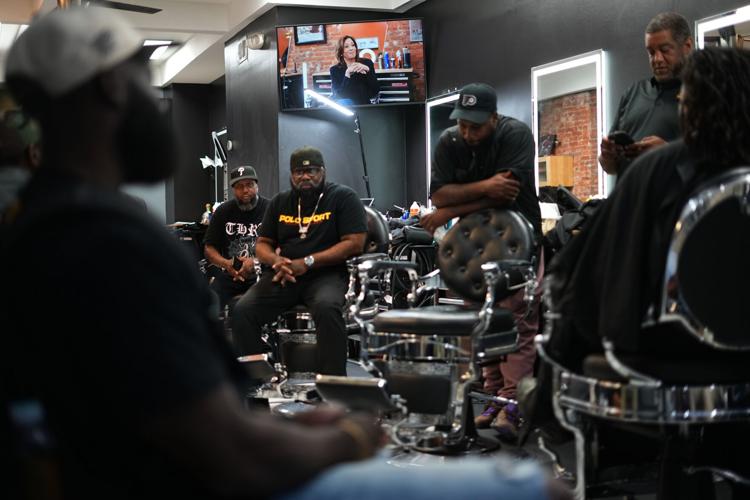
The conversation at Philly Cuts ran past two hours. It moved from government and education to artificial intelligence, criminal justice and the cost of getting ahead, and it never really settled anywhere. Barbers, customers, politicians, union leaders and teenagers all had a turn. They interrupted each other. Agreement was scarce.
Political strategist Khalil Thompson had brought the Win With Black Men listening tour to the West Philadelphia shop in September 2026. What he got was something a survey rarely produces: Black men arguing in front of people they actually knew, without a campaign feeding them the approved language first. He mentioned;
We know the shop is like our own country club that we come to, so we really just want to start having a conversation about what’s important to us in our community. — Khalil Thompson
A campaign can buy advertising. It can hire consultants, rent a hall, schedule a town meeting. What it can’t buy is the ten years a customer has spent in the same chair. Some of the men at Philly Cuts had exactly that history with their barber — long enough to have heard how his politics changed, and to disagree with him about it in front of a room.
The Associated Press’s account of the evening explains why that room matters heading into the next presidential race. Black men still vote heavily Democratic. That support has gotten less uniform, especially among younger voters, and Pennsylvania doesn’t give either party much room for a bad guess.
Trump carried the state in 2024 by 120,266 votes — a 1.7-point margin, according to Pennsylvania’s official returns. Philadelphia stayed overwhelmingly Democratic. But Harris got fewer votes there than Biden had four years before.
None of this requires a dramatic swing to matter. Lower turnout in Philadelphia alone could flip a close state. So could a small Republican gain among Black men, or more voters simply declining to back either party.
What Actually Got Said
Maurice Anderson, one of the barbers, traced some of his distrust of government back decades. He brought up the 1994 crime law Bill Clinton signed — the one that pushed federal money toward prison construction and hardened sentencing policy nationwide.
For the longest time, we always have a reason to distrust government, because we know our history, right? — Maurice Anderson
That law is still part of how a lot of Black communities remember the Democratic Party, even though researchers still argue over exactly how much of the prison boom it actually drove versus state-level policy. For Anderson, the history was close enough to bring into a present-day conversation about who deserves his vote.
It’s a detail that undercuts the tidy campaign theory that representation, or simple opposition to Republicans, settles the question. People bring old legislation into the shop right alongside this month’s rent and next year’s school budget. A candidate’s own biography gets weighed too — it just doesn’t cancel out what people remember.
Pew’s study of validated voters found Trump’s Black support rising from 8 percent in 2020 to 15 percent in 2024. Harris took 83 percent. AP VoteCast, using a different method, put Trump’s support among Black men specifically at around one in four — up from 12 percent in 2020. Among Black men under 45, it approached three in ten.
Those are two different surveys measuring two different things, and they shouldn’t be flattened into one number. But they’re both large enough to matter in a state this close.
Some of that movement will never register as a vote for Trump. A frustrated voter might just skip the presidential line, back an independent, or vote down-ballot and leave the top of the ticket blank. Anyone tracking only formal party defection is going to miss most of what’s actually happening.
Thompson pushed back on the idea that one message could reach every Black man in the room.
When you’re polling, messaging, making TV decisions for Black men with one monolithic filter, you’re going to lose a broad swath. — Khalil Thompson
Age does a lot of the dividing on its own. A union member near retirement is thinking about his pension and his healthcare. A 27-year-old trying to get a small business off the ground is thinking about credit scores and commercial rent. Ask both men what matters most and they might both say “the economy” — and mean almost nothing in common.
The Numbers Underneath the Argument
Black male unemployment sat at 6.2 percent in July 2026, versus 3.5 percent for White men, per the federal labor data cited in the AP’s reporting.
The wealth gap is starker. The Fed’s 2022 Survey of Consumer Finances — still the most recent edition available — put median Black family wealth at $44,890 against $285,010 for White families.
None of that tells you who deserves a Black man’s vote. It does explain why an appeal built mostly on party history can land flat. A man whose rent has outpaced his paycheck for three years running isn’t necessarily comforted by a politician telling him the economy is strong. A business owner who’s been turned down for financing twice hears “entrepreneurship” as a word, not a plan. Someone scared of violence in his neighborhood might want more police on the corner and still not trust what happens to his nephew if that same police force pulls him over.
The imprisonment numbers came up too. In 2023, the Black male imprisonment rate ran roughly 5.5 times the White male rate, a gap the Bureau of Justice Statistics has tracked for years across both state and federal systems.
Campaigns like to sort these into separate policy folders — jobs here, criminal justice there, housing somewhere else. Inside the shop they don’t separate that cleanly. A criminal record blocks a job application. A missed paycheck turns into a missed rent payment. No savings cushion turns a car repair into a crisis. No access to credit means a good worker never becomes an employer.
Why the Shop, and Not the Field Office
A barbershop’s political value comes from something almost boring: people keep coming back. Appointments repeat. Customers talk while they wait their turn. A barber remembers what somebody said three visits ago and can ask, straight up, whether that opinion has shifted.
A campaign field office tries to fake that familiarity on a deadline. Volunteers knock on doors with a script someone else wrote. Digital ads chase demographic slices with more and more precision. Pollsters sort opinions into categories a campaign manager can act on by Friday.
A shop owner sees what doesn’t fit those categories. He knows the guy who complains about Democrats every single week and still votes for them. He’s heard the Republican who can’t stand Trump personally but likes the tax plan. He can usually tell when somebody’s disgust with both parties has hardened into just not showing up.
The mix of people matters as much as the familiarity. Teenagers sat in on the same conversation as elected officials and union leaders at Philly Cuts. Nobody there had to join a party or show up to a ward meeting to have a say.
Campaigns can wreck that dynamic fast if they only show up for the photo. A camera in the room changes how honest people are willing to be. A barber’s public endorsement can shut some customers up rather than open them further. Pre-screened questions make for a cleaner video and a much thinner conversation.
Money is its own problem. Campaigns routinely pay pollsters, media buyers, consultants, venue staff — everyone except the barber whose shop and relationships made the event possible in the first place. Expecting that as a volunteer contribution borrows a lot of credibility for free.
A better version of this shows up long before an election and sticks around after it. Campaign staff come back with actual answers to what was asked last time. Shop owners and local organizers get paid when they’re doing real work — planning, advising, hosting — separate from any endorsement. And the conversation covers what actually touches the shop’s bottom line: licensing, insurance, commercial rent, access to credit, safety on the block outside.
Nobody’s Writing This Script
If Philly Cuts proves anything, it’s that there’s no single formula for how Black men vote.
Republicans have found a real opening with men worried about prices, business conditions and public safety — Trump’s 2024 numbers back that up, even with Democrats still holding a clear majority of Black support. Whether that opening widens depends on whether voters actually see their finances improve, not just hear that they should.
Democrats are still sitting on decades of relationships — churches, unions, elected officials, civic groups — that aren’t going anywhere overnight. But those relationships come with a paper trail voters can go check for themselves, and Anderson brought that paper trail into the room himself, unprompted.
Both parties will be back in Philadelphia before 2028. Some of those visits will end in a speech and a handshake photo. Others will end with somebody in the shop pointing out exactly where a promise doesn’t match a record.
That second kind of moment is usually the one worth paying attention to. Philly Cuts produced more than two hours of it, and nobody in the room walked out having settled anything.
A Few Things Worth Clarifying
Why Philadelphia specifically? Pennsylvania is close enough that Philadelphia’s Democratic turnout alone can decide the state — Trump’s 2024 margin was about 120,000 votes out of millions cast, and the state’s 19 electoral votes go winner-take-all.
How big was the shift among Black voters in 2024? Pew put Trump’s overall Black support at 15 percent, up from 8 percent in 2020. AP VoteCast, measuring men specifically and using a different method, had him closer to 25 percent, up from 12 percent. The two surveys aren’t measuring the same thing, but both show real movement.
Does this mean Black men are leaving the Democratic Party? Not in any wholesale sense — most still vote Democratic. What’s changed is the margin, particularly among younger men, and some of that shift shows up as non-voting or third-party choices rather than a straight party switch.
What came up in the actual conversation? Jobs, schools, wealth-building, AI, policing, incarceration, food access, and neighborhood investment — plus, from Anderson, the 1994 crime bill as a piece of unfinished history still shaping how the room saw the present.
Should barbers get paid for hosting these events? When they’re doing real organizing or advisory work, yes, and openly. A casual campaign stop that turns into an open conversation doesn’t necessarily need money changing hands — the problem is treating the former like the latter.
What should campaigns actually take from this? Show up more than once. Come back with answers instead of just more questions. Stop assuming a script written for “Black men” as a category will land the same way with a 22-year-old and a 61-year-old sitting three chairs apart.