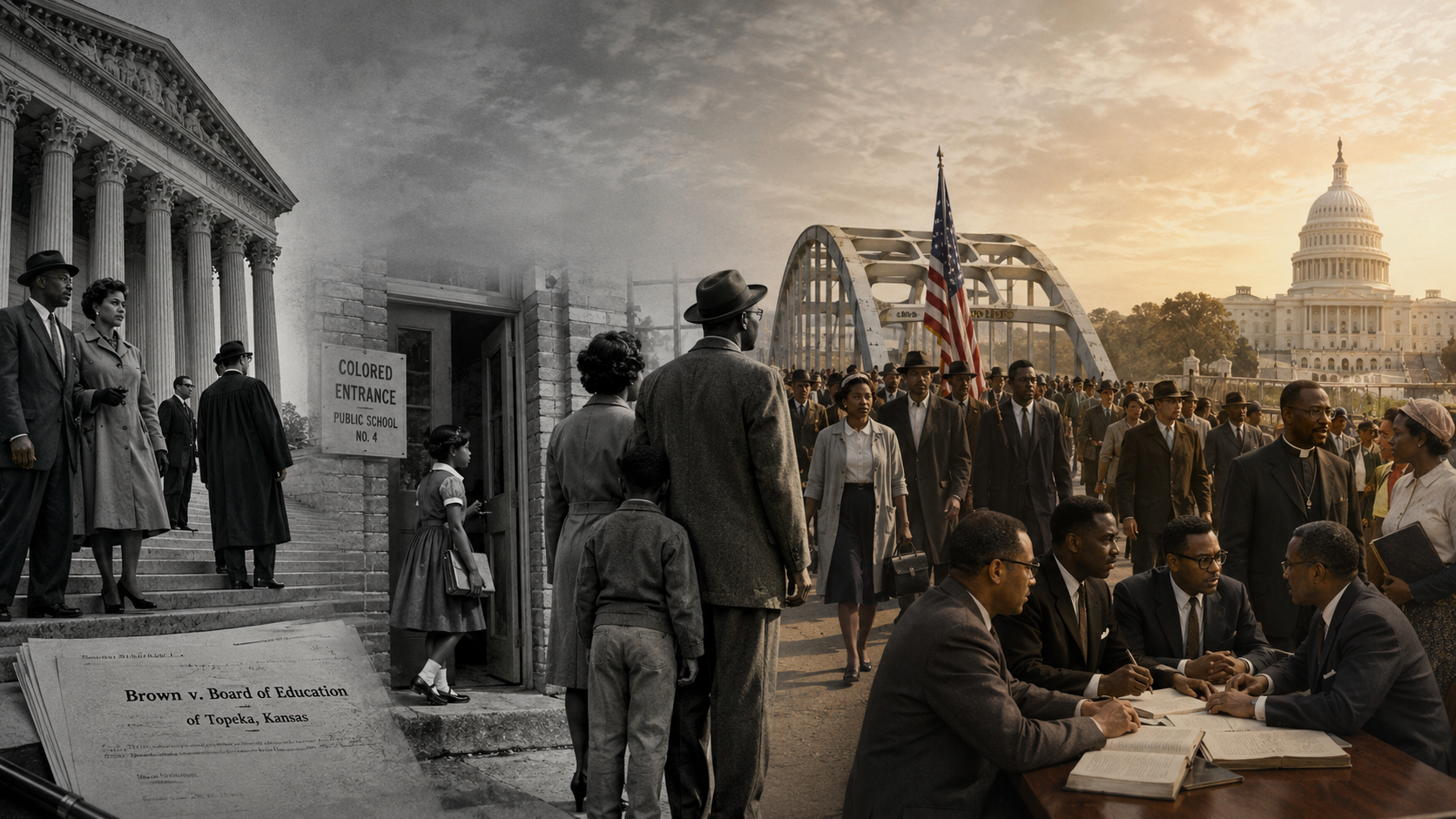
Fourteen years separated Brown v. Board of Education from Green v. County School Board. In one sense, that seems extraordinary. The Supreme Court had ruled segregated public schools unconstitutional in 1954. Yet in 1968, it was still deciding what school systems actually had to do to comply.
That delay tells us more about the period than a simple list of landmark victories.
Civil rights law between 1954 and 1968 developed through confrontation with resistance. A court removed one legal defence; officials found another route. Congress passed voting legislation; discriminatory registration continued. Federal authority became stronger partly because earlier laws had shown lawmakers exactly where enforcement could fail.
What changed over those fourteen years was therefore larger than the number of rights written into law. Washington gradually acquired better tools for making those rights difficult to ignore.
May 17, 1954: Brown v. Board of Education
Five school-segregation cases from Kansas, South Carolina, Virginia, Delaware and Washington, DC, arrived before the Supreme Court around the same constitutional question: could states educate Black and white children separately while still claiming the education was equal?
The answer was unanimous.
Chief Justice Earl Warren wrote that segregation in public schools violated the Equal Protection Clause of the Fourteenth Amendment. With that ruling, the Court dismantled the constitutional argument supporting state-mandated school segregation.
Separate educational facilities are inherently unequal. — Chief Justice Earl Warren
What Brown did not provide was an instruction manual.
The ruling invalidated segregation, but school systems still had to dismantle it. That distinction soon became crucial. Officials opposed to integration learned that losing the constitutional argument did not necessarily mean they had lost every practical means of delay.
May 31, 1955: Brown II
The Court returned to the issue a year later because declaring segregation illegal had left the question of implementation unresolved.
Its answer became one of the most disputed phrases in the history of American civil rights law: schools were to desegregate “with all deliberate speed.”
Federal district judges would supervise the process while taking local circumstances into account. In cooperative districts, that discretion allowed judges to manage complicated transitions. In resistant ones, time became a weapon.
School officials delayed assignments, adopted new administrative procedures and, in some cases, closed public schools rather than integrate them. Other policies abandoned explicit racial classifications without producing meaningfully integrated schools.
The law had moved. Many of the institutions covered by it had not.
September 9, 1957: The Civil Rights Act of 1957
Voting rights presented Washington with another version of the same problem. Across much of the South, Black citizens could encounter literacy tests, intimidation, economic retaliation and registration officials with broad discretion over who joined the voter rolls.
President Dwight D. Eisenhower signed the Civil Rights Act of 1957 against that background. It was the first federal civil rights legislation enacted since Reconstruction.
The law established the U.S. Commission on Civil Rights and created a Civil Rights Division inside the Department of Justice. It also authorised the attorney general to pursue civil action against certain forms of interference with voting rights. Its reach was limited before it was even signed.
Southern lawmakers weakened the original proposal during negotiations, reducing the immediate enforcement power available to the federal government. But the legislation left behind something more durable than its early results suggested: permanent federal institutions whose job was to investigate and litigate civil rights violations. That machinery would matter later.
May 6, 1960: Congress Returns to Voting Rights
Congress tried again three years later.
The Civil Rights Act of 1960 required election officials to preserve federal election records for 22 months. That gave investigators more evidence when examining allegations of discriminatory registration. Courts could also appoint voting referees in cases where discrimination had been established.
The weakness was in what had to happen before those powers became useful. Federal officials still had to identify abuse, investigate it, build a case and obtain judicial relief. During that process, the officials accused of discrimination could remain in charge of registration.
The 1960 law improved the government’s ability to document what was happening. It did much less to remove control from the local systems doing it. Congress would eventually take a different approach.
January 23, 1964: The Twenty-Fourth Amendment
Poll taxes made voting conditional on payment. Five states still used them when the Twenty-Fourth Amendment was ratified in January 1964. The amendment prohibited poll taxes as a condition for participating in federal elections.
Its reach stopped there. States could still impose such taxes in state elections. Two years later, the Supreme Court addressed that remaining gap in Harper v. Virginia Board of Elections.
July 2, 1964: The Civil Rights Act Reaches the Economy
The Civil Rights Act of 1964 was much broader than the voting-rights measures Congress had passed in 1957 and 1960. Getting it through the Senate took 60 working days of debate. On June 10, senators invoked cloture against a civil rights filibuster for the first time. Nine days later, the Senate approved the bill 73–27.
President Lyndon B. Johnson signed it on July 2.
The law reached into several areas of everyday and commercial life. Title II prohibited racial discrimination in covered public accommodations. Title VI addressed discrimination in federally assisted programmes. Title VII prohibited employment discrimination based on race, colour, religion, sex or national origin and established the Equal Employment Opportunity Commission.
For employers, civil rights law was no longer a distant constitutional question centred mainly on schools and elections. Hiring mattered. Promotion mattered. Dismissal mattered. Workplace access mattered. Federal anti-discrimination law had entered the employment relationship itself.
August 6, 1965: The Voting Rights Act Changes the Method
On March 7, 1965, Alabama state troopers and local officers attacked voting-rights marchers attempting to cross the Edmund Pettus Bridge.
Five months later, Johnson signed the Voting Rights Act. The difference between this law and the earlier voting statutes was not simply that Congress had passed another measure. The federal government was becoming less willing to depend on case-by-case litigation while discriminatory registration systems remained in place.
Literacy tests were prohibited. Federal examiners could be sent into jurisdictions where local registration practices had excluded Black voters. Under the original Section 5, certain jurisdictions also had to obtain federal approval before changing their voting rules.
The effect appeared quickly. By some estimates, roughly 250,000 new voters had been registered by the end of 1965. By 1967, more than half of eligible African American citizens were registered.
Those numbers make the failure of the previous system easier to see. Qualified Black citizens had been there all along. What changed was the amount of control local officials retained over whether they entered the electorate.
September 24, 1965: Federal Contracts Become an Enforcement Tool
The Johnson administration also used the federal government’s purchasing power. Executive Order 11246 required covered federal contractors and subcontractors to comply with equal-employment obligations. Johnson signed it on September 24, 1965. Sex was added through an amendment in 1967.
For businesses seeking federal work, the consequences were immediate. Employment practices were now attached to a valuable commercial relationship with the government. Civil rights compliance was becoming part of the price of doing business with Washington.
March 24, 1966: Harper v. Virginia Board of Elections
Virginia had continued charging a poll tax in state elections after the Twenty-Fourth Amendment eliminated the practice from federal contests. The Supreme Court ended that distinction in Harper v. Virginia Board of Elections.
The Court held that conditioning access to the ballot on payment violated the Equal Protection Clause. Its reasoning did not depend on whether the amount charged was large enough to create hardship.
Wealth simply had no legitimate connection to whether a citizen was qualified to vote. States could no longer preserve the poll tax by confining it to their own elections.
June 12, 1967: Loving v. Virginia
Richard and Mildred Loving married legally in Washington, DC, in 1958. They returned home to Virginia, where interracial marriage remained a crime.
The couple were arrested, pleaded guilty and received suspended one-year prison sentences on the condition that they leave Virginia and not return together for 25 years. Nine years after their marriage, the Supreme Court unanimously struck down the Virginia law.
Loving v. Virginia carried the Fourteenth Amendment into an intensely private part of American life. State governments could no longer use racial classifications to decide whom an adult was legally permitted to marry.
April 11, 1968: The Fair Housing Act Reaches Property
Martin Luther King Jr. was assassinated on April 4, 1968. Seven days later, Johnson signed the Civil Rights Act of 1968. Title VIII became known as the Fair Housing Act. The law prohibited housing discrimination based on race, colour, religion and national origin. Congress later expanded the protected categories.
Housing carried financial consequences well beyond the right to occupy a particular property.
Where a family lived could affect access to schools, jobs and public services. Homeownership offered another advantage: the opportunity to accumulate equity as property values increased. Mortgage access therefore influenced who could buy an appreciating asset and, eventually, who had something valuable to pass to the next generation.
The Fair Housing Act could not restore wealth already lost through exclusion from housing and mortgage markets. It did create a federal legal basis for challenging discrimination inside one of America’s most important engines of household wealth.
That economic question did not disappear with the passage of the law.
May 27, 1968: Green Asks Whether Desegregation Actually Happened
The timeline ends almost where it began: inside a Virginia school system. New Kent County had replaced explicit racial assignments with a “freedom-of-choice” policy. Families could theoretically choose which school their children attended.
The formal rule had changed. The racial composition of the schools largely had not. By 1968, the Supreme Court was less interested in whether a school board could point to race-neutral language and more interested in what its policy actually produced.
“The burden on a school board today is to come forward with a plan that promises realistically to work, and promises realistically to work now.”
— Justice William J. Brennan Jr.
That was a significant distance from Brown. In 1954, the Court had answered whether state-enforced segregation was constitutional.
In Green, the question was whether a school district claiming to comply with Brown had actually dismantled its segregated system. A formally neutral policy was no longer enough when the result told a different story.
What Actually Changed Between 1954 and 1968
Brown established that segregated public education violated the Constitution, but implementation remained vulnerable to delay. Congress gave the federal government new voting-rights powers in 1957 and 1960, yet discriminatory local officials retained substantial influence over registration.
The weaknesses of those early measures shaped what followed. The Twenty-Fourth Amendment removed poll taxes from federal elections. Harper extended the principle to state elections.
The Civil Rights Act of 1964 brought employers and public accommodations within a stronger federal civil rights framework. The Voting Rights Act reduced dependence on litigation against individual registrars. Executive Order 11246 attached equal-employment obligations to federal contracts. The Fair Housing Act extended federal protection into property transactions.
Resistance changed too. Once a law could no longer openly require racial segregation, officials could turn to assignment rules and administrative procedures. Once explicit exclusion became unlawful, discrimination could become more difficult to see on the face of a policy.
That history is part of the reason modern civil rights disputes often focus on effects as well as wording. The law may appear neutral. The harder question is what the institution actually does.
Much of the work of contemporary civil rights lawyers still takes place inside the legal structure built during these years. Ben Crump’s career, for example, shows how litigation, institutional pressure and public scrutiny continue to interact in high-profile civil rights cases.
The period from 1954 to 1968 did not eliminate racial inequality in the United States. It did make many of its older legal defences considerably harder to sustain.
Frequently Asked Questions
What Started the Major Civil Rights Law Changes Between 1954 and 1968?
Brown v. Board of Education is the clearest legal starting point. On May 17, 1954, the Supreme Court unanimously ruled that racial segregation in public schools violated the Fourteenth Amendment. The decision removed the constitutional protection previously given to segregated public education, although enforcing desegregation would take years of further litigation and federal intervention.
Why Didn’t Brown v. Board of Education Immediately Desegregate Schools?
Because the Court struck down segregation without creating one national system for dismantling it. In Brown II, the justices instructed school districts to proceed “with all deliberate speed” and left much of the supervision to federal judges. Resistant authorities used that flexibility to delay assignments, close schools and adopt policies that changed the rules without quickly changing the racial reality.
What Made the Voting Rights Act of 1965 Different From the Earlier Voting Laws?
The earlier laws still depended heavily on investigations and lawsuits against discriminatory local systems. The 1965 Voting Rights Act intervened more directly. It prohibited literacy tests, allowed federal examiners to operate in certain jurisdictions and subjected some voting-rule changes to federal review. Roughly 250,000 new voters were registered by the end of 1965.
How Did the Civil Rights Act of 1964 Change Business Practices?
Its effect reached directly into employment and commerce. Title II prohibited racial discrimination in covered public accommodations. Title VII prohibited employment discrimination based on race, colour, religion, sex or national origin. Employers therefore faced federal legal obligations covering areas such as recruitment, promotion, dismissal and workplace access.
Why Did the Fair Housing Act Matter for Black Wealth?
Because access to housing is also access to an asset. Families who can purchase homes can build equity, benefit from property appreciation and potentially transfer that wealth to another generation. The Fair Housing Act created federal protections against discrimination in covered housing activity, although it could not restore wealth already lost through earlier exclusion.
What Was the Biggest Legal Change by 1968?
Federal enforcement had become more direct. Earlier rulings often established rights while leaving resistant institutions room to delay. By the late 1960s, courts and lawmakers were increasingly asking whether those institutions had actually changed. Green v. County School Board captured that shift: a formally neutral desegregation policy was inadequate when segregation remained in practice.