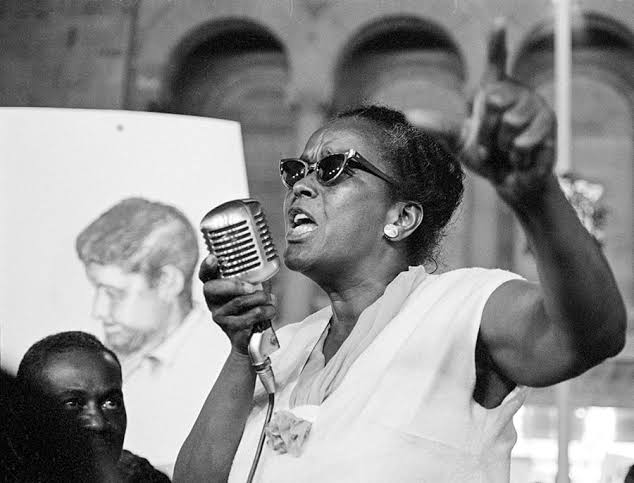
Martin Luther King Jr. was 26 when the Montgomery bus boycott made him a national figure. Ella Baker was 52. She had already spent years traveling through the South for the NAACP, recruiting members and helping neglected local branches function.
The travel gave her a different view of leadership than the one King came to represent. National figures arrived, drew a crowd, and moved on. The people who lived in these towns stayed behind with the reprisals, the unpaid bills, and the meetings that still had to happen once the reporters left. Baker wanted those residents to know enough, and trust themselves enough, to keep organizing without waiting for another visit from headquarters or from anyone famous.
She was not hostile to prominent leaders. A persuasive speaker could draw a crowd and force an issue into the national press in a way that quiet fieldwork rarely could on its own. What concerned her was dependence. If one person held the relationships, the information, and the authority to make a call, what happened to the work once that person was gone.
Baker’s low public profile was only partly a matter of preference. The NAACP and, later, the Southern Christian Leadership Conference operated in a culture where women carried much of the organizational load while male ministers were treated as the natural leaders. That closed doors to her regardless of what she wanted. Within those limits, though, she made a deliberate choice about where to put her influence. She built other people’s capacity rather than her own visibility.
What the NAACP Taught Her About Power
Baker’s political education began during the Depression with the Young Negroes’ Cooperative League, which encouraged Black families to pool their buying power. Much of the work was unglamorous — freight costs, wholesale prices, group purchasing agreements — but it showed her how people with little leverage individually could gain real leverage by acting together.
She joined the NAACP as a field secretary in 1940. The job meant long stretches on the road: recruiting members, raising money, helping local branches settle their internal disputes. Three years later she became director of branches, at the time the highest staff position held by a woman in the organization.
Headquarters in New York had lawyers, funds, and press access. It could not tell Baker whom a particular town trusted, which grievance was serious enough to bring people into a room, or who would still show up to a meeting once a campaign had disappeared from the newspapers. Those questions got answered in kitchens, in church basements, in branch meetings nobody wrote about. Baker went and found the answers there, often staying in the homes of the people she was organizing and listening for some time before she offered advice.
As the SNCC Digital Gateway notes, organizers arriving in the South during the 1960s could draw on contacts Baker had cultivated during her NAACP years. In many towns, she had already done the work of earning people’s trust.
I began to feel that my greatest sense of success would be to raise the level of masses of people, rather than the individual being accepted by the Establishment.
– Ella Baker
She was describing her own measure of progress. Personal advancement counted for less than leaving other people better able to act on their own.
The Argument Beneath Her Conflict With the SCLC
Baker helped establish the Southern Christian Leadership Conference in 1957. She set up its Atlanta office, coordinated fieldwork, and ran the Crusade for Citizenship voter-registration campaign. After executive director John Tilley resigned in 1959, she kept the organization running until a permanent successor was appointed the following year.
She remained, even so, an awkward fit. The SCLC drew its authority from prominent Black ministers and placed King at the center. Baker was neither a minister nor a man. Andrew Young later observed that the Baptist church had no real tradition of women in independent leadership roles. Her competence did not settle the question of whether the men around her would accept her authority.
Strategy caused further friction. King’s moral standing and command of the national press could turn a local injustice into a crisis the whole country had to notice, and that mattered. But Baker had also seen campaigns generate national attention without leaving residents any better equipped to organize, negotiate, or press for follow-through once the attention moved on.
In a 1968 interview preserved by the Civil Rights Documentation Project, Baker contrasted a “leader-centered movement” with “group-centered leadership.” Her alternative was not a leaderless movement. She wanted leadership spread across the group, with local people developing the judgment to participate in decisions that affected them directly.
The first consideration is to try to develop leadership out of the group and to spread the leadership roles.
-Ella Baker
This also shaped how she talked about King specifically. She accepted that his symbolic role had real value, but resisted the idea that any single person could meet all of a movement’s leadership needs. In her account, the people and conditions surrounding Montgomery had produced King’s prominence — not the other way around.
The movement made Martin rather than Martin making the movement. This is not a discredit to him. This is, to me, as it should be.
-Ella Baker
A version of this same failure shows up decades later in ordinary organizations that have nothing to do with civil rights. A founder leaves, and it turns out the client relationships lived in one person’s head rather than in any file the company kept. Baker was describing the same structural weakness in 1959, in Atlanta, with voter registration instead of client accounts.
Why She Refused to Absorb the Student Movement
On February 1, 1960, four Black students took seats at a segregated Woolworth’s lunch counter in Greensboro, North Carolina, and refused to leave. Sit-ins spread quickly to other Southern cities, presenting established civil rights organizations with a wave of energetic young recruits.
Baker worried that absorbing the students too quickly would cost them something. Before joining an older organization, they needed room to decide for themselves how they wanted to work.
She persuaded the SCLC to fund a conference at Shaw University, her alma mater, in Raleigh. More than 200 delegates arrived in April 1960. The Student Nonviolent Coordinating Committee came out of that meeting.
Folding the students into the SCLC’s youth division would have solved several immediate problems — a recognized name, office support, an existing fundraising operation. Control, though, would have rested with an older generation of ministers. Baker urged the students toward independence instead, and stepped back far enough to let them argue, make mistakes, and choose their own officers.
SNCC organizers went into some of the most dangerous counties in the Deep South to register voters and work with residents the larger national organizations rarely reached. Diane Nash, John Lewis, Bob Moses, Julian Bond, and Marion Barry all developed within SNCC. The Martin Luther King Jr. Research and Education Institute credits Baker with bringing the students together and encouraging this group-centered approach.
She never took a formal office in the organization she had helped create. She stayed close as an adviser and mentor, while the consequences of SNCC’s decisions belonged to its members.
The Price of Working Outside the Spotlight
Baker did not have an equal choice between fame and obscurity. The civil rights establishment rewarded male authority, ministerial standing, and public performance, and a Black woman without a pulpit had no comparable route to national recognition — that limitation was structural, not a preference she was free to opt out of.
She also made herself difficult to contain within it. Baker questioned salary differences, resisted deference, and challenged concentrated authority wherever she found it. These habits served the work well and complicated her advancement inside institutions that expected women to support male leaders rather than direct them.
Fame itself held little appeal for her. She looked instead for a branch that had grown stronger, an organizer who no longer needed close supervision, a community capable of settling its own disagreements. Success, by her own measure, tended to make her less necessary to a given place — which is not the kind of achievement history is especially good at remembering.
SNCC went on to play central roles in the Freedom Rides, Freedom Summer, and the Mississippi Freedom Democratic Party’s challenge to the state’s all-white delegation at the 1964 Democratic National Convention. It also moved in directions Baker did not always support. She had defended its right to do exactly that.
Baker died in New York on December 13, 1986, her 83rd birthday. Her name never acquired King’s familiarity. Her influence is easier to find in the people who learned to organize without waiting for her, and in the local networks that kept working once national attention had moved on to something else.
Frequently Asked Questions
Who was Ella Baker, really?
Ella Baker was one of the civil rights movement’s most important organizers, although she rarely occupied the kind of public role that made someone famous. She worked with the NAACP, helped build the SCLC, and played a major role in the creation of SNCC. Much of her work centered on strengthening local organizations and helping ordinary people become organizers themselves.
Was Baker actually opposed to Martin Luther King Jr.?
Not exactly. Baker understood why King mattered. His ability to draw national attention could give a local struggle a reach it might otherwise never have had. Her objection was to building a movement that depended too heavily on one person. She wanted leadership distributed among the people doing the work.
Why did the 1960 meeting at Shaw University matter so much?
The meeting gave the student activists who had launched the sit-ins a chance to decide what came next for themselves. Baker could have pushed them toward an existing organization, but instead encouraged them to build something independent. That meeting became the foundation for SNCC.
What about the famous line, “Strong people don’t need strong leaders”?
The phrase is commonly attributed to Baker, but the wording is difficult to pin down as a direct quotation from her. Her 1968 oral-history interview gives a clearer sense of what she meant: she wanted to develop people who could make decisions and act without depending on a “saviour-type” leader.
Why don’t more people know Baker’s name?
Part of the answer is the structure of the movement itself. Public leadership was overwhelmingly associated with male ministers and charismatic speakers, while women often did the organizational work behind them. Baker also had little interest in turning herself into the story. Her approach was almost the opposite: if the people around her could eventually organize without her, that was evidence that the work had succeeded.
Does her idea of leadership still matter?
It does, particularly anywhere an organization becomes too dependent on one person. A founder who keeps every relationship and decision in their own head may look indispensable until they leave. Baker’s model suggests a different test of leadership: whether the people you develop can keep making good decisions when you are no longer in the room.