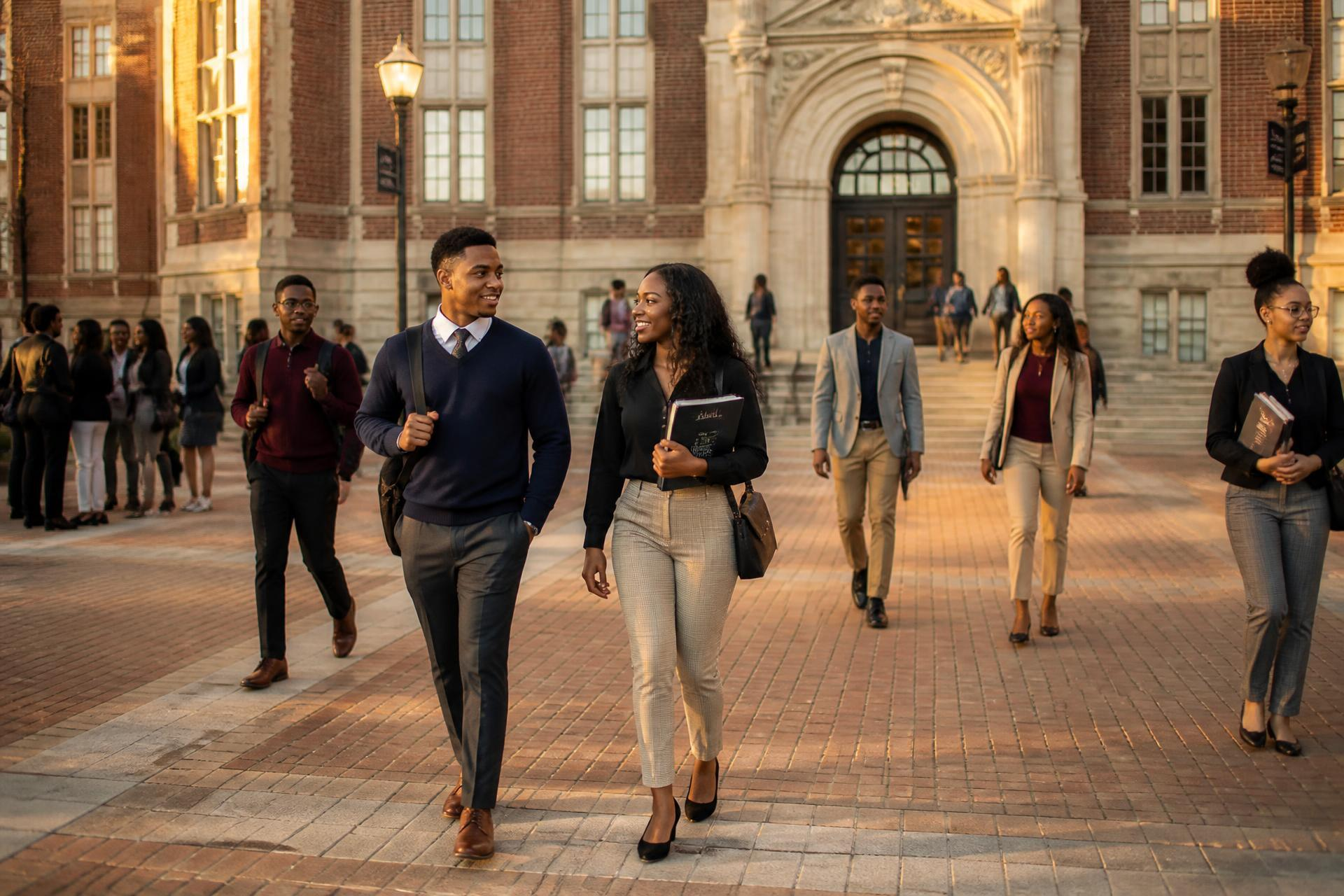
The first Historically Black Colleges and Universities did not set out to offer a different version of American higher education. They opened because most colleges would not admit Black students.
Cheyney University of Pennsylvania dates its beginning to 1837, when Quaker philanthropist Richard Humphreys left $10,000 to establish a school for people of African descent. Lincoln University opened in 1854 as the Ashmun Institute and became the first HBCU authorised to award college degrees.
These were unusual institutions before the Civil War. After emancipation, the need for them was everywhere.
Millions of formerly enslaved people were free in law, but many entered freedom without access to schools. Existing colleges generally remained closed to them. Black churches, religious organisations, northern missionary groups and the Freedmen’s Bureau helped establish schools across the South. Some began in church basements and other borrowed spaces. A number later grew into the universities known today.
The courses were shaped by the work waiting outside the classroom. Communities needed teachers for new schools and ministers who often doubled as civic leaders. They needed farmers, tradespeople and professionals. HBCUs trained them.
Nearly two centuries later, those universities educate nurses, engineers, scientists, executives and entrepreneurs. The work changed as Black America changed.
Federal Support Came With Unequal Treatment
The Morrill Act of 1862 provided federal land for states to finance public colleges, particularly in agriculture and the mechanical arts. In much of the segregated South, Black students could not attend the institutions benefiting from it.
Congress returned to the problem in 1890. The Second Morrill Act required states operating segregated college systems to provide land-grant education for Black students. That law helped produce the network now known as the 1890 land-grant universities. There are 19 of them.
The arrangement expanded access, though it preserved separate systems and did not fund them equally.
HBCU became a formal federal category through the Higher Education Act of 1965. The law generally defines an HBCU as an accredited institution established before 1964 whose principal mission was, and remains, the education of Black Americans.
By then, legal segregation was coming apart. Black students could apply to a much wider range of colleges, and HBCUs entered competition with universities that often had larger endowments, stronger facilities and generations of accumulated wealth.
Their share of Black college enrolment declined. In 1976, 18 percent of Black college students attended an HBCU. By 2022, the figure was about 9 percent. The National Center for Education Statistics counted 99 HBCUs and approximately 289,000 students that year.
The student body changed too. Non-Black students made up 24 percent of HBCU enrolment in 2022, compared with 15 percent in 1976. HBCUs have always been defined by their origin and mission, not by a rule that every student must be Black.
The Bill for Decades of Underfunding
Many HBCUs are expected to compete nationally while carrying financial problems built over decades.
Congress created the HBCU Capital Financing Program in 1992 after recognising that small enrolments, limited endowments and other constraints made conventional borrowing difficult. The programme helps institutions finance construction, repairs and debt refinancing.
The repair needs are substantial. In a 2018 Government Accountability Office review, responding HBCUs reported that an average of 46 percent of their building space required repair or replacement. This reaches beyond appearances. An outdated laboratory restricts research. Poor student housing makes recruitment harder. A leaking roof consumes money that could have supported teaching.
State funding produced an even larger gap for public land-grant HBCUs. In 2023, the US Departments of Education and Agriculture compared funding for 1890 institutions with support received by predominantly white 1862 land-grant universities in the same states.
The departments examined the years from 1987 through 2020. Across 16 states, they estimated that the Black land-grant institutions had been underfunded by approximately $12.6 billion. Tennessee State University’s calculated shortfall alone was about $2.15 billion.
Had that money arrived when it was due, some would have gone into scholarships, faculty salaries, buildings and research. Some might have been invested. The loss cannot be measured only in yesterday’s dollars.
HBCUs, working with meager resources, almost single-handedly created an African-American professional class in the face of decades of Jim Crow discrimination. — Arne Duncan
What HBCUs Produce
Enrolment figures tell only part of the story.
HBCUs awarded 14.9 percent of the science and engineering bachelor’s degrees earned by Black students in 2018. Among Black recipients of science and engineering doctorates between 2015 and 2019, 23.2 percent had first earned a bachelor’s degree at an HBCU. The share exceeded 31 percent in computer and information sciences.
A student may leave an HBCU for doctoral study elsewhere, but the undergraduate institution remains part of how that scientist entered the field.
During the 2021–22 academic year, HBCUs conferred about 48,800 degrees. NCES counted approximately 32,800 bachelor’s degrees, 7,600 master’s degrees and 3,000 doctorates. Combined institutional revenue stood at $10.7 billion.
Results at individual campuses can be striking. Bowie State University reported that its December 2025 nursing cohort achieved a 100 percent first-time pass rate on the NCLEX-RN licensing examination.
The achievement belonged to one cohort at one university. Still, it is a useful answer to anyone who treats HBCUs mainly as historical symbols. Their graduates are filling present-day shortages in healthcare and other fields.
Beyond Recruiting Graduates
Corporate interest in HBCUs has often appeared near graduation, when employers arrive looking for trained workers. Recent partnerships have moved closer to the classroom and laboratory.
Google announced a $50 million grant to 10 HBCUs in 2021. The money supported scholarships, technology, curriculum and career preparation. Apple committed $25 million to the Propel Center, which works with HBCUs in fields such as artificial intelligence, agricultural technology, app development, design and entrepreneurship.
Federal policy is moving in that direction as well. An April 2025 executive order called for stronger private-sector partnerships and greater HBCU participation in research connected to technology, healthcare, manufacturing and finance. In August 2026, the US Department of Agriculture opened $67.2 million in scholarship funding for the 19 universities in the 1890 land-grant system.
Announcements are easy. Building research capacity is slower.
Universities need grant administrators who can manage complex federal applications, modern laboratories and rules that protect intellectual property created on campus. Faculty need time and support to conduct research. Students need routes from an idea to a working company. None of that can be assembled during an annual recruitment visit.
Nor should every partnership be accepted simply because money is attached. An agreement can use an HBCU’s name, students and credibility while leaving the institution with little ownership. University leaders have to ask what remains on campus after the programme ends.
The funding mix matters here. The analysis of funding used by Black entrepreneurs found that durable businesses rarely depend on a single source. HBCUs also draw from tuition, state appropriations, federal grants, philanthropy, alumni giving, debt and commercial partnerships. A weakness in one area places more pressure on the rest.
We hold the possible future in our hand but not by wish and will, only by thought, plan, knowledge, and organization. — W.E.B. Du Bois, 1933
The Work Ahead
There is no shortage of ceremonial praise for HBCUs. Money is harder to secure.
The coming years will test whether new investment reaches ordinary campus needs as well as fashionable technology programmes. A university cannot build a serious research portfolio while basic facilities deteriorate. It cannot protect inventions without lawyers and administrators who understand commercialisation. It cannot expand opportunity if students leave with unmanageable debt.
Companies can help before recruitment season by funding equipment, faculty research and courses connected to real employment. Alumni can strengthen endowments and support student ventures. Governments can close funding gaps instead of issuing another letter acknowledging them.
HBCUs were built because Black Americans were refused entry elsewhere. Survival became their first achievement. Their future should include a larger claim on the research, companies and wealth their campuses help create.
Frequently Asked Questions
Which School Was the First HBCU?
Cheyney University of Pennsylvania, founded in 1837 as the African Institute, is generally recognised as the first HBCU. Lincoln University, founded in 1854, was the first to award college degrees.
Are HBCUs Open Only to Black Students?
No. They admit students of every race. Non-Black students represented 24 percent of HBCU enrolment in 2022.
How Many HBCUs Exist?
NCES counted 99 HBCUs in 2022. The number can shift when an institution’s accreditation or operating status changes.
Why Do HBCUs Matter in STEM?
They prepare a notable share of Black students who later earn advanced science and engineering degrees. Of the Black recipients of science and engineering doctorates from 2015 to 2019, 23.2 percent had completed their bachelor’s degree at an HBCU.