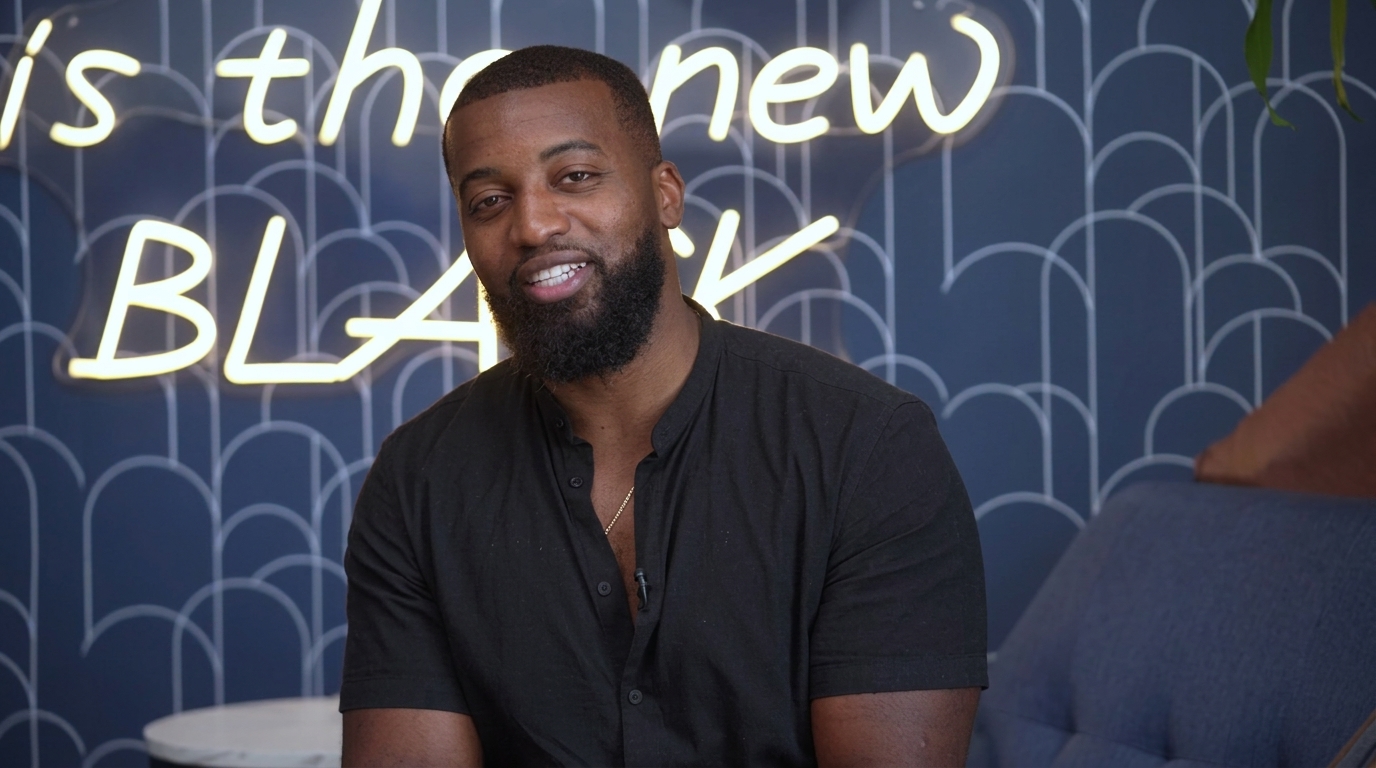
Cyrus Harbin used to read poetry to strangers for a living. Before that clicked into a career, he drove for Lyft — no computer science degree, no bootcamp certificate, nothing that looks like a normal entry point into an industry that’s spent two decades guarding its front door with exactly those credentials.
He didn’t break the door down. He found the one door tech companies leave open, out of necessity: the Sales Engineer seat. It’s a hybrid role — half technical, half business — built for people who can take a product’s technical guts and turn them into a case a non-technical buyer will actually sign off on. The scarce skill isn’t syntax. It’s making complexity legible. Turns out that’s closer to a poet’s skill than an engineer’s.
Enterprise software has quietly built a whole hiring category around this gap. A product can be technically brilliant and still lose the deal, because the person holding the budget doesn’t think in API calls and latency benchmarks. They think in risk, cost, and outcomes. Sales engineers sit in that gap and translate both ways — which is also why it’s a role most people outside tech have never heard of. That obscurity is exactly what left it open to someone with Harbin’s résumé.
By his own account, his first year in that seat brought in somewhere between $500,000 and $580,000 in gross comp. Spoken word and rideshare driving to six-figure enterprise sales, in a single year.
Built for Leverage, Not Lines of Code
What makes this story worth paying attention to isn’t the number. It’s that Harbin didn’t treat the win as a fluke and move on — he pulled the mechanism apart to see what made it work.
On the podcast We The Sales Engineers, talking about his first year, Harbin said the hardest adjustment was psychological, not technical. He had to stop “being an island to myself” — stop assuming he had to grind through every problem solo when support was sitting right there. The best SEs he watched treated constant questions and constant collaboration as the job itself, not a workaround for not knowing enough.
That instinct — stop hoarding the technical translation — is the same one that shows up, scaled way up, in everything he built afterward. If the personal lesson was “don’t keep the technical translation to yourself,” the business lesson was “don’t keep the career translation to yourself either.”

From One Break to a Pipeline
That’s the logic behind Tech Is The New Black, the media and education business Harbin built to make his own pivot repeatable for other people. It runs on two engines.
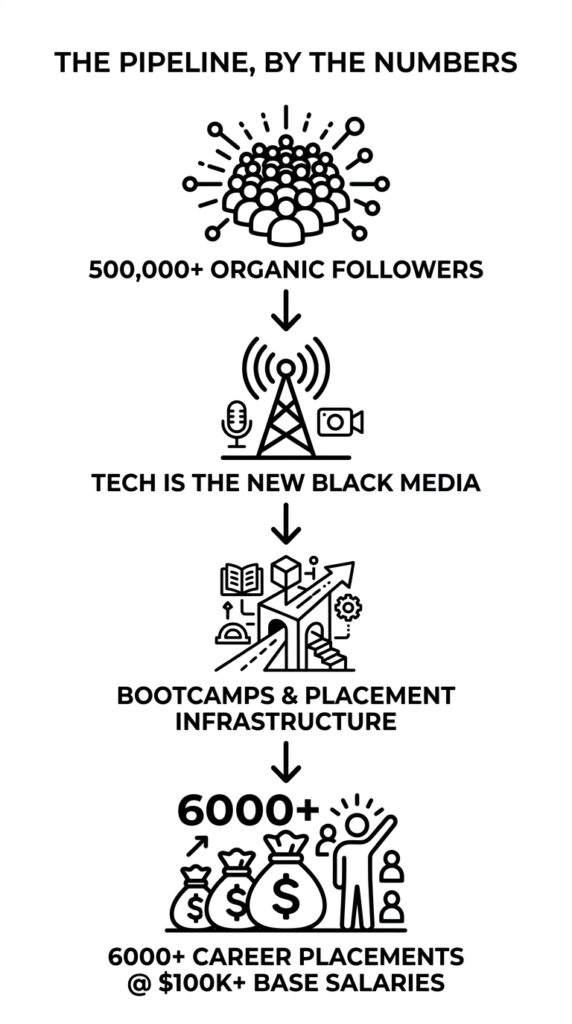
The first is distribution — a podcast and social presence that’s grown to roughly 500,000 followers, built without paid acquisition, mostly by interviewing sales engineers, recruiters, and career-changers about the exact kind of jump Harbin made himself.
The second is what sits behind that audience: a bootcamp and placement pipeline aimed squarely at non-technical candidates, moving them into sales engineering, QA, and SDR roles with six-figure ceilings. By Harbin’s count, more than 6,000 people have come through it and landed tech careers.
Same mechanism as his own career, just running at scale: find the role the industry is short-staffing, then build the on-ramp for the people the industry wasn’t looking at in the first place.
The Consulting Turn
Harbin’s most recent move takes the model from individual placement to company-level infrastructure. His consulting practice works with early-stage companies on operational automation — built on self-hosted, open-source LLM tooling rather than off-the-shelf platforms, which keeps client data in-house and keeps costs manageable for founders who aren’t operating on enterprise budgets.
By his account, that practice has helped scale more than twenty startups from mid-six-figure revenue into multi-million-dollar ARR. He’s also applied the same thesis to his own product: Octaply.AI, a SaaS platform he says hit a seven-figure valuation within five months of launch.
The interesting part isn’t any single number — it’s the direction of travel. Harbin’s business has moved from selling his own labor, to selling access to his method, to selling the automation infrastructure itself. Each step trades time-for-money for something that scales without him personally in the room. That’s the difference between having a good career and building a business on top of one.
What to Actually Steal From This
Strip out the specific dollar figures and the lesson still holds: stop trying to out-credential engineers for engineering seats. Enterprise tech has a whole tier of high-paying roles — sales engineering, solutions consulting, technical program management — where the scarce skill is translation, not production. None of them require four years of a CS degree. They require someone willing to learn the technical layer just deeply enough to make it make sense to whoever’s signing the check.
Harbin’s version came with a poetry background and a rideshare side hustle attached. The next person’s will look completely different. That’s the point of the on-ramp he’s spent years building — media reach first, placement infrastructure behind it — so the next version of his story doesn’t have to start from zero.
The Pipeline, By the Numbers
Roughly 500,000 people follow Tech Is The New Black across platforms — reach Harbin built on purpose, feeding directly into the bootcamps and placement work behind it. More than 6,000 people have come through that pipeline and landed six-figure tech careers, by his count.
His consulting practice runs alongside that. Harbin says he’s helped push more than twenty startups from mid-six-figure revenue into multi-million-dollar ARR, and he built Octaply.AI to test the same playbook on his own — a SaaS product he says hit a seven-figure valuation five months after launch.