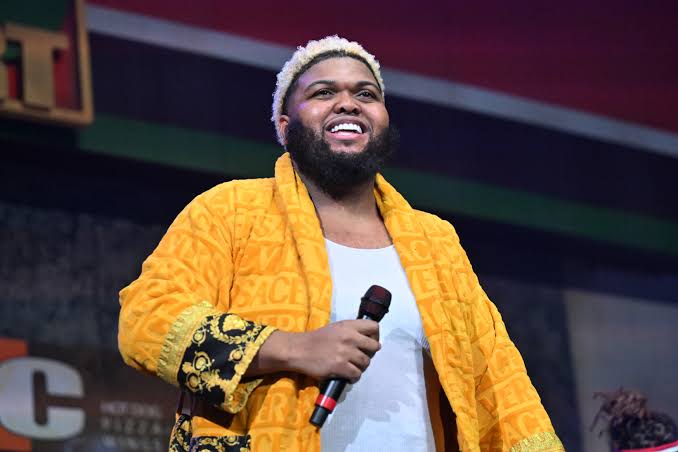
Druski could have kept pitching. That would have been the normal move. Netflix says no? Fine. Try again. Amazon passes? Rework the deck. Call another executive. Find an agent with better relationships. Keep knocking until somebody with a streaming budget finally says yes.
He did something more interesting. He started paying for the shows himself. And that decision tells you more about Drew “Druski” Desbordes as a businessman than almost anything else in his career.
For years, people understandably saw Druski as the funny guy on Instagram. The awkward skits. The fake record executive. The celebrity cameos. Coulda Been Records looking ridiculous on purpose.
But somewhere along the way, the joke became infrastructure. Druski stopped treating attention as the product and started treating it as fuel — something he could convert into shows, live experiences, characters, formats and, crucially, intellectual property he actually controlled. That distinction is the whole story. Because followers are useful. Very useful. But you don’t own Instagram. You don’t own YouTube. You definitely don’t own the algorithm deciding whether three million people see your next post or 300,000.
Forbes ranked Druski No. 7 on its 2026 Top Creators list and estimated his earnings at $20 million. In 2025, he ranked No. 9 with estimated earnings of $14 million. His audience grew too. Forbes put his following at 25 million in 2025. By 2026, that number had climbed to 38.5 million. His reported average engagement rate jumped from 5.87% to 13.77%.
But the more interesting number might be Forbes’ entrepreneurship score. Four out of four.Because Druski isn’t just getting better at monetising fame. He appears to be getting better at turning fame into assets.
He Used Sponsor Money Like Investment Capital
The easy version of the Druski story is that he created Coulda Been Records. That’s true. But it misses the smarter part. The real decision was what happened after traditional entertainment companies weren’t interested.
Druski told AfroTech that his team approached bigger platforms, including Netflix and Amazon, early on. The answer was basically no. More than once.
Now, rejection from Netflix isn’t unusual. Thousands of producers hear no. Most creators with a hit concept would probably keep shopping it around because the dream is obvious: somebody else finances production, gives you distribution and puts your face on a giant homepage.
Druski changed the equation. His team decided to finance the work themselves.
We can do this by ourselves, he told AfroTech in 2025.
That sounds motivational when you pull it out as a quote. In practice, it is a pretty uncomfortable financial decision. Self-financing means you spend before you know whether the audience will show up.
Cameras cost money. Sets cost money. Production crews cost money. Editors cost money. Marketing costs money. Talent costs money.
And there is no friendly Netflix executive guaranteeing recovery. So where did the money come from? Brands. Nike. Google. Raising Cane’s. PrizePicks. Later, partnerships involving companies such as T-Mobile and Dunkin’.
Instead of treating those endorsement cheques as the final reward for becoming famous, Druski started treating them like financing. That is a very different mindset. As he told Complex in January 2025,
Any money I make from endorsements… I always reinvest it back into everything I’m doing.
Look, this is where creator economics gets interesting. A sponsor is essentially paying Druski to access the attention he has already built. He then takes some of that cash and uses it to build more content, more formats, and more things he owns. So the sponsorship doesn’t just monetise the audience. It helps finance the next asset. The money goes around again.
The Real Advantage Is Capital Allocation
A lot of people make money. Far fewer know what to do with it. That sounds almost too simple, but it’s one of the clearest differences between earning well and actually building something. Druski has talked openly about taking money that could have gone into his pocket and putting it back into production.
Bloomberg gave a useful example during a 2025 interview. A hypothetical $1 million Nike cheque could become funding for an episode instead of personal consumption. Obviously, Druski isn’t living like a monk. That’s not the point. The point is where the incremental dollar goes.
Plenty of creators turn audience growth into lifestyle growth. Bigger deals arrive, expenses rise, the houses get bigger, the cars improve and suddenly the business needs constant sponsorship income just to maintain everything.
Druski seems to be trying to build the opposite. Use rented attention to create owned assets. He told Bloomberg in August 2025,
I wanted to build something bigger by myself first.
That’s the sentence. Because social-media popularity is rented land. You can build a massive following on somebody else’s platform, but the platform still controls distribution. Coulda Been Records, a show format, a character, a production company, a touring concept? Those can travel.
Druski’s 4Lifers production company gives him a vehicle for doing exactly that. Instead of waiting for a buyer to tell him which concepts deserve investment, he can make the thing, distribute it, watch the numbers, and then walk into future negotiations carrying evidence.
Very different conversation.
Rejection Changed the Order of Operations
Netflix and Amazon rejecting Druski probably mattered more than a quick yes would have. Not because rejection is magical. It isn’t. Sometimes no just means no.
But in this case, the refusal forced him to rethink the sequence. The traditional entertainment sequence looks something like this: Pitch the platform. Get financing. Make the show. Hope the audience comes.
Druski flipped it. Build the audience. Make the show. Prove demand. Then talk to platforms.
Audience first. Proof second. Partnership later. That last part matters because Druski hasn’t become some anti-Hollywood purist. He has said he is open to larger deals. He’s just less interested in approaching them empty-handed. And, I mean, why would he?
If you’ve already proved that people will watch, already developed the format, already demonstrated sponsor demand, and already shown that you can produce without them, then the streamer isn’t rescuing the project anymore. They’re joining something that works. That changes leverage.
Creative Control Is Also a Financial Asset
There’s another part of Druski’s strategy that can look like an artistic preference but is actually commercial. Creative control.
“We want to make sure that we have a say so… on any creative,” he told Bloomberg.
Makes sense. Druski’s audience isn’t responding to generic celebrity advertising. They’re responding to Druski being Druski. The weirdness is the product. The awkward pauses. The ridiculous scenarios. The way he inserts himself into music culture without behaving like a conventional music celebrity.
A brand can easily ruin that. Take the cheque, read the stiff marketing copy, smile at the camera, post it and move on. Great. Except every bad integration trains your audience to stop trusting you.
So when Druski insists on creative input, he isn’t just protecting his artistic ego. He’s protecting the thing the advertiser is paying for. Audience trust. That has economic value. He put it more broadly in a GQ interview years earlier:
“I live with no boundaries. I don’t like being boxed in.”
His Network Is Useful Because Different People Solve Different Problems
Then there is the network. Drake. Kevin Hart. Lil Yachty. Jack Harlow. Kai Cenat. Odell Beckham Jr. It would be easy to flatten all of this into “Druski knows famous people.”
Sure. But that’s not particularly useful analysis. Different relationships solve different business constraints.
Drake reportedly became a fan of Druski’s comedy and brought him into the “Laugh Now Cry Later” video. That was access to one of music’s biggest audiences.
Relationships with Lil Yachty and Jack Harlow pushed Druski deeper into music culture. Kevin Hart connects him to traditional comedy and entertainment. Kai Cenat connects him to the streaming generation. Odell Beckham Jr. helped differently. Forbes reported that Beckham connected Druski with financial advisers.
That’s not clout. That’s infrastructure.
And this is worth clarifying because people tend to exaggerate celebrity business networks. Druski’s network effect is more clearly documented in distribution, access, advice, and collaboration than in some giant venture portfolio. Those are not the same thing.
The Part Entrepreneurs Should Steal
You do not need 38.5 million followers. You don’t need a Nike deal either. The useful idea here is much smaller.
Create an audience-to-asset rule. Whenever your reputation produces unusually profitable income, don’t automatically consume all of it. Convert part of it. Maybe that’s 20%. Maybe 30%. Whatever. The exact percentage isn’t sacred. But imagine a consultant who lands a ₦10 million project and puts ₦3 million into building proprietary software.
Or a business owner who has an unusually strong quarter and uses part of the profit to build a customer database that isn’t dependent on Instagram.
Maybe you fund original research. Build a product. Acquire equipment. Develop your own distribution channel. Create a repeatable training programme. Register valuable IP. Improve technology.
The test is simple: does something remain after the original cheque is gone? That’s what makes Druski’s strategy interesting. Temporary money comes in. Something durable comes out.Anything that survives after the original cheque is gone. That’s what Druski’s strategy looks like from the outside. Temporary money comes in. Something durable comes out.
Then that durable thing makes the next negotiation easier.
FAQs
How does Druski make money?
Druski earns from brand partnerships, digital content, live entertainment and production-related businesses. Forbes estimated his gross creator earnings at $20 million for the period covered by its 2026 ranking. That’s estimated earnings, not net worth.
The interesting bit is what happens after the money arrives. Druski has repeatedly said he reinvests endorsement income into content and production.
What company does Druski own?
Druski operates 4Lifers, his production company. It sits behind much of his self-produced entertainment work.
Coulda Been Records is probably his most recognisable franchise. What started as a satirical internet concept has expanded into longer-form content, live entertainment and other extensions.
Why did Druski self-fund his shows?
Because the traditional route didn’t work. Druski said his team pitched major platforms, including Netflix and Amazon, and got rejected. Instead of waiting indefinitely for somebody else to finance the concept, his team decided to produce independently and use brand income to help fund the work.
That gave him ownership and proof. Both matter.
Is Druski a creator or a media entrepreneur?
Both. But “creator” increasingly feels incomplete. His audience is still the engine. Without the comedy and cultural relevance, none of this works.
But 4Lifers, Coulda Been Records, live shows, sponsorships and self-produced formats show a business being built around the audience. That’s closer to a media company.
What is the biggest business lesson from Druski?
Don’t confuse cash flow with ownership. A sponsorship cheque is nice. A viral post is nice. A huge month is nice. But eventually the cheque gets spent and the viral moment disappears.
The better question is what you still own afterwards. Druski’s answer appears to be increasingly clear.
The show. The format. The company. The IP. And, probably most importantly, the right to decide what happens next.