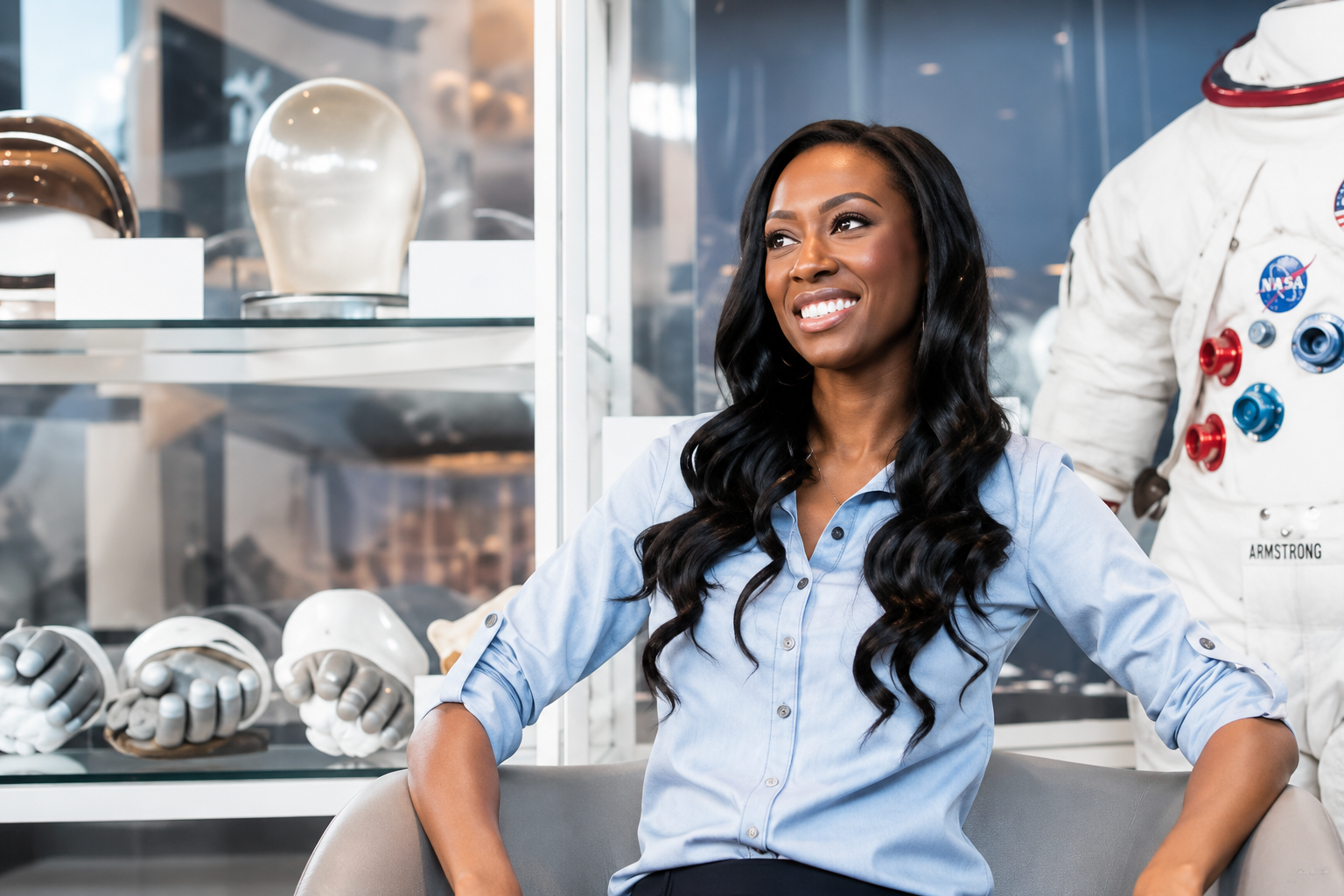
A guidance counsellor once told Aisha Bowe that college might not be for her. Years later, she would become a NASA rocket scientist and one of the few Black women to travel to space.. At that time, she was earning average grades and had little reason to believe she would one day work alongside some of the world’s top engineers. For many students, that kind of advice would have crushed their ambitious dreams before they even began.
Aisha Bowe refused to let that prediction shape her future. Determined to prove that she was capable of more than her academic record showed, she enrolled at community college. She rebuilt her confidence in maths and science, and slowly replaced doubt with evidence. That decision set her on a path that eventually led to NASA—and much further than anyone had predicted.
Career Turning Point: She Initially Rejected NASA
Bowe’s most significant near-failure occurred after NASA Ames offered her a 2009 internship involving small spacecraft. She turned it down.
Her decision was not based on the role, pay, or technical fit. She thought NASA would prefer students with perfect grades. Although she received what she called an opportunity of a lifetime, she turned it down because she felt she didn’t belong among the top candidates. People around her encouraged her to reconsider, and she ultimately spent six years at NASA.
The mistake was a failure in decision-making: she let insecurity guide her.
The correction was creating a hierarchy of evidence. After that close call, her decisions increasingly relied on proven results, expert opinions, and controlled experiments. She no longer needed internal confidence to take action.
That distinction is crucial. Waiting for confidence would have kept her out of NASA. Accepting external evidence allowed her competence to build confidence afterward.
The Strategy: Let Evidence Build Confidence
Invalidate the Old Model
When evidence contradicts how you see yourself, update your self-image—not the evidence. According to Bowe’s 2016 LinkedIn interview, she said,
“What if I just throw out everything I thought about myself to be true?”
After getting an A in pre-algebra, she initially thought the result was unimportant. She took the test again. One A led to several strong results, including As in Calculus I and II. Only then did she make a list of ambitious goals: attend the University of Michigan, become an engineer, work at NASA, and own a business.
This wasn’t positive thinking. It was evidence changing her decision-making. She used repeated performance to challenge her inherited view of her abilities.
Acquire Expertise Before Confidence
When a critical decision falls outside your skill set, seek specialized knowledge instead of improvising or delaying. According to her interview with WIPO Magazine, she mentioned, “If you don’t know something, calmly and confidently ask someone to educate you.”
Bowe acknowledged that intellectual property strategy initially intimidated her. Instead of trying to learn about trademark, copyright, and commercial-protection laws by herself, she hired a law firm to educate her company and protect its investments. STEMBoard and LINGO later used trademarks and copyright protection for their brands, educational content, and teaching materials.
Her principle is simple: borrow expertise before trying to master everything yourself.
Finance Access Through Value Exchange
When access is costly, find out what other stakeholders value and create a transaction around it. She told Washington following the NS-31 mission, “In lieu of payment, I accepted funding for my seat.”
Bowe did not share the cost of her Blue Origin seat. She explained that she funded it through paid speaking engagements and research partnerships. Some organizations covered the mission costs instead of paying her regular speaking fees, while research institutions supported experiments that could be conducted in microgravity.
She eventually flew on Blue Origin’s NS-31 mission on April 14, 2025, conducting three research experiments in plant biology and human physiology.
Rather than paying for access outright, Bowe turned her expertise into currency.
Strategic Relationships
Strategic Partners
University of Michigan professor Thomas Zurbuchen helped connect Bowe’s academic work to NASA. WiSC Enterprises and Morehouse College supported STEMBoard through the Department of Defense Mentor-Protégé Program. LINGO later secured a $2.25 million seed investment led by Pinnacle Private Ventures, with additional funding reported from 1863 Ventures, Sequoia Capital’s Scout program, and investor Joy Johnson.
Protégés
One of Bowe’s earliest mentees went on to become an aerospace engineer working on a Blue Origin rocket engine related to Bowe’s own mission—an example of how her influence now extends beyond her own career.
Strategic access
Bowe’s network provides her with four types of leverage: NASA-level technical credibility, knowledge of federal contracting, institutional distribution, and venture capital. LINGO’s programs have also been used by organizations such as General Dynamics Information Technology, Siemens Healthineers, Leidos, and Howard University.
Her network is not just prestigious. Each connection fills a capability gap, whether it’s expertise, certification, contracts, funding, research access, or customer distribution.
Strategic Lesson: Run a Seven-Day Evidence Test
Identify one opportunity you are avoiding because you think you are unqualified.
Write the belief as a testable statement: “I cannot do X because I lack Y.”
Then complete three actions:
1. List the observable evidence supporting and contradicting that belief.
2. Ask one credible expert to assess your readiness and identify the smallest proof task.
3. Complete that proof task within seven days, before waiting for confidence.
Bowe didn’t become a NASA engineer because she believed she could. She became one because she kept collecting evidence that she could—and allowed that evidence to reshape her decisions.