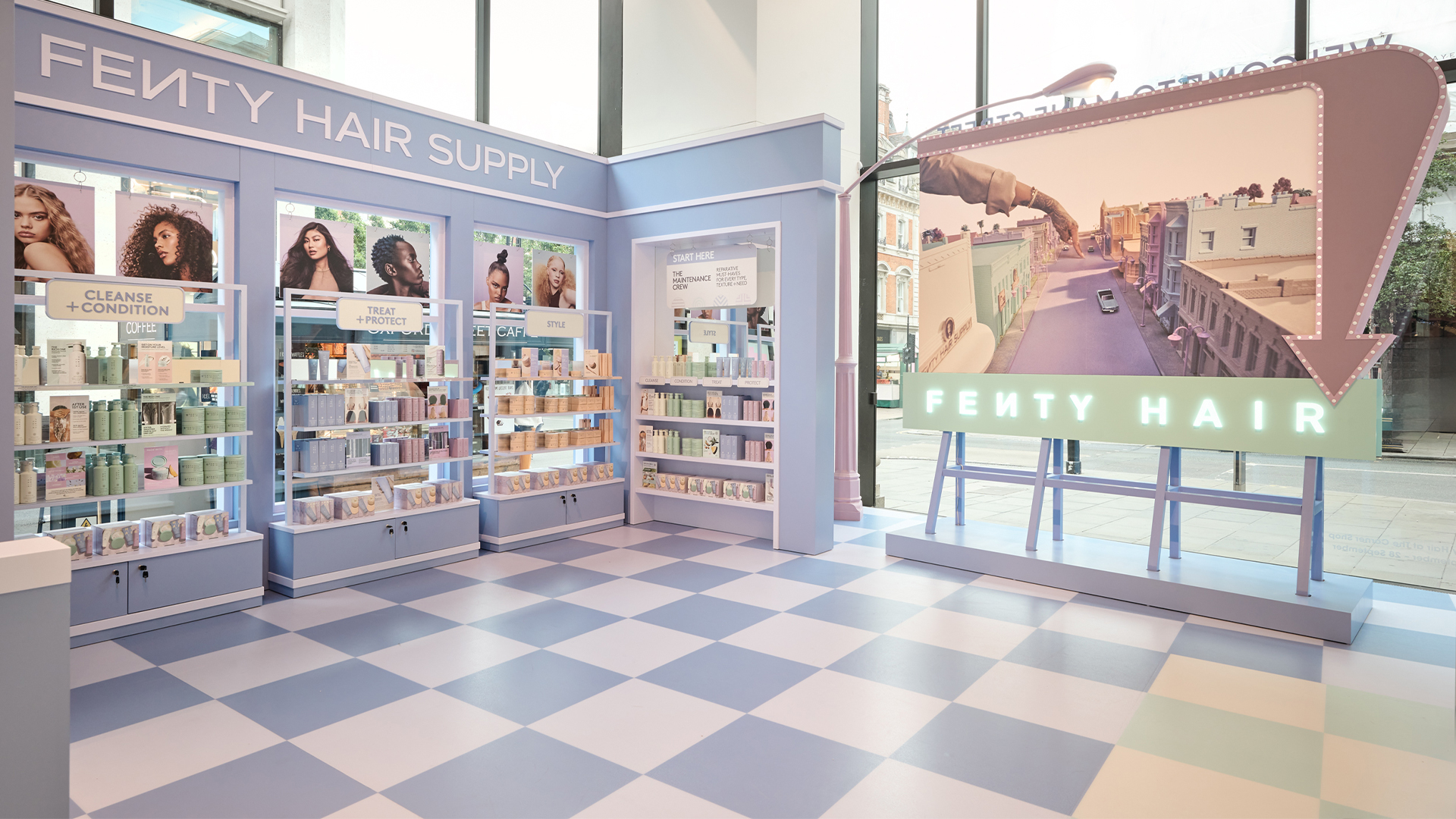
On September 3, 2024, shoppers entering Selfridges’ Corner Shop on London’s Oxford Street found a street made for hair care. Mane Street had a supply store, a salon, a flower market and a shop for Fenty Beauty’s Gloss Bomb. It was Fenty Hair’s first UK retail showcase, and it did a specific job: give customers a place to see the range, talk through their needs and try a style while the brand entered a new retail market.
The installation lasted until September 28. The retail presence extended further. At launch, TheIndustry.beauty reported Fenty Hair at four Selfridges locations and on the retailer’s website. Mane Street was the attention-grabbing London address; the stores and online shop gave customers other ways to find the range.
A Haircare Launch With a Salon in the Middle
Selfridges’ Corner Shop is designed for temporary retail concepts. For Mane Street, the department store gave Fenty Hair a flagship space and a ready-made setting for an event. The brand filled it with more than shelves: customers could move between a supply store carrying the haircare range, a salon for consultations and styling, a flower market inspired by the line’s scent, and a Gloss Bomb shop.
The salon was the part that brought the product promise closest to a customer’s own routine. The styling menu included a curl refresh, braids, twists and Bantu knots, alongside looks such as “Sleek ‘N Snatched” and “Vibey + Voluminous.” Customers could also book a one-to-one consultation or a barber service. A shopper didn’t have to arrive knowing which bottle to buy. They could start with the style they wanted and get help choosing products from there.
That service had a price. TheIndustry.beauty reported appointments at £35, redeemable against Fenty products. Customers could reserve a slot through Selfridges, with a limited number available to walk-ins. This detail connected the salon to the sales floor: an appointment could end with product in hand, and a customer who came to shop could discover a service worth booking. Rihanna mentioned;
I wanted a clean, vegan brand in environmentally friendly packaging with healthy hair and great styling results at the forefront.
— Robyn Rihanna Fenty
The quote describes what Rihanna wanted the line to deliver. Mane Street gave shoppers a way to encounter that ambition as a retail experience. They could ask for advice, watch a stylist work and browse products in the same visit. For hair care, where a product may need to fit a person’s texture, style and routine, that hands-on contact can matter more than another campaign image.
The Retail Deal Went Beyond the Pop-Up
The Corner Shop takeover was temporary. The UK retail arrangement was broader. At launch, the full Fenty Hair range was reported at four Selfridges locations: London Oxford Street, Birmingham Bullring, Manchester Trafford Centre and Manchester Exchange, alongside Selfridges.com. A separate launch report named locations in London, Birmingham and Manchester.
That network changed the meaning of the London event. Mane Street concentrated attention in one place, but a customer in another city could shop the same range at a Selfridges store. Online access extended the reach beyond the store floor. The activation gave the launch a vivid physical expression; the retailer’s other channels gave customers somewhere to go after the installation closed.
Selfridges brought the retail infrastructure: store space, an online shop, salon bookings and locations outside London. Fenty Hair brought the product line and the concept for the experience. The partnership put the brand inside an established department store, where shoppers already browse beauty and book services. It also gave Selfridges an event that made one section of the flagship feel different for a few weeks.
The Corner Shop format helped make that arrangement possible. Selfridges describes it as a permanent pop-up space for “creativity and collaboration,” with rotating retail concepts. Fenty Hair could take over a prominent part of the flagship without opening a permanent standalone store. For a launch, that is a practical way to put a new range in front of shoppers while keeping the experience tied to the retailer’s existing stores and online channel.
Making an Inclusive Claim Tangible
Fenty Hair’s positioning centers on hair health, self-expression and products for different hair types and textures. The brand says its formulas were tested across hair types, and its materials call out customers with curls, protective styles, straight hair and waves. The product line spans cleansers, conditioners, treatments and stylers. Rihanna mentions;
“Creating products that were easy to use, no matter your hair type or texture, and that included repair in every step and could keep up with me, was crucial.”
— Robyn Rihanna Fenty
A statement about different textures can sound broad until the customer has to choose something for her own hair. At Selfridges, the salon menu made that choice more specific. A customer could request a curl refresh, ask about a protective style, or book a consultation before deciding what to take home. The setting gave the brand’s language about inclusion a practical counterpart: different services and a chance to discuss the products face to face.
That matters to Black shoppers, whose hair routines can include a range of textures, protective styles and styling choices. A brand does not prove its relevance simply by naming those customers in its marketing. The product has to be available, and the store experience has to help people find what they need. Mane Street put a range of styles on its menu and a stylist within reach of shoppers.
What the Format Asked of the Brand
Mane Street depended on a few parts working together. The product range had to be on display. Staff needed to explain it. The salon had to translate styling requests into recommendations. And shoppers needed a way to buy the products after seeing or trying them. The Selfridges setup brought those pieces into one retail environment, then connected that environment to store and online availability.
The useful detail is the connection between an experience and a route to purchase. A temporary event can attract attention, but an event alone leaves a customer with nowhere to go next. Here, the Selfridges listing extended past the London pop-up. The retail relationship gave the activation a practical endpoint: customers could shop the line through stores and online.
Mane Street was the visible part of Fenty Hair’s UK entry. The less theatrical part was just as important: Selfridges had the product in its retail network. The installation let the brand introduce itself in person, with stylists, consultations and product discovery. Store and online availability carried that introduction beyond the weeks the street existed.
FAQs
What was Fenty Hair’s Mane Street pop-up?
Mane Street was a Fenty Hair installation at Selfridges London’s Corner Shop from September 3 to 28, 2024. It included a supply store, salon services, a flower market and a Gloss Bomb shop.
Where was Fenty Hair available in the UK at launch?
TheIndustry.beauty reported that the range was available at four Selfridges locations: London Oxford Street, Birmingham Bullring, Manchester Trafford Centre and Manchester Exchange. It was also available through Selfridges.com.
What could customers do at the Mane Street salon?
They could book a consultation or styling service, with options including curl refreshes, braids, twists and Bantu knots. TheIndustry.beauty reported that appointments cost £35, redeemable against Fenty products.
How did the pop-up reflect Fenty Hair’s inclusive positioning?
Its styling menu included services for different textures and styles, and consultations gave shoppers a chance to discuss their own hair needs. The experience paired the brand’s broad product message with face-to-face product discovery.
Why was Selfridges a useful UK retail partner?
Selfridges offered the London flagship space for Mane Street, plus stores in other UK cities and an online shop. Customers could experience the brand at the pop-up and find the range through the retailer’s other channels afterward.