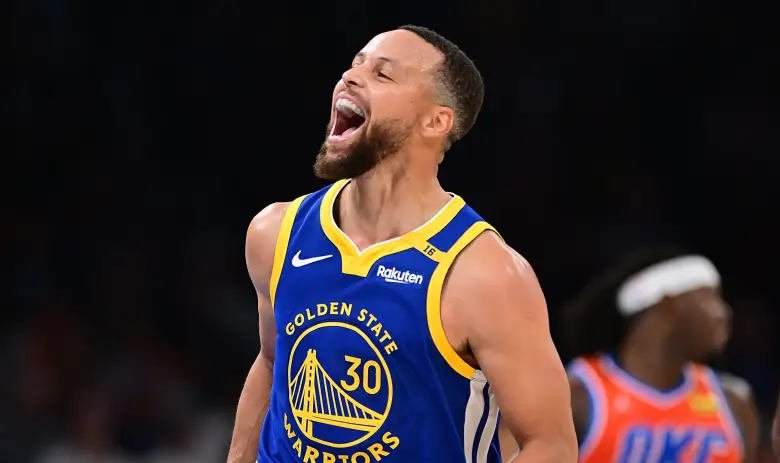
For several years, an unwritten rule existed in the basketball sport. The Hall of Fame was meant for retired guys. Even the absolute biggest stars of the game have to wait till retirement to get embodied. This was the norm until Steph Curry showed up. In the year 2026, the Naismith Memorial Basketball opened a permanent exhibit just for him while he was still playing. He was the first active player to ever get the honor and this wasn’t just a glorified trophy case holding his four championships and his 4000 plus career threes.
The real focus here is how he completely wrapped the geometry of basketball. He made a whole new generation have a total rethink on where and how the game is played. By securing a historic exhibit. before his career even ended, Curry did something totally unprecedented to build a legacy that goes beyond statistics.
Why Stephen Curry?
While putting up historic numbers, he already changed the sport’s foundation. Four rings, two MVPs and an all-time three-point king made him the first guy to hit 4,000 of them. However, his off-court hustle was what the Hall wanted to highlight. By diving deep into his business efforts, his charity work, and his large cultural footprint through Thirty Ink.
Before he could break the game, there was a need to fix his body first. Way before his dynasty started, his biggest gamble happened. In 2012, after two ankle surgeries and missing 40 games, Curry signed a risky $44M extension. Instead of just rehabbing the joint, he rebuilt his entire biomechanical system, shifting force absorption to his hips and glutes. The result? A 400-pound deadlift, 80 games played, and the first unanimous MVP in history.
The real magic came next. Rather than merely doing non-stop exercises to make his ankles stronger, he took a different approach. He teamed up with performance director Keke Lyles to stop relying on the joint so much and this shifted his focus entirely. Overtime, he started building up his hips, glutes, and core. The idea? Let his biggest, strongest muscles absorb all the brutal force from his crazy direction changes. He even got his trap-bar deadlift up to around 400 pounds.
The results were incredible; eighty games in the 2014-2015 season, His first MVP, and his first championship. The very next year, he shattered the long-standing three-point record with 402 makes, dragged the Warriors to 73 wins, and became the first unanimous MVP in NBA history. You can’t have a three-point revolution without a shooting genius, but you also need that genius to actually stay on the court long enough to prove it works.
Curry Operates on Three Basic Decision Rules.
Expand only when the skill is totally repeatable.
You can never mistake raw ambition for actual readiness, which means you don’t just wake up one random Tuesday and decide to start launching basketballs from the parking lot without putting in the slow build. His crazy deep shooting range didn’t happen on a whim. It wasn’t improvisation. It was an inventory. Tested inventory.
Diagnose the Issue
When performance tanks, don’t just blindly grind harder. Find the broken piece producing the error. If his shots drift right, he knows his follow-through is fanning out. Look at his ankle reconstruction. The chronic issue was the joint itself, but the actual fix required targeting his hips, glutes, balance, and total movement mechanics.
Judge the Choice, not the Scoreboard.
A missed shot doesn’t mean the underlying call was wrong. Take Game 3 against Houston in the 2018 Western Conference Finals, where Curry started one-for-seven from deep and looked completely out of sync before finishing with 35 points, including a massive 26 in the second half alone, as Golden State ultimately blew them out by 41. The shots were right. He knew he had to keep hunting for openings. He didn’t bail on the process.
People Tend to Forget His Major Challenge; The ankles.
Back in the 2011-12 season, he missed 40 out of 66 games, and his right ankle had already been cut open twice before Golden State handed him a $44 million contract extension. The risk was huge. Former GM Bob Myers even admitted they were taking a deliberate gamble on a guy who might never actually reach his potential.
So what fixed it?
Not a hype speech. Process. Curry completely overhauled how his body generated and absorbed physical force. He didn’t just grit his teeth and try to baby a weak joint. He literally redesigned the entire biomechanical system around it.
Then there is the empire. The network behind the number 30.
Golden State gave him the initial institutional safety net, supplying the coaching structure and performance infrastructure needed to survive those early injury risks. Today, Thirty Ink handles the rest, seamlessly connecting his brand deals, media projects, investments, and philanthropy.
He Doesn’t Do it Alone.
Curry co-founded Unanimous Media with Erick Peyton and serves as a special adviser to Penny Jar Capital, a fund backing early-stage startups like RePurpose Global, Local Kitchens, and Syndio. It is all about strategic leverage, converting raw athletic influence into media reach, founder deal flow, consumer brands, and institutional partnerships. Just look at the Hall of Fame exhibit. They actually partnered with Thirty Ink to build his “Beyond the Arc” installation, proving that Curry’s infrastructure doesn’t just slap his face on billboards anymore. They manage the entire story.
Turn your failures into a diagnostic dashboard.
Do exactly what Curry does when he misses.
For your next 20 important projects, stop just logging a simple pass or fail, and instead take the time to write down exactly what broke, why it broke, and which specific variable you need to tweak for round two.
The rule is dead simple.
Mindless repetition just gives you experience. Diagnosed repetition is what actually creates improvement.