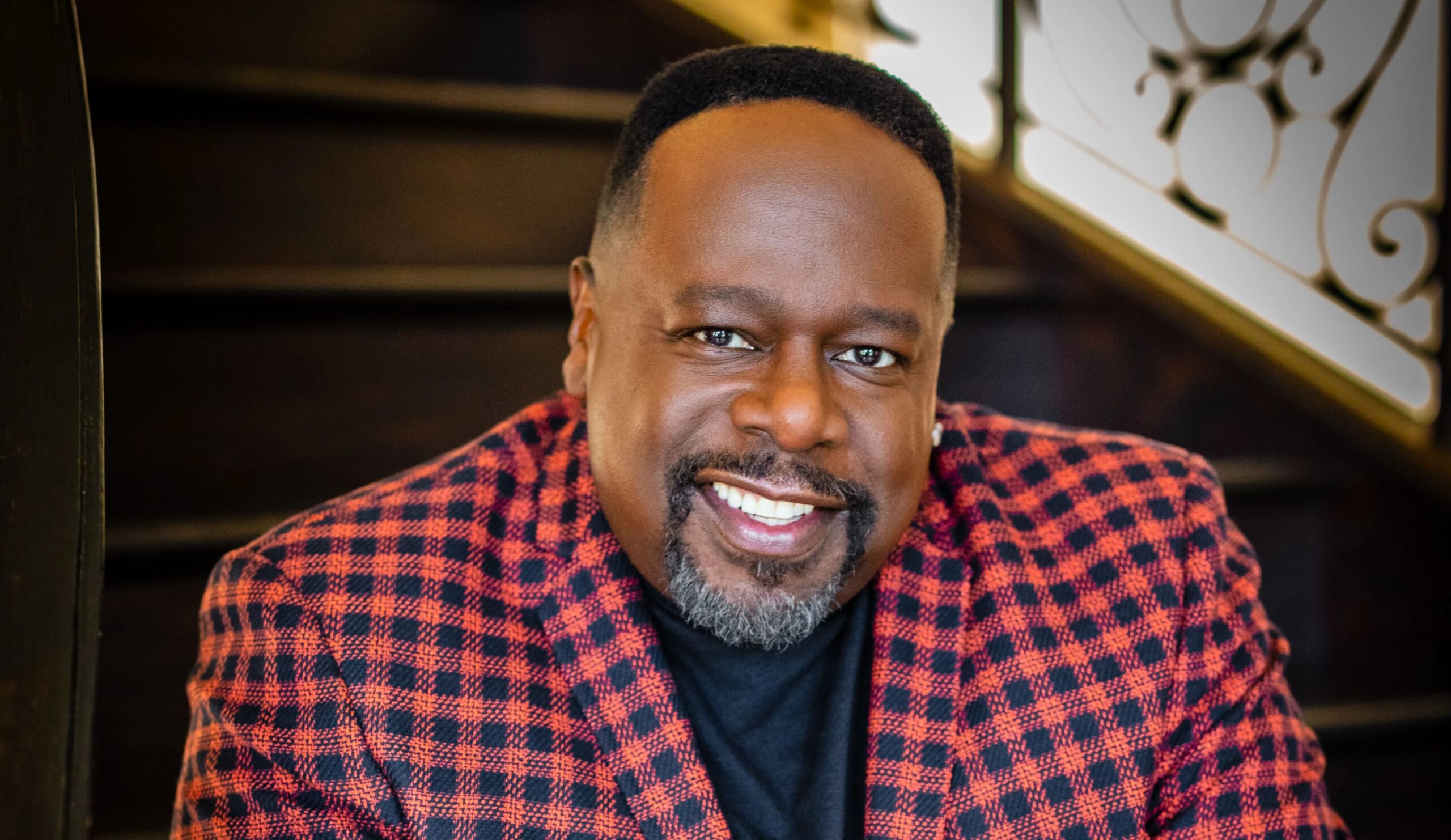
Long before he was trading one-liners with sold-out arenas, Cedric Antonio Kyles was processing paperwork as a corporate claims adjuster. It’s a detail that tends to get buried under the fedoras and the punchlines, but it’s also the key to understanding him. The comedian who built his name on effortless-looking crowd work has spent three decades running his career like the businessman he trained to be — methodical, diversified, and allergic to leaving money on the table.
To audiences, he’s Cedric the Entertainer: smooth, sharp-dressed, always working a room. To Hollywood, he’s something closer to a conglomerate — actor, producer, author, restaurateur, and now novelist — who has turned steady, unglamorous decision-making into one of comedy’s more durable fortunes.
The Break That Rewrote the Rules
Every empire needs a founding moment, and Cedric’s came in 2000, standing alongside Steve Harvey, D.L. Hughley, and Bernie Mac in Spike Lee’s The Original Kings of Comedy. Shot on a modest $3 million budget, the concert film wasn’t supposed to be a phenomenon. It grossed $38.1 million anyway, and the accompanying tour pulled in another $37 million on top of that — proof, delivered at scale, that Black-led comedy lineups could sell out arenas just as reliably as any rock act.
For Cedric personally, the film did something more permanent than turn a profit. It reset his market value. Overnight, he went from club dates to headlining arenas and theaters, commanding six figures per appearance — a number that’s stayed with him ever since.
What’s easy to miss about Cedric’s film career is that his biggest commercial wins didn’t happen on camera at all — they happened in a recording booth. His voice work has quietly become one of the most bankable parts of his résumé.
As Maurice the lemur in the Madagascar trilogy, he helped anchor a franchise that crossed $1.8 billion worldwide. Add in his roles across the Ice Age series and Disney’s Planes films, and his animated footprint alone accounts for well over $2 billion in global ticket sales.
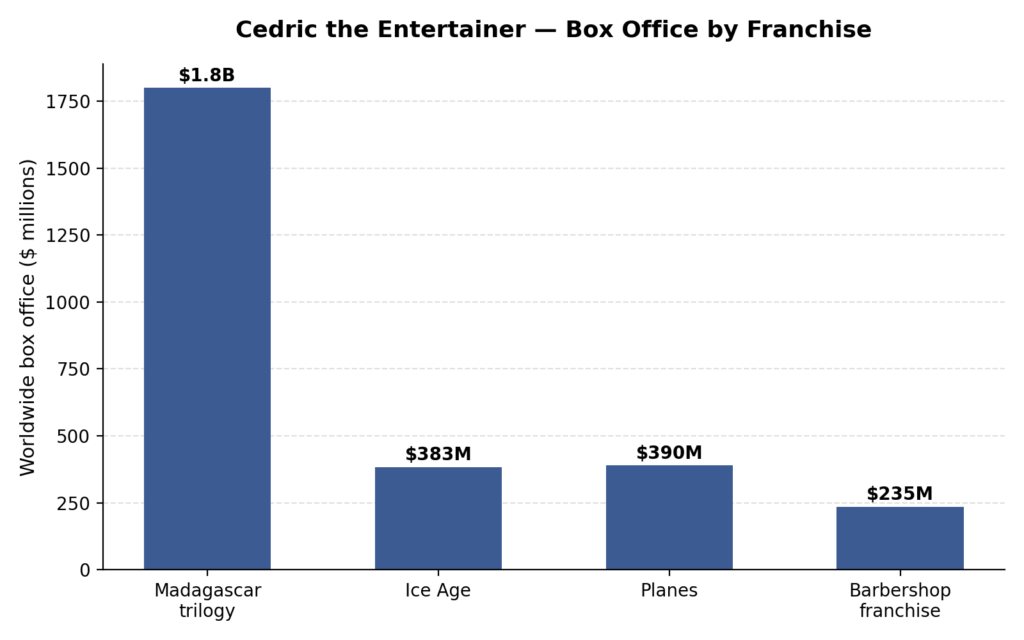
His live-action legacy tells a different, more personal story. As Eddie, the loudmouthed elder statesman of the Barbershop franchise, Cedric became the emotional anchor of a series that grossed over $235 million. He was paid just $150,000 for the first film — a number that looks almost quaint next to the bargaining power that role would eventually hand him for everything that came after.
Television as the Long Game
If film gave Cedric his box office weight, television gave him something arguably more valuable: recurring income that compounds over time. His TV résumé reads like a study in outlasting the competition. Six seasons and 122 episodes as Cedric Jackie Robinson on The Steve Harvey Show. Five seasons co-creating and starring in The Soul Man. A full season hosting 180 episodes of Who Wants to Be a Millionaire.
Today, as Calvin Butler on CBS’s The Neighborhood, he’s not just the lead — he’s an executive producer earning an estimated $125,000 to $150,000 per episode. More importantly, the show has cleared the 100-episode syndication threshold, which means Cedric is now collecting the kind of backend and international licensing checks that keep arriving long after a season wraps. Even in the streaming era, his pull hasn’t faded: his voice role in Netflix’s Swapped drew 38.7 million views in a single week.

The Businessman Behind the Brand
Cedric’s estimated net worth sits between $25 million and $26 million, and the way he talks about managing it says as much about him as any box office number. He once set up a $25,000 annual family fund, capped and specifically earmarked for emergencies, education, and essential bills. When relatives started treating it as an open tap rather than a safety net, he shut the program down without ceremony — a small story, but a telling one about how he separates generosity from being taken advantage of.
That same discipline runs through his production company, A Bird and A Bear Entertainment, which he co-runs with longtime partner Eric Rhone. The company now holds a first-look deal with CBS and recently signed on with the Independent Artist Group, giving Cedric ownership stakes and executive influence over projects rather than just a paycheck for appearing in them.
Life Beyond the Screen
The most recent chapter of Cedric’s career has little to do with acting at all. Alongside Anthony Anderson, he co-founded AC Barbeque, a food brand that leveraged their show Kings of BBQ to land shelf space in roughly 2,200 Walmart stores — a retail rollout most food startups spend years chasing.
There’s a quieter, more personal venture too: Setta Wine, a label he launched as a tribute to his late mother, Rosetta B. Kyles. And in 2023, he added “novelist” to the list, publishing his debut crime-noir caper Flipping Boxcars through Amistad/HarperCollins. On the live side, he’s kept touring, most notably with the Love & Laughter residency alongside Toni Braxton at The Chelsea in Las Vegas.
None of these ventures are flukes, and none of them happened by accident. What connects the claims adjuster, the arena headliner, the barbecue entrepreneur, and the first-time novelist is the same instinct: never depend on one paycheck. Cedric the Entertainer built a career the way a good accountant builds a portfolio — diversified, patient, and built to outlast any single trend. The jokes are what people remember. The business behind them is what’s kept him working for thirty years.