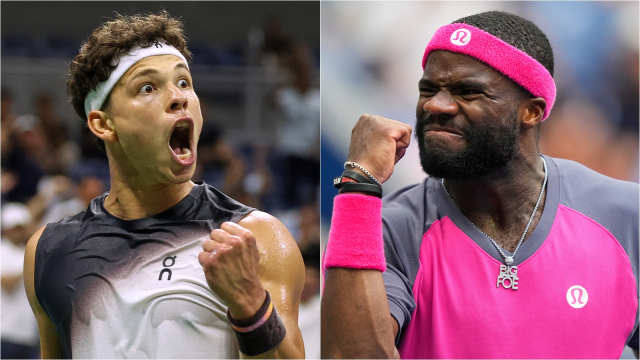
Frances Tiafoe and Ben Shelton reached Arthur Ashe Stadium through very different parts of American tennis. Their semifinal guarantees a breakthrough not seen in more than five decades.
At 3:33 on Wednesday morning, Ben Shelton had one serve left to complete the biggest victory of his career.
Defending US Open champion Carlos Alcaraz waited across the net. Shelton had never beaten him. He had also lost all 17 of his previous matches against players ranked inside the top three. The final serve travelled at 146 mph. Alcaraz could not touch it.
Shelton had won 6-7(5), 6-1, 6-3, 1-6, 7-6(7) after four hours and 28 minutes. The result ended Alcaraz’s 18-match Grand Slam winning streak and produced the latest finish in US Open history.
Frances Tiafoe had already spent four hours and 38 minutes fighting through his own quarterfinal. Alex Michelsen led by two sets and served for the match at 5-4 in the third. Tiafoe broke back, took the next two sets and survived a final-set tiebreak to win 5-7, 3-6, 7-5, 6-3, 7-6(6).
The two comebacks created the first Grand Slam men’s semifinal between Black American players in the Open Era. Friday’s winner will become the first Black American man to reach the US Open final since Arthur Ashe in 1972. He will also be the first American man in the final since Andy Roddick in 2006.
The history is shared. Almost everything about how they reached it is different.
The Tennis Centre that Gave Tiafoe a Chance
Tiafoe, 28, is the son of immigrants from Sierra Leone. His father, Constant, worked on the construction of the Junior Tennis Champions Center in College Park, Maryland, and later became its maintenance head.
Frances and his twin brother, Franklin, sometimes slept in a spare office at the centre while their father worked. They spent their days around courts, coaches and junior players. Constant’s job brought tennis into their lives, though the family could not afford the usual cost of pursuing the sport seriously.
Misha Kouznetsov noticed Tiafoe at the centre and began coaching him. He eventually helped pay for tournament travel, allowing Tiafoe to compete on a junior circuit that might otherwise have been closed to him.
Shelton, 23, encountered tennis at home. His father, Bryan, reached No. 55 in the ATP rankings before moving into coaching. At the University of Florida, he led the men’s team to a national championship and later coached Ben to the 2022 NCAA singles title.
Ben did not immediately embrace the idea of turning professional. He stayed in college, where he could play strong opponents and develop without assuming the full cost of life on tour. Bryan left Florida in 2023 to become his full-time coach.
Shelton entered professional tennis with years of specialist knowledge within his family. Tiafoe’s entry depended on a series of circumstances that happened to align around his father’s workplace. Neither experience resembles a standard route into the sport because American tennis has yet to build one for many young Black players.
Shelton Rebuilt the Game behind His Serve
Shelton’s left-handed serve made him dangerous almost as soon as he joined the tour. It also covered weaknesses that stronger opponents learned to find.
His power unsettled returners on fast courts, but the leading players could extend rallies and punish his impatience. The problem appeared in the numbers. Before Wednesday, Shelton had faced top-three opponents 17 times without winning.
He presented Alcaraz with a different game. Shelton varied the speed and placement of his serve, followed more balls towards the net and used his hands well when Alcaraz dragged him into shorter exchanges. Alcaraz could not remain in one return position and wait for the same pattern.
The changes had been developing for more than two years.
“I love to get to net, be able to use some of my hand skills, athletic skills,” Shelton said in 2024. He described serve-and-volley tennis as an important part of his game and something he wanted to keep improving.
I love to get to net, be able to use some of my hand skills, athletic skills. — Ben Shelton
His schedule offered another indication of where he thought his career needed work. Shelton skipped the 2024 Paris Olympics to prepare for the North American hard-court season. He told The Guardian that he wanted to perform at a high level every week.
A first Masters 1000 title followed in Canada in 2025. He climbed to a career-high No. 5 and retained the Canadian title in 2026.
The serve remained decisive against Alcaraz. It delivered the final point and repeatedly took pressure off Shelton during the fifth set. Yet the match lasted long enough for Alcaraz to test every other part of his game. Shelton’s ability to give him different looks kept the contest alive.
Tiafoe Confronted His Own Drift
Tiafoe had already experienced a breakthrough in New York. He defeated Rafael Nadal at the 2022 US Open and reached the semifinal, where Alcaraz stopped him in five sets. By June 2023, Tiafoe was ranked inside the world’s top 10.
His form began to fall away soon afterwards.
He arrived at Wimbledon in 2024 ranked No. 29 with a 14-14 record for the season. Across 15 tournaments, he had managed consecutive victories only twice. Tiafoe acknowledged that entering the top 10 had made him comfortable and weakened his motivation.
During the same admission, he dismissively called some of the opponents beating him “clowns.” The comment attracted criticism, understandably, but Tiafoe had also identified a problem inside his own camp. His ranking had begun to feel like confirmation that the difficult part was over.
He hired David Witt in July 2024, reached the Cincinnati final and returned to the US Open semifinals. Tiafoe later ended his 2025 season early and changed his team again after recording a 26-23 mark during his first full stretch with Witt.
A January 2026 interview with tennis journalist Ben Rothenberg provided some insight into the way Tiafoe receives difficult advice.
From people that are closest to me, people that I know genuinely want the best for me, it hits me much harder. — Frances Tiafoe
He was selective about whose criticism mattered. People within his trusted circle could reach him when the wider commentary around his career became easy to ignore.
New York crowds have long responded to Tiafoe’s energy. After beating Daniil Medvedev in the fourth round, he described the atmosphere inside Louis Armstrong Stadium as “out-of-body.” It was his 10th consecutive victory on that court.
There was little room for showmanship when Michelsen moved two sets ahead. Tiafoe had to defend his position in the tournament one service game at a time. He broke when Michelsen served for the match and gradually pulled him into a fifth set. The eventual victory was physically draining and frequently untidy. It was also Tiafoe’s third trip to a major semifinal.
The People Who Kept Both Careers Moving
Tiafoe and Shelton needed people who could fill the gaps around their talent.
The Junior Tennis Champions Center gave Tiafoe access to courts, coaching and regular competition. Kouznetsov added financial help when travel became necessary. Years later, Tiafoe turned to coaches such as Witt when his performances began to decline.
He has also directed money back towards the programme that helped him. In 2023, Tiafoe committed $250,000 to tennis-access initiatives, including $50,000 for the Junior Tennis Champions Center.
Shelton’s closest influence has remained his father. Bryan’s professional career gave him first-hand knowledge of the tour, while his years at Florida taught him how to develop younger players over time. Their relationship existed long before rankings, prize money or sponsorship agreements became part of Ben’s life.
Florida supplied the facilities and regular match play that supported that development. Shelton entered the professional game as an NCAA champion who had already competed under pressure, rather than as a junior expected to learn everything while travelling from tournament to tournament.
The two players have also become recurring figures in each other’s careers.
Shelton defeated Tiafoe in Houston in 2024 in the first ATP final of the Open Era contested by two Black men. Tiafoe won their five-set meeting at the US Open later that year. Shelton responded with a victory in Washington in 2025 and entered Friday’s semifinal leading their completed tour-level rivalry 2-1.
The rivalry has moved through three prominent American tournaments in three seasons. Broadcasters and audiences are no longer encountering either player as an isolated example of Black success in the men’s game. Their careers now overlap often enough to create a continuing story.
What One Historic Match Leaves Unresolved
For the first time in 54 years, a Black American man will play in the US Open final. Young players watching Friday’s semifinal will see that possibility through two active careers instead of footage from Ashe’s era.
The conditions behind those careers deserve equal attention.
Tiafoe’s father happened to find work at a tennis centre. Kouznetsov noticed the young player and helped his family meet travel costs. Shelton had a former ATP professional at home and later trained within a leading college programme. Few aspiring players can plan around circumstances like those.
Court fees remain expensive. National and international junior tournaments require money for travel, accommodation and coaching before a player earns meaningful prize money. Many families encounter those costs years before anyone can know whether a child will become a professional.
Friday’s match will not change that calculation. It may attract sponsors, bring more attention to development programmes and give tennis administrators a strong case for expanding access. The effect will be determined by decisions made after the tournament.
On court, Tiafoe and Shelton will have more immediate concerns. Each has already survived a five-set quarterfinal, and each knows the other’s game. One will leave Arthur Ashe Stadium with a place in the final. The other will leave after contributing to a milestone he wanted to win.
Beyond the result, the next generation will still need somewhere to play, someone capable of coaching them and enough money to remain in competition. Those needs existed before this semifinal and will remain when the stadium is empty.
Frequently Asked Questions
Is this the first all-Black semifinal in tennis history?
It is the first Grand Slam men’s semifinal between two Black American players in the Open Era, which began in 1968. The record does not cover every professional or amateur tennis competition in history.
When will Frances Tiafoe play Ben Shelton?
They are scheduled to meet on Friday, September 11, at Arthur Ashe Stadium in the 2026 US Open men’s semifinal.
What is their head-to-head record?
Shelton leads their completed tour-level rivalry 2-1. He won the 2024 Houston final and their 2025 match in Washington. Tiafoe defeated him in five sets at the 2024 US Open.
What history will the winner make?
The winner will become the first Black American man to reach the US Open final since Arthur Ashe in 1972. He will also become the first American man to reach the final since Andy Roddick in 2006.
Have either Tiafoe or Shelton won a Grand Slam?
No. This is Tiafoe’s third major semifinal after his appearances at the 2022 and 2024 US Opens. It is also Shelton’s third, following his runs at the 2023 US Open and 2025 Australian Open.