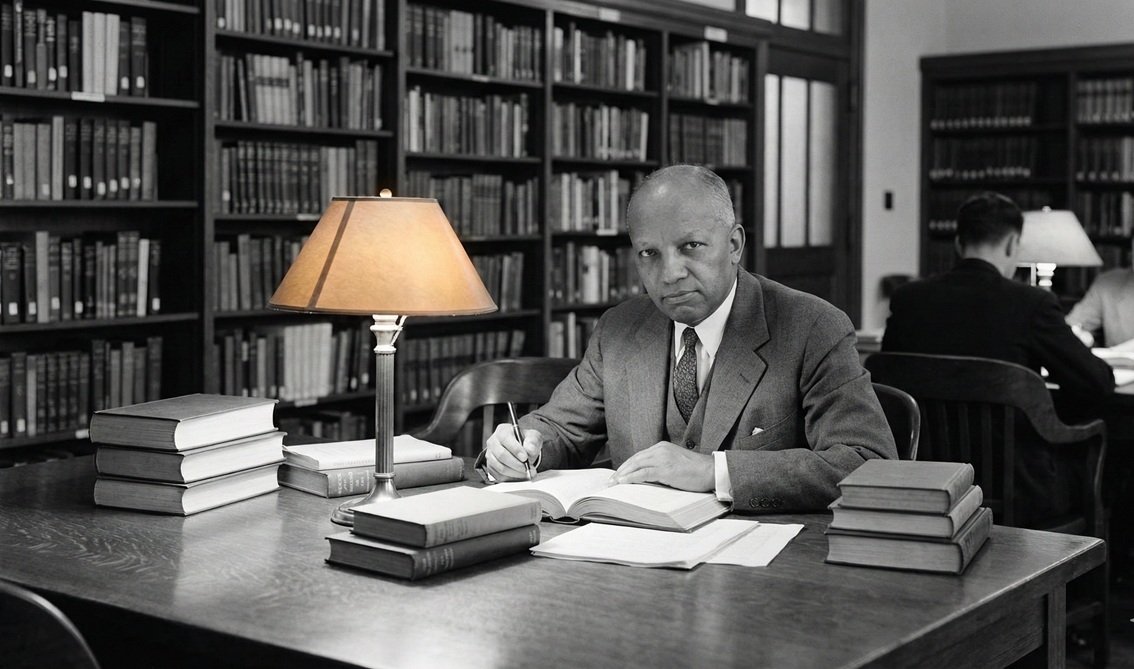
On July 18, 1922, Carter G. Woodson bought a three-story house at 1538 Ninth Street NW in Washington, D.C. The Association for the Study of Negro Life and History took the first floor. Woodson lived upstairs.
The arrangement put his home and his work in the same building. He edited a journal there, ran a publishing company and organized a campaign to bring Black history into classrooms. For a field that many established institutions had neglected, the address became a place to do the work.
Negro History Week reaches its centennial in 2026. Woodson is often remembered for starting the observance that grew into Black History Month. The less familiar part of the story is what he built around it: an organization that collected research, published it and tried to get it into the hands of teachers and the public.
Carter G. Woodson Built a Home for Black History
Woodson was born in Virginia in 1875 to parents who had been enslaved. Before he pursued higher education, he worked as a miner and sharecropper. He earned a doctorate in history from Harvard in 1912.
A degree gave him a place in the academy. It did not make Black history easy to find in the collections and publications that shaped accepted accounts of the past.
On September 9, 1915, Woodson and fellow scholars founded the Association for the Study of Negro Life and History. It is now known as the Association for the Study of African American Life and History, or ASALH. The founders wanted the public to know about Black Americans’ contributions to the country.
The association began publishing The Journal of Negro History the following year. Scholars could use it to publish work that might otherwise have struggled to find a home. The journal continues today as The Journal of African American History.
There was research to do before an article could be written. Woodson looked for records about Black soldiers in the First World War. He asked people who had survived slavery to share their testimony and searched for letters and artifacts. Some documents were hard to locate. Others had never been gathered in one place. Finding them shaped what historians could say.
Not to know what one’s race has done in former times is to continue always a child. — Carter G. Woodson
Research and publication needed money, equipment and people who could carry the work through. Woodson founded Associated Publishers to print books on Black history and education. The National Park Service identifies the company as publisher of The Negro in Our History in 1922 and The Mis-Education of the Negro in 1933.
The money did not come easily. A JSTOR review of Woodson’s archival work says the Guggenheim and Carnegie institutions declined to fund him. Woodson also formed alliances with the Library of Congress and other organizations. Those connections mattered, but they did not run the association for him. The journal needed editors. Books needed to be printed and distributed. The organization needed people to keep showing up.
It had far fewer resources than a university. Much of its work rested on Woodson and the networks of educators, scholars and community groups around him. The association could not take the place of the academy. It could give researchers and readers somewhere to meet.
Teachers and Communities Carried the Work
Woodson and the association launched Negro History Week in 1926. February already brought celebrations of Frederick Douglass and Abraham Lincoln. Woodson used the month’s existing focus to make room for a broader account of Black life.
The week was not established as a government holiday. Woodson announced it. Teachers, churches, civic groups and local communities decided what to do with it.
For schools, the date created an occasion to plan lessons. For community organizations, it offered a reason to hold programs and bring people together. The campaign needed those local efforts. An announcement from Washington could not make Black history part of everyday teaching on its own.
Woodson also worked to give educators material they could use. At Mary McLeod Bethune’s request, ASALH began publishing the Negro History Bulletin in 1937. Teachers had something to bring into the classroom, not only a date to mark on the calendar.
Black communities had been building schools and colleges when white institutions excluded them. The history of historically Black colleges and universities describes how those institutions served students shut out of much of American higher education. Woodson’s association became part of that wider work, with its focus on research and publication.
Negro History Week continued after Woodson’s death in 1950. Local observances and student activism helped expand it. Black History Month was first federally recognized in 1976. The month came later; it grew from an effort Woodson had started decades before.
ASALH has named its 2026 theme “A Century of Black History Commemorations.” The association says it continues to research, preserve, interpret and disseminate Black history. A centennial can draw attention to that work. It cannot decide who will fund it or whose records will be kept.
The mere imparting of information is not education. — Carter G. Woodson
Digital Archives Still Depend on People
A scanned document can be read around the world. Plenty of historical material is still difficult to find, and putting a scan online does not tell readers what it means. Someone has to locate the document, transcribe it, explain its context and keep the collection available.
A project to build an archive of Black women’s diaries from Reconstruction shows what goes into making a collection useful. Students are transcribing and annotating diaries and connecting them to other historical records. The public launch is planned for October 2026. Uploading a page is only one part of the task. Readers also need to be able to make sense of what is on it.
Artificial intelligence may help people search a large collection or compare a summary with its source. It can also return invented citations, plausible errors and images of events that never happened. The American Historical Association’s 2025 guidance on AI in history education warns that generative systems reflect the limitations of their source material. Historians still have to check evidence and understand context.
That matters when some communities left fewer records in the archives. If letters, diaries and photographs were less likely to be collected, an AI system searching what survives can repeat that imbalance. A larger volume of search results does not make the record more complete.
Woodson’s operation leaves a practical question for anyone building an archive, teaching history or publishing research: where did the source come from? Who created it? Has someone changed or transcribed it? What can it tell us, and what can’t it? Readers need that information whether they find a record in a book, a database or an AI-generated answer.
Woodson’s work depended on other people from the start. Scholars and community networks helped the association reach beyond its headquarters. New tools may help preserve more material, but they cannot decide what deserves to be collected. People and institutions still make that choice.
FAQs
Who was Carter G. Woodson?
Carter G. Woodson was a historian, educator and author. He founded the Association for the Study of Negro Life and History in 1915, established The Journal of Negro History and launched Negro History Week in 1926.
What did Woodson mean by saying Black people had a history?
He challenged scholarship and education that left Black life out of the historical record. Woodson argued that Black people’s experiences deserved serious study and preservation, then built organizations to support that work.
How did Negro History Week become Black History Month?
Woodson launched Negro History Week in 1926. Teachers, communities and student activists expanded the observance over time. Black History Month was first federally recognized in 1976, decades after Woodson’s death.
Why does Woodson’s work matter in the age of AI?
AI can help search historical material, but it can also repeat gaps in the archives or produce false information. Preserving original records and checking interpretations against evidence remain essential.