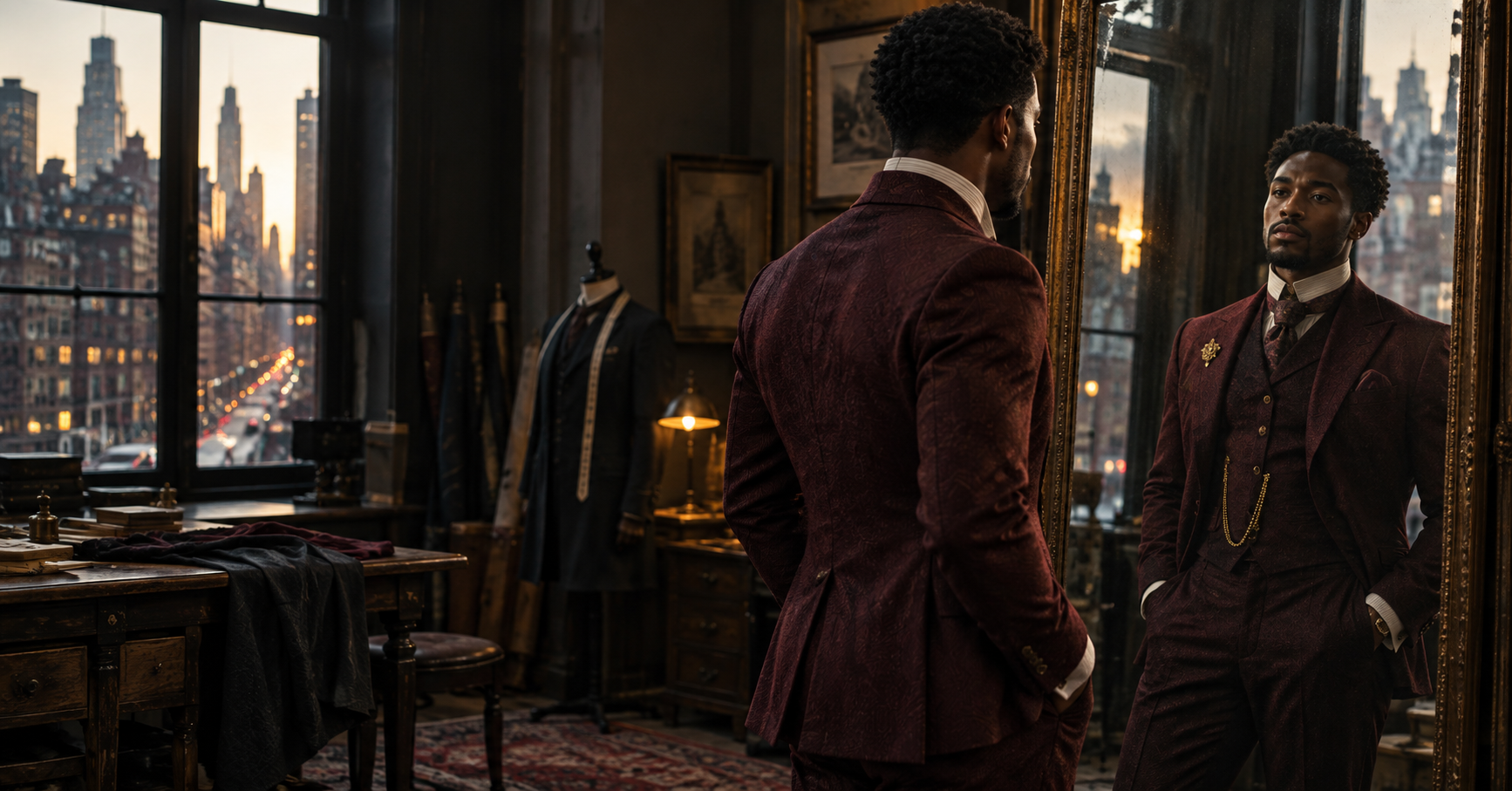
At the 2025 Met Gala, A$AP Rocky arrived in a custom suit by AWGE, the creative agency he founded. Asked about wearing a Black designer, he pointed to the agency behind his own look. The moment compressed a larger business question into one outfit: when Black style takes the stage, do the people who create it gain lasting customers, credit and ownership—or mainly provide the image?
That question sits behind the renewed attention to Black dandyism. The Met’s 2025 exhibition and Gala put the subject before a large international audience. In January 2026, the museum continued the conversation with a library essay that widened its focus to Black style across continental Africa. For Black Innovators in fashion, the renewed visibility can open doors. It also makes the terms of commercial participation harder to ignore.
The History Inside the Clothes
Black dandyism did not begin with a runway show or a red carpet. In 1789, Olaudah Equiano described buying a fine suit as he approached freedom. He had earned and saved money toward buying his freedom; the clothes were for the dance he planned to attend.
I laid out above eight pounds of my money for a suit of superfine clothes to dance with at my freedom. — Olaudah Equiano
Equiano wrote that people recognized him as a free man in the suit. The purchase did not make him free; it marked a moment he had struggled to reach. He chose how to appear at the celebration and recorded that choice in his own account.
Clothing carried other meanings in the 18th-century Atlantic world. Fine dress could display an enslaver’s wealth or mark a Black person’s status. Black people also understood and used the social codes of dress for themselves. The Met’s Superfine: Tailoring Black Style traced this history across three centuries, interpreting dandyism as both an aesthetic and a strategy for creating social and political possibilities. Its account joins European tailoring traditions with African influences and Black people’s own acts of self-fashioning.
Monica L. Miller, the exhibition’s guest curator and author of Slaves to Fashion, describes the practice in terms that resist treating it as simply a taste for expensive clothes:
Dandyism is both an aesthetic and politics, a pronouncement and provocation. — Monica L. Miller
A sharply tailored suit is one expression of dandyism, not the whole tradition. Colour, grooming, accessories, posture and gesture matter too. The choices vary by person and place. What connects them is deliberate self-presentation in societies that have often tried to assign Black people’s appearance—and what it supposedly means—for them.
Why the Subject Has Returned to the Centre
The 2025 Met exhibition gave Black dandyism unusual institutional scale. It ran from May 10 to October 26 and was funded in part by Instagram, the Hobson/Lucas Family Foundation, Africa Fashion International and the Perry Foundation. Those details matter: the exhibition brought together museum authority, a technology platform, a foundation and an African fashion organisation. They show how cultural attention depends on institutions and sponsors as well as designers. They do not, by themselves, show that participating designers gained sales or investment.
The Gala carried the theme from the galleries onto a global red carpet. It raised a record $31 million for the Costume Institute, according to the Associated Press. That was fundraising for the Met’s institute—not a pool of money distributed to the designers whose work appeared in the exhibition or on the carpet. The distinction is important in a story where institutional recognition and creator income can easily be mistaken for the same result.
The exhibition also included emerging talent. The Associated Press reported that two designs by Jacques Agbobly were selected for display. A museum acquisition or exhibition can establish a designer’s work in a recognised cultural record and introduce it to visitors. The public record of the exhibition, however, does not tell us whether Agbobly’s selection resulted in more orders, investment or repeat customers.
That gap between visibility and business outcome helps explain why the question is timely. A designer may be praised, photographed and discussed while still carrying the costs of making the work: materials, sampling, labour, production and distribution. The spotlight lasts a night; a business must meet customers’ needs long after the carpet is rolled away.
The Met’s 2026 follow-up also changed the map. Its essay, “Expanding the Lens,” said the exhibition had focused primarily on designers of the African diaspora in the United States, United Kingdom, France and Caribbean, while Black dandyism is a global conversation. The essay pointed readers to African fashion and photography, including the Sapeur and Sapeuse communities of the Congo. The Met also convened a 2025 conversation with Nigerian designer Adeju Thompson, Cameroonian designer Imane Ayissi and South African designer Wanda Lephoto on African design, production and international success. This is one concrete reason the story has moved beyond a single US event: the renewed attention is bringing distinct histories and fashion systems into the same discussion.
From Recognition to Commercial Value
A fashion image is rarely the work of one person. A designer may develop the garment, a tailor construct it, a stylist assemble the look, a barber shape the grooming, and a photographer create the image that travels. Their roles—and their payment—can differ. The wearer or label may be prominent while the people who made the final appearance receive less attention.
Rocky’s AWGE suit made the connection between wearer and creative agency unusually visible. He had a role in the company that designed the garment; many emerging makers do not have that platform. They may be paid for a single commission, then have little say in how the look is credited or reused.
That is where contracts and ownership become more than paperwork. Who owns the design? Who can license the image? Does a maker receive a fee for the original work only, or payment when a campaign continues to use it? Credit can help bring new clients, but it does not replace compensation. A small label also needs working capital, reliable production and access to buyers. Without those, editorial attention can arrive faster than the capacity to fulfil orders.
A collaboration between fashion and haircare offers a useful business example of brands working across categories, with products and customer relationships that extend beyond an outfit or event. A collaboration can connect audiences; it still depends on clear roles, rights, production and a reason for customers to return.
The value of an image can also depend on how a public figure uses it. André 3000’s Met Gala appearance with a piano on his back treats the outfit as part of a larger creative statement. Such looks can draw an audience to an artist’s work, but attention is not a guaranteed sale. The creator needs a path from that moment to a product, performance, commission or continuing relationship with fans.
What “Back” Means in 2026
Black dandyism did not vanish and then suddenly return. Its traditions have continued in everyday dress, music, photography, tailoring and communities across the diaspora. What has changed is the scale of institutional attention: a major museum exhibition, a Met Gala theme, a related programme featuring African designers and a 2026 essay that expands the conversation beyond the exhibition’s original geographic emphasis.
The evidence supports renewed cultural visibility. It does not establish that fashion sales have surged or that Black creators are capturing a larger share of the value.
For a designer, the practical test comes after the image circulates. Can the label fulfil demand without compromising quality? Can it finance the next collection? Does it control the name, design and customer relationship? Can the people who made the look be credited and paid when it travels? These questions do not diminish the cultural force of dandyism. They clarify what it takes for recognition to support the people whose work made the image worth seeing.
Frequently Asked Questions
What Is Black Dandyism?
Black dandyism is a tradition of intentional dress and self-presentation shaped by Black people across different communities and periods. It can involve tailoring, colour, grooming, accessories and gesture, with meanings connected to identity, creativity, power and resistance.
Why Is Black Dandyism Receiving Attention Again in 2026?
The Met’s 2025 Superfine exhibition and Gala brought it to a global audience. A January 2026 Met essay then widened the conversation toward Black fashion and dandyism across continental Africa.
How Has Clothing Served as Resistance?
Clothing cannot remove racism or discrimination. But Black people have used choices about dress and presentation to assert agency, challenge imposed stereotypes and shape how they appear in public.
Does Greater Visibility Guarantee Black Designers More Revenue?
No. Visibility may bring recognition, but revenue depends on factors such as contracts, ownership, production capacity, distribution and access to customers. Museum attendance and Gala fundraising figures do not show individual designers’ earnings.
Is Black Dandyism Limited to Men’s Fashion?
No. Although the term is often associated with menswear, Black dandyism’s influence appears across genders and forms of dress. The wider tradition includes varied approaches to tailoring, adornment and self-presentation.