

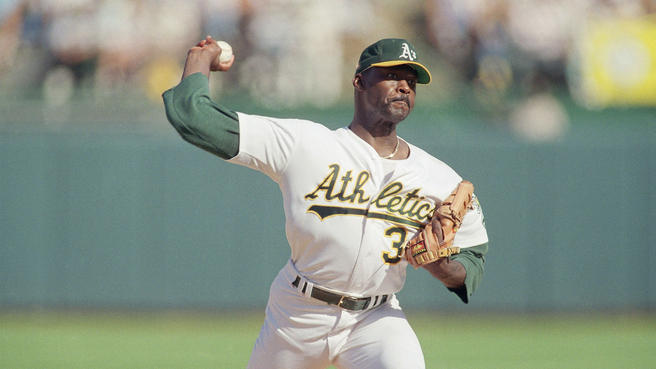
At 29, Dave Stewart was ready to walk away from baseball. Years of frustration with Texas and Philadelphia had worn him down, and he told his former Dodgers teammate Dusty Baker as much. Baker wouldn’t hear it. Within a year, Stewart was winning again for his hometown Oakland Athletics, helped by a new manager and a forkball he had finally learned to trust.
From 1987 through 1990, Stewart won at least 20 games every season, took home a World Series MVP award and became the anchor of an Oakland team that reached three straight World Series.
The Low Point in Texas and Philadelphia
Stewart broke into the majors with the Dodgers in 1978 and won a title with them in 1981. After that, his career became a series of setbacks.
A 1983 trade to Texas moved him into a starting role, but he clashed with manager Doug Rader almost immediately. He bounced between the rotation and bullpen and finished 12–22 over two-plus seasons with the Rangers. By 1985, Stewart was 0–6 with a 5.42 ERA when Texas sent him to Philadelphia. The Phillies released him in May 1986.
For a pitcher who had already won a World Series, it was a hard fall. At 29, Stewart was no longer sure there was another way back. He told Baker, then with Oakland, that he was finished. Baker remembered the conversation decades later in a 2022 interview with the San Francisco Chronicle.
Stew, don’t you ever walk away from this game. Make them take the uniform off your back. -Baker
He signed with Oakland that May, but the move did not immediately solve anything. He struggled under manager Jackie Moore and pitching coach Wes Stock. Then Tony La Russa took over later that season and brought Dave Duncan in as pitching coach. That changed the direction of Stewart’s career.
Duncan’s Fix: More Forkball, Less Fastball
La Russa remembered a strong start Stewart had made against the Chicago White Sox three years earlier. Duncan saw something else. Stewart could throw hard, but his fastball moved too straight to consistently beat major league hitters. Duncan wanted another pitch in the mix, and he wanted Stewart to use his forkball more often.
It was a relatively simple adjustment. Stewart had the pitch already. Duncan wanted him to trust it. He mentioned;
“The forkball gave him an off-speed pitch he could control… He can throw that thing for strikes almost whenever he wants.” -Duncan
The difference showed quickly. Stewart finished the 1986 season 9–5 with a 3.74 ERA for Oakland. In 1987, he won 20 games, led the American League in victories and finished third in Cy Young voting. The pitcher who had been thinking about quitting was suddenly one of the best starters in the league.
Four Straight 20-Win Seasons
Stewart’s next four seasons produced 20, 21, 21 and 22 victories. He averaged roughly 265 innings a year during that stretch, a workload that would be unusual for a starting pitcher in today’s game. In 1990, he also threw a no-hitter against Toronto.
Oakland reached three consecutive World Series from 1988 through 1990 and won the championship in 1989. Stewart was at the center of that run.
He went 4–0 during the 1989 postseason, including two victories over Toronto in the American League Championship Series. In the World Series against San Francisco, he shut out the Giants in Game 1 and worked seven innings in Game 3 as Oakland completed the sweep. Stewart finished the Series 2–0 with a 1.69 ERA and was named World Series MVP.
The awards did not stop there. He won ALCS MVP honors with Oakland in 1990 and again with Toronto in 1993. By the end of his career, he had gone 10–6 with a 2.84 ERA in 18 postseason starts.
A Championship in the Middle of an Earthquake
The 1989 World Series carried another layer of significance for Stewart. The Loma Prieta earthquake struck the Bay Area shortly before the Series was scheduled to begin. The disaster killed 63 people, injured thousands and caused extensive damage across the region. The Series was delayed for more than a week.
When baseball resumed, Stewart was pitching for the team he had grown up watching in his hometown. Oakland won the Series in four games. For Stewart, the championship was the high point of a career that had looked close to ending only three years earlier.
Life after Oakland
Stewart’s numbers cooled after his four-year run of 20-win seasons. He went 11–11 with a 5.18 ERA in 1991 before bringing the ERA down to 3.66 the following year. Then came one more championship.
In 1993, Stewart helped the Toronto Blue Jays win the World Series, giving him three championships with three different franchises: the Dodgers in 1981, the Athletics in 1989 and the Blue Jays in 1993. His career had started with a championship and nearly ended in a conversation with Dusty Baker. Instead, Stewart stayed. The forkball helped change what happened next.
FAQ
Why did Dave Stewart almost quit baseball in 1986?
The immediate breaking point was Philadelphia releasing him in May 1986. Stewart was 29 and coming off a difficult period that included a 5.42 ERA during his final stretch with Texas. He told Dusty Baker he was finished, but Baker urged him to keep playing. Stewart signed with Oakland that same month.
What did Dave Duncan change about Stewart’s pitching?
Duncan wanted Stewart to rely more heavily on his forkball. Stewart’s fastball had plenty of velocity, but Duncan believed it moved too straight to be enough on its own. The forkball gave Stewart a second pitch he could throw for strikes and helped change the way he attacked hitters.
How many championships did Dave Stewart win?
Three. He won with the Los Angeles Dodgers in 1981, the Oakland Athletics in 1989 and the Toronto Blue Jays in 1993.
How good was Stewart in the postseason?
Stewart went 10–6 with a 2.84 ERA in 18 career postseason starts. His 1989 World Series was particularly strong: he went 2–0 with a 1.69 ERA and was named MVP as Oakland swept San Francisco.