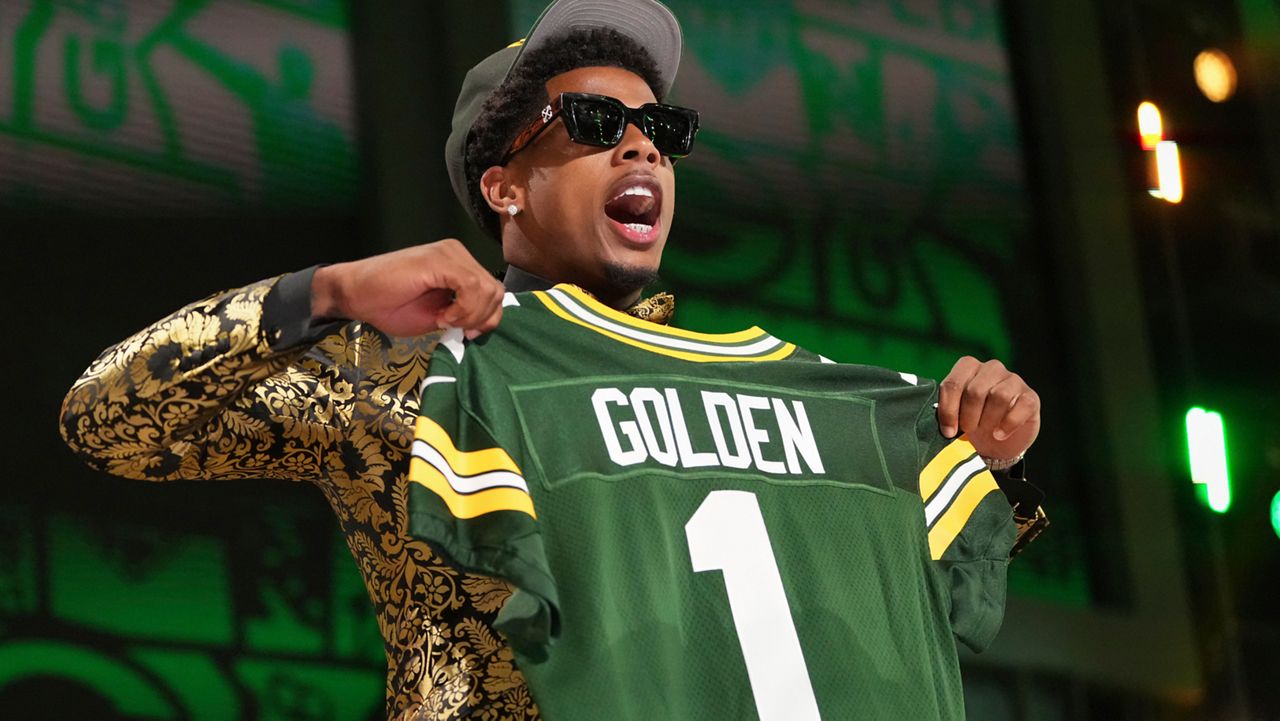
Matthew Golden caught five passes for 100 yards and a touchdown against Atlanta. Green Bay lost 35–14. Jordan Love threw 53 times; the Packers gained 17 yards on the ground. The score pushed Green Bay toward the pass, but Golden still had to make his plays: adjust to a deep ball, take a slant into the end zone and convert late in the game.
Three games into his second season, Golden has 253 receiving yards. He had 361 in 14 games as a rookie. His average has climbed from 12.4 yards per catch to 16.9. The Packers’ receiver room has changed, and Golden is getting more from his chances.
Green Bay chose him 23rd overall in 2025. His night against Atlanta offered a better measure of that investment than his draft slot: he made plays at different depths and gave Love a target who can stretch the field.
Whenever my number’s called, I know I’m going to be able to perform. — Matthew Golden
Matthew Golden’s 100-Yard Breakout Shows How Green Bay Uses Him
Golden’s first big gain came on third-and-11. Love threw deep; Golden adjusted for a 43-yard catch. He later scored on a 15-yard slant, then caught a 20-yard pass on third-and-10 late in the game. His longest reception went for 45 yards.
Each catch asked something different of him. He had to track the deep ball, hold on through traffic near the goal line, then find space on a late third down. His 100 yards didn’t come from a stream of short passes.
Golden led the Packers with 12 targets. Christian Watson had seven catches for 96 yards and a touchdown, giving Green Bay two productive receivers in the same game. That matters for an offense looking for reliable options beyond one player.
Love’s 53 attempts gave Golden extra chances. Whether he keeps this role when Green Bay can run more will take longer to answer. Atlanta showed, at least, that his work can extend beyond a few routes built around his speed.
His Second Season Has Started Differently
Golden’s rookie season was uneven. He played 14 regular-season games, started five and caught 29 passes for 361 yards. His season high was 86 yards against Cincinnati. Injuries interrupted his progress: he was inactive for three games and missed time in others.
He did make an impact on money downs. Golden caught 11 passes for 232 yards on third and fourth down, an average of 21.1 yards per catch. Among receivers with at least 10 catches in those situations, only two averaged more. The Packers’ player profile shows the split: modest season totals, strong production when Green Bay needed a conversion.
Against Chicago in the playoffs, he caught four passes for 84 yards and a touchdown. It was his best game of the year, though injuries and a crowded receiver room had made it difficult for him to establish a steady role before then.
Golden has gained at least 58 yards in each of Green Bay’s first three games this season: 95 against Minnesota, 58 against the Jets and 100 against Atlanta. Before the Falcons game, he had 153 yards—more than 40 percent of his rookie total.
Last year, injuries and inconsistent opportunities broke up his promising stretches. This season, he has been involved from the start. His deep catches are now appearing alongside shorter and intermediate gains, giving Green Bay more ways to use him.
A Different Receiver Room Gives Him Room to Grow
Golden’s route to playing time widened in the offseason. Romeo Doubs left in free agency, and the Packers traded Dontayvion Wicks to Philadelphia. Jayden Reed signed an extension; Watson remains one of Love’s primary targets. There is still competition at receiver, but Golden faces a different group than he did as a rookie.
Green Bay made him the 23rd pick in 2025, its first first-round receiver since 2002. His rookie contract gives the team time to see how much responsibility he can handle. A productive receiver on a cost-controlled deal can also leave the front office more room to spend elsewhere. That makes his progress relevant beyond the weekly game plan.
Golden doesn’t need to be the No. 1 receiver for his development to matter. Watson has scored four times through three games. Tucker Kraft is a major target at tight end, and Reed remains part of the plan when healthy. Golden can complement them: his speed pulls coverage deep, while his slants and third-down catches give Love options underneath.
LaFleur has also emphasized Golden’s work when he isn’t targeted. During training camp, the coach described what he looks for away from the ball:
I think that says a lot about you as a player. What do you do when you don’t have the football? — Matt LaFleur
Blocking and finishing assignments help keep a receiver on the field. Golden gets more chances to make a play when he stays on the field, but that starts with doing the work that doesn’t show up in his stats.
The Atlanta loss exposed what Golden can’t fix. Green Bay rushed for 17 yards and struggled to keep its offense balanced. He can make the passing game more dangerous; the Packers still need a run game and steadier protection. His production will matter most if defenses also have to respect the rest of the offense.
What Green Bay Should Watch Next
The next few games will show whether Golden keeps drawing priority targets when Green Bay isn’t forced to pass. Coaches can track his route participation, alignment and third-down usage, then watch how often he turns targets into catches. He caught five of 12 against Atlanta. The yardage was excellent, but he and Love will need a more consistent connection as defenses get more film on them.
That’s the test of whether his role can hold. Deep gains and a broader route tree would support using Golden as a regular starter, not only as a situational speed threat. If his production cools, Green Bay still has Watson, Reed and Kraft. Either way, this stretch should tell the team more than an injury-interrupted rookie season could.
Golden has made a case for more work. In Atlanta, he showed he can contribute at multiple depths and make plays in key moments. Green Bay now has to decide how much of the weekly offense to put through him.
Frequently Asked Questions
What were Matthew Golden’s stats against the Falcons?
Golden caught five of 12 targets for 100 yards and a touchdown in Green Bay’s 35–14 loss to Atlanta on September 24, 2026. His longest reception was 45 yards. The touchdown was his first in a regular-season game, and the 100 yards set a career high.
How many receiving yards does Matthew Golden have in 2026?
Through Green Bay’s first three games of the 2026 regular season, Golden has 15 receptions for 253 yards and one touchdown. He gained 95 yards against Minnesota, 58 against the Jets and 100 against Atlanta.
How productive was Golden as a rookie?
Golden caught 29 passes for 361 yards in 14 regular-season games in 2025, with five starts. He also had 49 rushing yards on 10 carries. In Green Bay’s Wild Card playoff game against Chicago, he caught four passes for 84 yards and a touchdown.
Is Matthew Golden now Green Bay’s No. 1 receiver?
Golden has earned a larger role, but three games don’t settle Green Bay’s receiver hierarchy. Watson has been productive, Kraft remains a key target and Reed is part of the plan when healthy. The Packers will know more after seeing Golden against different coverages and in different game situations.
Why could Golden become more important to Green Bay’s offense?
Green Bay reshaped its receiver group in 2026: Doubs left in free agency, and Wicks was traded to Philadelphia. Golden’s early production gives the Packers another young option to develop. If he sustains his role, Green Bay can spread targets across a deeper group.