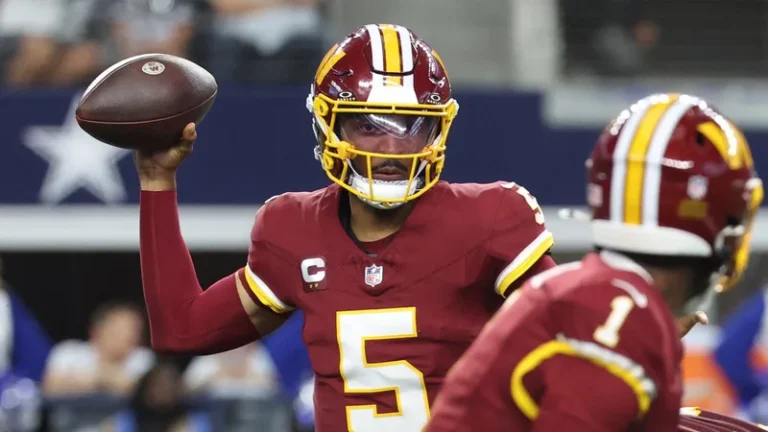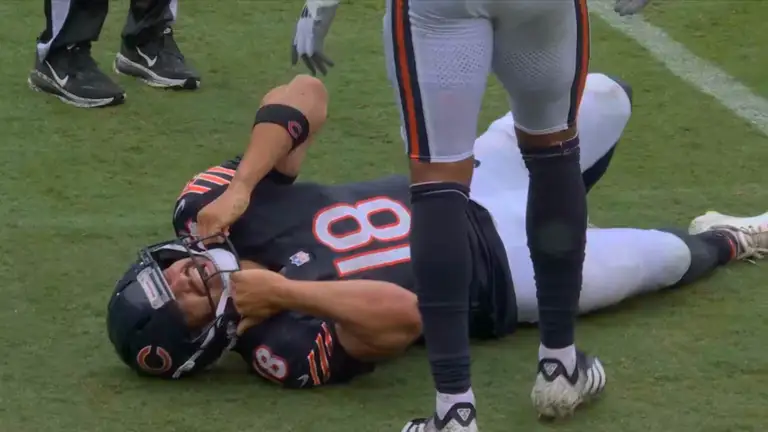
Caleb Williams’ hamstring injury looked frightening because his body stopped before the play did. The Chicago Bears quarterback was scrambling left toward the end zone against the Minnesota Vikings when he fell without contact. He remained on the ground, needed help reaching the sideline, and later went to the locker room on a cart.
Bears coach Ben Johnson confirmed that Williams injured his right hamstring during Chicago’s 9-3 loss on September 20, 2026. The team scheduled imaging for the following day.
“I’m actually happy it’s nothing with the knee,” Johnson said. “That was my first inclination, but the hamstring could be pretty damaging as well. We’ll see how bad it is tomorrow, and we’ll go from there.”
NBC’s Mike Florio later reported optimism that Williams had avoided a severe injury and said it could be as mild as a Grade 1 strain. The Bears had not confirmed a grade, so that report was not a diagnosis.
The cart and Williams’ inability to continue made the incident look worse than the hamstring injury he played through at USC in December 2022. They did not prove that the current tissue damage was more severe. Chicago’s examination and imaging would establish that.
The old injury still gives the Bears a useful reference. Williams hurt his left hamstring on December 2, 2022, and returned for the Cotton Bowl on January 2, 2023.
That was 31 calendar days between games. He returned and delivered one of the finest passing performances of his college career. Chicago should treat the timeline as history, not a deadline.
He popped his hamstring on that long run. It wasn’t even close to 50 percent. —Lincoln Riley
Why the Caleb Williams Hamstring Injury Looked Different
The contrast begins with what Williams could do after each injury.
Against Utah in the 2022 Pac-12 Championship Game, Williams broke off a 59-yard run before injuring his left hamstring. USC coach Lincoln Riley said Williams had “popped” the muscle and was “not even close to 50 percent.”
Williams stayed in the game. His mobility disappeared, but he continued operating from the pocket as Utah sacked him seven times in a 47-24 USC defeat. Riley later described the injury as “pretty severe” while noting that hamstring injuries differ from one player to another.
The Minnesota injury ended Williams’ afternoon. He could not continue, required assistance off the field and used a cart to reach the locker room. That loss of function created a more alarming first impression.
Other details offered some reassurance. Johnson ruled out a knee injury. Williams was seen walking in the locker room without crutches and was reportedly in good spirits. Those observations cannot identify the injured muscle, grade the strain or reveal whether a tendon was involved.
For now, the strongest conclusion concerns the exit rather than the damage: Williams left the Minnesota game in worse condition than he left the USC game. The reported optimism may ultimately prove justified, but visible pain and the ability to walk are unreliable measures of a muscle injury’s severity.
What the 2022 Recovery Can Tell Chicago
Williams suffered the USC injury on December 2. With no game for a month, he returned on January 2 and completed 37 of 52 passes for 462 yards and a Cotton Bowl-record five touchdowns against Tulane. USC lost 46-45, but Williams’ arm was not the problem.
His running remained a smaller part of the offence. Official Cotton Bowl statistics credited him with four carries for 10 yards. That was well below the movement threat normally associated with his game, even as he produced through the air.
The college schedule gave Williams something the Bears will not receive during an NFL season: roughly one month without competitive football. Chicago will continue playing while he rehabilitates, and pressure to return will build with every missed start.
The injuries are also on opposite sides. The 2022 strain affected his left leg; the current injury is in his right. Without imaging details, the latest problem cannot be called a recurrence involving the same muscle or tendon.
Chicago can still use the old case as context. Williams has already shown that he can regain high-level passing function after a serious hamstring problem. It does not tell the Bears how quickly his right leg will tolerate sprinting, cutting and sudden stops.
The hamstring could be pretty damaging as well. We’ll see how bad it is tomorrow, and we’ll go from there. — Ben Johnson
His Style Demands more than Stationary Throwing
Williams’ off-platform ability is central to his value. He escapes pressure, changes direction without fully resetting his feet and generates throwing power from positions that would force many quarterbacks to abandon the play.
No public medical or biomechanical evidence shows that those mechanics caused either hamstring injury. His style does, however, require repeated acceleration, lateral movement and hard braking. Those are physical demands, not a diagnosis.
The hamstrings help extend the hip, bend the knee and control the leg as it swings forward. Sprint research shows high loading around the transition from late swing into ground contact, when the muscles help absorb and redirect force.
On the Minnesota play, Williams moved laterally before turning towards the goal line. Similar actions occur throughout his game: curved runs, sudden stops, hurried resets and throws made before his lower body is organised.
Chicago should not try to remove those movements from his football identity. The rehabilitation process must prepare him to perform them again.
A pocket session will test his arm and only part of his lower body. Before he faces a live defence, Williams will need to accelerate, brake, cut and react without guarding the injured leg.
Why the Calendar Cannot Decide His Return
Hamstring recovery is not simply a question of pain disappearing.
A return-to-sport review available through the National Library of Medicine describes a substantial recurrence problem after hamstring strains. It also warns that pain, flexibility and basic strength measures may improve before biological healing is complete.
That gap helps explain why an athlete can pass standard clinical checks yet remain unprepared for repeated high-speed movement. Previous hamstring injury is also a recognised risk factor for a future strain, although Williams’ earlier left-leg injury does not establish the cause of his current right-leg problem.
Compensation deserves attention as well. If Williams protects his right leg, he could change his stride, throwing base or braking pattern. That may reduce his effectiveness or shift stress elsewhere.
Return protocols vary by injury and athlete. Sports-medicine literature commonly evaluates pain, strength, sprint exposure, cutting ability and the response to consecutive high-intensity sessions. For an improvisational quarterback, Chicago should also examine how accurately and freely he throws after unplanned movement.
Medical clearance and competitive readiness need not arrive on the same day. Williams could become physically available before he regains the movement freedom that makes the offence work.
The Bears Are Managing More Than One Start
Williams had started 36 consecutive games for Chicago before the Minnesota injury. He entered the season after throwing for 3,942 yards and 27 touchdowns in 2025. That record of availability may create confidence, but it should not shorten the rehabilitation process.
The Bears are managing the player around whom their offence and long-term roster plans are built. Turning one absence into a recurring problem would cost more than losing a September game.
Tyson Bagent replaced Williams against Minnesota and completed five of nine passes for 54 yards. If Williams misses time, Chicago can narrow the offence or ask Bagent to handle more of the system. Neither option is ideal. Both are safer than sending Williams back before his right leg can handle the movements his game requires.
The USC precedent supports patience. Williams received a month before his next game and returned as an exceptional passer, although his running contribution was limited. An NFL return will place him immediately into a weekly cycle of pressure, contact and unpredictable movement.
Chicago first needs the diagnosis. After that, his progress through rehabilitation should determine the date rather than the schedule dictating the recovery.
Frequently Asked Questions
What happened to Caleb Williams against the Vikings?
Williams injured his right hamstring during a fourth-quarter scramble in Chicago’s 9-3 loss to Minnesota on September 20, 2026. He fell without contact, needed assistance leaving the field and later went to the locker room on a cart. Coach Ben Johnson said the knee was not involved.
Has Williams injured a hamstring before?
Yes. He injured his left hamstring against Utah in the Pac-12 Championship Game on December 2, 2022. Lincoln Riley said Williams “popped” it during a 59-yard run. Williams remained in the game despite losing much of his mobility.
How long did his previous recovery take?
Williams next played on January 2, 2023, which was 31 calendar days after the injury. “Roughly one month” is more accurate than describing it as a fixed 29-day recovery window.
How did he perform after returning?
Williams completed 37 of 52 passes for 462 yards and five touchdowns against Tulane. Official statistics also credited him with four carries for 10 yards. The performance showed that his passing had recovered well enough for elite production, but it did not prove full restoration of his usual mobility.
Why do hamstring injuries carry a reinjury risk?
Pain and basic strength can improve before the muscle regains full capacity for sprinting, braking and repeated acceleration. Rehabilitation must therefore rebuild high-speed function and endurance, not merely produce a pain-free workout.
When should the Bears allow Williams to return?
Chicago should wait for the diagnosis before setting a timetable. Williams will then need to progress through running, acceleration, braking, cutting and football-specific movement without pain, apprehension or an abnormal response after high-intensity work.
Did Williams’ playing style cause the injury?
There is no public evidence proving that his mechanics caused either hamstring injury. His game does require frequent acceleration, lateral movement and sudden braking, which place demands on the hamstrings. Those demands should shape his rehabilitation without being mistaken for the cause of the strain.