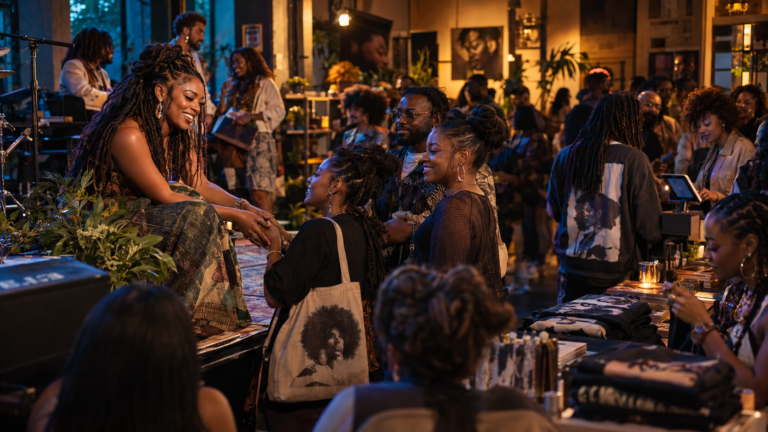
Black households now account for an estimated $272 billion in discretionary spending. That proves market significance. It does not reveal who owns the companies converting that demand into equity — and the difference is where the power sits.
The Half She Cannot Control
In October 2025, Reuters reported that LVMH had hired Evercore to explore a sale of its 50 percent stake in Fenty Beauty, the cosmetics company it co-owns with Rihanna. None of the parties publicly confirmed the process. By May 2026, the Financial Times and Reuters were still describing the stake as being considered for sale within LVMH’s broader portfolio pruning. Even the valuation reports diverged: Reuters sources placed the entire business at $1 billion to $2 billion, while the Financial Times later reported that JPMorgan valued LVMH’s half at €1.5 billion to €2.5 billion. Those are estimates, not a transaction price.
Fenty’s significance is not in doubt. When it launched in 2017 with 40 foundation shades, it did not invent demand among women with darker skin; it made the industry’s neglect visible and expensive. The brand reset the commercial standard. The potential stake sale exposes a different question: who controls the asset after the market has been proved? Rihanna controls her half. LVMH controls its half. The consumers whose demand made the launch consequential control neither side of the transaction.
A Trillion-Dollar Deck Slide
Black households accounted for $272 billion in discretionary spending on nonessential goods and services as of fall 2025, MRI-Simmons estimates — 14 percent of the U.S. total, up from $259 billion a year earlier and 44 percent over five years. In metropolitan Atlanta, Black households account for one-third of an estimated $45 billion in annual discretionary spending. These are not marginal-market numbers. Any brand ignoring them is making a growth decision, whether it admits that or not.
Nielsen gives marketers an even larger figure: projected Black buying power of $2.1 trillion in 2026, based on the University of Georgia’s Selig Center for Economic Growth. Buying power is income available for spending after taxes; it is not the amount actually spent, and it is certainly not wealth. Both figures establish commercial relevance. Neither identifies who owns the firms positioned to capture that demand.
Four Numbers, One Category Error
Four numbers routinely collapse into one story. Buying power is income available after taxes. Discretionary spending is the portion directed to nonessentials. Revenue is what a company books from sales. Equity is an ownership claim carrying economic rights and, depending on the structure, governance rights. They may move together, but they are not interchangeable. A community can expand the first three while holding very little of the fourth.
Much of the coverage built on Black-consumer statistics runs on exactly that error: it tracks money moving through households and into markets, then presents the total as if it proved power retained by those households. It doesn’t.
The Market Johnson Built — and Owned
Marketers have made this substitution for generations. In the postwar era, corporations began treating Black Americans as a distinct consumer market, often using the period’s language of the “Negro market.” John H. Johnson forced advertisers to take that market seriously. In 1952, he described it as $15 billion strong, “ripe and ready.” Proving that Black people bought products was only part of what Johnson achieved. Through Ebony and Jet, he owned one of the most important channels through which national advertisers reached them.
The distinction became stark decades later. Johnson Publishing sold Ebony and Jet in 2016 to Clear View Group. The remaining company filed for Chapter 7 liquidation in 2019. The audience did not disappear, and advertisers did not lose interest in reaching it. What disappeared was the original Black-owned institution that had converted knowledge of that audience into media power.
Pepsi took a different route to the same market, and it makes the point in reverse. The company began building a specialized Black-consumer marketing operation before World War II; in 1947, it revived and expanded the initiative under Edward F. Boyd, one of corporate America’s earliest Black marketing executives, whose team is credited with pioneering what marketers now call niche marketing and with cutting into Coca-Cola’s advantage in Black neighborhoods. The sales force was Black. The bottling plants, the distribution network and the balance sheet were not. Pepsi captured brand loyalty that outlasted Boyd’s tenure by decades. Ownership of the company doing the capturing never moved.
The same asymmetry keeps recurring: Black culture identifies demand, Black consumers validate it, and outside capital often owns the infrastructure that scales it. Agencies, distribution, retail shelf space, financing, data and acquisition markets determine who captures durable value. Discovery gets celebrated. Ownership is treated as a footnote.
What Eleven Corner Offices Actually Control
Fortune counted 11 Black chief executives on the 2026 Fortune 500 — a record — overseeing companies with $432 billion in combined annual revenue. The full list generated $21 trillion. Eleven seats represent 2.2 percent of the ranking, and Fortune reports that only 28 Black executives have held a Fortune 500 chief-executive role since the list began in 1955. This is meaningful representation, and proof of how narrow the path to the top remains. Ownership sits on a separate ledger entirely.
The pipeline helps explain the scarcity. A 2021 McKinsey study covering 24 companies and about 3.7 million U.S. employees found that Black workers made up 14 percent of employees, 7 percent of managers and 4 to 5 percent of senior-manager, vice-president and senior-vice-president roles. The distinction matters because executive authority is delegated through corporate governance. Public-company CEOs may receive substantial stock, but they do not ordinarily possess the controlling or founding stake that determines the residual economics of the enterprise.
Consumer-opportunity language can blur the same line. McKinsey estimated a $300 billion annual opportunity in meeting underserved Black consumer needs, including roughly $260 billion that consumers were willing to redirect toward companies serving them better. Those figures are valuable for strategy; they identify revenue at stake. They do not say whether the winning supplier is Black-owned, whether Black investors participate in the upside, or whether the gains strengthen Black institutions.
Fenty keeps the distinction visible because its 50-50 structure has been publicly reported — materially stronger than the royalty-only license most celebrity beauty lines settle for, since Rihanna holds actual equity rather than a fee. It also creates shared control. A sale of LVMH’s stake would not erase Rihanna’s ownership, but it could change her capital partner or activate rights governed by agreements the public has not seen. Calling the story a simple triumph of representation misses the capital structure.
Loyalty Without Governance
Demand can make a brand valuable without giving consumers governance. LVMH’s capital, Kendo’s operating platform and Sephora’s distribution helped Fenty reach global scale at a speed few independent beauty brands could match. Rihanna’s vision, cultural authority and equity were central to the same result. The structure worked because the partners contributed different assets. It also means control is divided, and the terms of a partner’s exit are governed by contracts consumers never see.
Fenty isn’t the only version of this trade-off. It may not even be the cleanest one to read. In November 2017, Unilever agreed to acquire Sundial Brands, the company behind SheaMoisture, Nubian Heritage and the Madam C.J. Walker Collection, in a transaction later estimated at $1.6 billion; Unilever never disclosed official terms. Forbes reported that founder Richelieu Dennis and his mother, Mary, who had co-founded the company with him, together owned 51 percent and stood to receive roughly $850 million before taxes. Dennis stayed on as chairman and chief executive, directed part of the proceeds into the New Voices Fund for women of color entrepreneurs, and stepped down from both roles in December 2019. SheaMoisture now operates as a wholly owned Unilever subsidiary alongside Dove and Axe.
The two structures do not produce identical outcomes. Dennis exercised full ownership by choosing a complete exit at a negotiated valuation — he was not cheated, he was paid, and paid well, for something that was entirely his to sell. Rihanna retains substantial equity in an ongoing business, but a partner’s proposed exit can still alter that company’s capital structure without originating from her side of the table. Both cases point to the same underlying truth from different directions: ownership matters most at the exact moment the asset’s future is being decided, and that moment doesn’t always arrive on the founder’s schedule.
Nielsen reports that 70 percent of Black consumers would stop buying from brands they believe devalue their community — real leverage, capable of denting revenue, reputation and valuation all at once. What it can’t do is buy a seat at the table. Consumers cannot appoint a director, exercise a contractual purchase right or sign an acquisition agreement. Their power is consequential, but it remains downstream from governance.
A Different Test for the Next Trillion
The answer is not to retire buying-power statistics. It is to label them honestly and stop asking them to prove what they cannot. Every large Black-consumer number should force a closer examination of what is being measured, which company books the revenue, who owns the equity and who has authority when the asset is financed, governed or sold.
Fenty is not a cautionary tale about Rihanna failing to own. She owns half of a globally scaled beauty business — an unusually substantial position. It is a warning against confusing cultural influence with unilateral control. The Black ownership decade will not be won by larger market-size headlines. It will be won when more of the companies converting Black demand into enterprise value remain Black-owned after the capital arrives, distribution expands and the exit conversation begins.
FOUR NUMBERS, FOUR DIFFERENT THINGS
$2.1 trillion — projected Black buying power for 2026, based on Selig Center data cited by Nielsen. This is income available for spending after taxes, not wealth or ownership.
$272 billion — Black household discretionary spending on nonessentials as of fall 2025, per MRI-Simmons. This is 14 percent of the U.S. total and a subset of broader buying power.
$432 billion — combined annual revenue of the 11 companies led by Black CEOs on the 2026 Fortune 500. It is revenue those executives oversee, not equity they collectively own.
$1–2B / €1.5–2.5B — conflicting valuation reports: Reuters sources estimated the entire Fenty Beauty business at $1 billion to $2 billion in October 2025; the Financial Times later reported that JPMorgan valued LVMH’s 50 percent stake at €1.5 billion to €2.5 billion in May 2026. Neither figure is a closed-deal price.