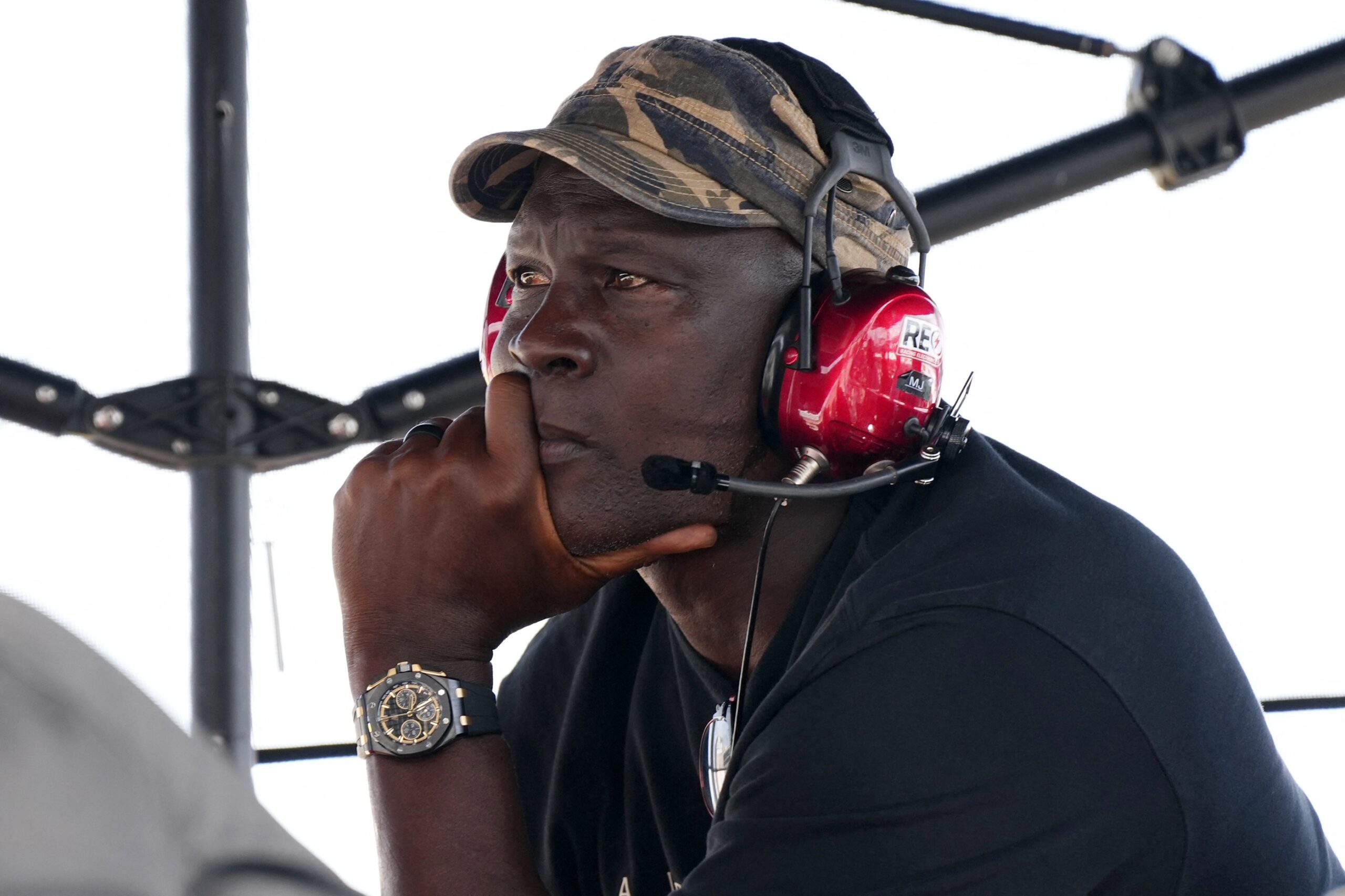
On October 2, 2024, Michael Jordan sued NASCAR. Not a rival team, not a driver, not a sponsor — NASCAR itself, the league his own team races in every weekend, along with its chairman, Jim France. The filing landed in federal court in Charlotte, in the middle of stock car country, from the most famous team owner the sport has ever had.
The short answer: he believes NASCAR operates as a monopoly that keeps most of the money and all of the power, and that the contract put in front of his team in 2024 was designed to lock that arrangement in for another seven years. The long answer is a story about a league where the teams don’t actually own anything — and about the one owner wealthy enough, and stubborn enough, to fight it.
The Team He Built
Jordan didn’t come to NASCAR as a celebrity tourist. In 2020 he founded 23XI Racing with driver [Denny Hamlin] — twenty-three from Jordan’s number, eleven from Hamlin’s — with Bubba Wallace behind the wheel of the first car. Jordan grew up in North Carolina, where stock car racing is close to a civic religion, and he wanted to own a team in it, not just lend his name to one.
The team got competitive faster than new teams usually do. Wallace won at Talladega in 2021, the organization’s first Cup victory. By 2024, Tyler Reddick had won the regular-season championship driving for 23XI. This was no vanity project. It was a functioning, winning business — which is exactly why the next part stung.
A League Where the Teams Own Nothing
Every other major American league is owned collectively by its teams. The NFL’s owners split billions and negotiate with players as a group. NASCAR is different: the France family privately owns the sanctioning body, and teams are independent businesses that pay their own drivers, crews, and travel bills in exchange for a share of the money.
That share is the whole fight. According to the complaint and widespread reporting, NASCAR teams receive roughly a quarter of the sport’s revenue, while the splits in football and basketball run close to half. The charter system — NASCAR’s version of a franchise — guarantees an entry in every race and a slice of the money, but the charter is only as strong as the rulebook, and NASCAR writes the rulebook.
In every other major American sport, the teams own the league together. In NASCAR, the league owns the teams.
The Contract Nobody Could Refuse
In late 2024, NASCAR offered teams a new charter agreement running through the end of the decade, tied to a reported $7.7 billion media rights deal. Per the lawsuit and reporting around it, the terms arrived on a take-it-or-leave-it basis: a signing deadline, no room to negotiate, a requirement that teams release every legal claim against NASCAR as the price of admission, and the removal of the automatic renewal that had made charters feel like real assets.
Thirty-four of thirty-six teams signed. Two didn’t: 23XI and Front Row Motorsports. The same day the deadline passed, the two teams filed suit in the U.S. District Court for the Western District of North Carolina, accusing NASCAR of monopolizing the market for top-level stock car racing under the Sherman Antitrust Act — of coercing signatures, devaluing charters, and punishing the teams that refused. NASCAR has denied the claims and maintains the agreement was fair and negotiated in good faith.
Racing Without a Net
The immediate problem was practical. 23XI had already arranged to buy a charter from the shutting-down Stewart-Haas Racing and asked the court to let it keep racing as a chartered team while the case proceeded. In December 2024, Judge Kenneth Bell denied the injunction.
So in 2025, Jordan’s team raced as an “open” team — no guaranteed protections, no charter revenue, full exposure every week. It didn’t collapse. Wallace won the Brickyard 400 that summer, an unchartered team taking one of the sport’s crown-jewel races mid-lawsuit, and Reddick kept the team competitive deep into the season. Meanwhile, discovery produced internal NASCAR communications that made for uncomfortable headlines, and the case survived NASCAR’s attempts to end it early, with trial scheduled for December 2025 in Charlotte — before a jury, if the teams get their way. Jordan has shown up to hearings in person, which tells you what this means to him.
He’s the only owner in the garage who cannot be economically threatened.
Why It Had to Be Him
Other owners had complained about NASCAR’s economics for years. None of them sued, and the reason is simple: suing the league you race in is expensive, retaliatory, and terrifying when NASCAR controls your access to the sport. Jordan is the exception. He’s a self-made billionaire with a shoe company that answers to nobody, fame that NASCAR needs as much as he ever needed NASCAR, and a career-long pattern of refusing bad numbers from an employer — the Bulls lowballed him once, and he built a brand instead.
Because He Could
Strip the courtroom language out and the answer holds in two sentences. He believes the deal in front of him was both illegal and bad business, and he’s the first owner in the sport’s history who could afford to find out which one in court. He didn’t sue because he stopped loving racing. He sued because he owns a team in it — and the numbers, as he sees them, said he was being underpaid. That has never been the kind of thing Jordan accepts quietly.
Common Questions About Michael Jordan’s NASCAR Lawsuit
Why exactly did Michael Jordan sue NASCAR?
The core claim is monopolization. Jordan’s team, 23XI Racing, argues that NASCAR and the France family control the market for top-level stock car racing — and use that control to keep roughly three-quarters of the sport’s revenue while teams eat most of the costs. The trigger was the 2024 charter agreement, which 23XI says arrived on take-it-or-leave-it terms with an impossible deadline and a requirement that teams surrender their legal claims as the price of admission. NASCAR denies all of it and says the contract was fair.
What does Michael Jordan own in NASCAR?
He co-owns 23XI Racing, founded in 2020 with driver Denny Hamlin. The name is their car numbers — twenty-three and eleven. It’s a real operation, not a celebrity badge: Bubba Wallace delivered its first Cup win at Talladega in 2021, and Tyler Reddick won the 2024 regular-season championship in the team’s fourth season.
What is a charter in NASCAR, and why does it matter?
A charter is NASCAR’s version of a franchise: it guarantees a team’s entry into every Cup race and a share of the sport’s revenue, including the media rights money. The problem, per the lawsuit, is that the charter isn’t owned property — it’s a revocable agreement governed by a rulebook NASCAR alone writes. Teams argue that makes their franchises worth far less than the equivalent asset in the NFL or NBA, where the teams collectively own the league.
Who joined Michael Jordan in the lawsuit?
Front Row Motorsports, owned by Bob Jenkins — making it two of the sport’s thirty-six chartered teams. The other thirty-four signed NASCAR’s agreement. Jordan is the face of the case because he’s the only owner in the garage who cannot be economically threatened; Front Row’s participation matters because it shows the grievances run beyond the sport’s newest and wealthiest team.
Did Michael Jordan’s team keep racing during the lawsuit?
Yes — and that’s part of what makes the story remarkable. 23XI asked the court to let it compete under the old charter terms while the case played out; a judge declined in December 2024. So the team ran the 2025 season as an “open” team with no charter protections, and Bubba Wallace still won the Brickyard 400, one of NASCAR’s crown-jewel races, in that configuration. The case survived NASCAR’s attempts to have it dismissed, with trial set for December 2025 in Charlotte.
Has NASCAR responded to the lawsuit?
Consistently, and predictably: NASCAR denies the charges, calls the 2024 agreement fair and the product of good-faith negotiation, and has fought the case in court rather than settle publicly. Courts have so far declined to kill the case early, which is why it reached trial. Beyond the courtroom, the lawsuit has already shifted the conversation — several team owners have spoken more openly about the sport’s economics since the filing.
What happens if Michael Jordan wins?
The honest answer: nobody knows, and that’s why the case matters. If 23XI and Front Row prevail, the most likely outcomes are either a negotiated revenue split closer to other major sports, structural changes to how charters work — or both, with NASCAR settling other teams’ claims alongside. If the teams lose, NASCAR’s charter model stands, and dissenting owners will have spent years and millions for nothing but the attempt. The verdict would reshape the sport either way, which is precisely why Jordan showed up to hearings in person.