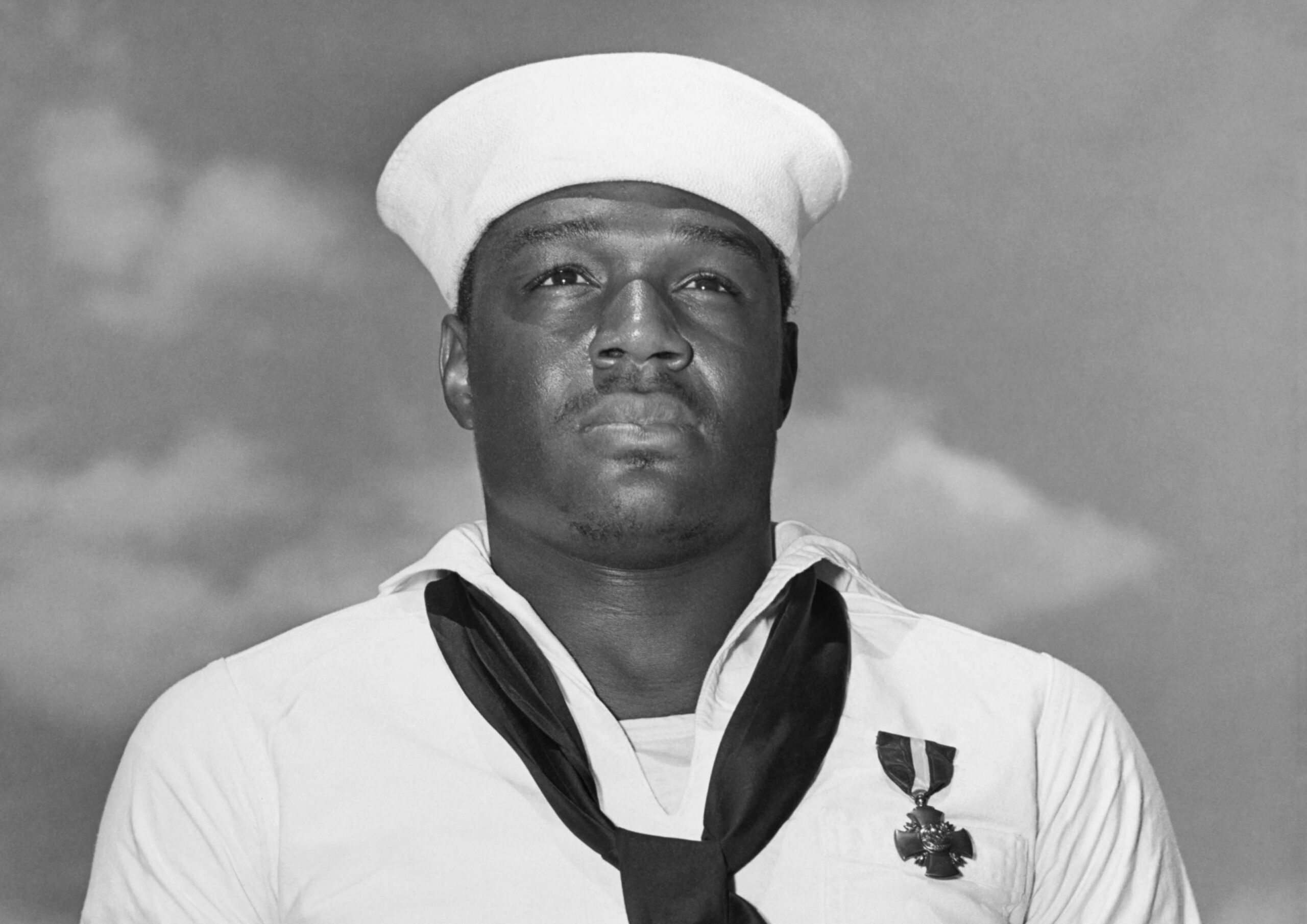
On January 18, 2020, Acting Secretary of the Navy Thomas Modly stood at Joint Base Pearl Harbor-Hickam on Martin Luther King Jr. Day and made it official. The fourth Ford-class supercarrier, CVN-81, would be the USS Doris Miller. Not an admiral. Not a president. A cook.
The announcement broke a century of tradition. Aircraft carriers, the most powerful warships in the U.S. fleet, had been named for battles, for revolutionary-era ships, for five-star admirals, and for presidents. Never for an enlisted man. Never for a Black sailor. In naming the ship after Miller, the Navy made a deliberate choice to honor a man who, in 1941, couldn’t even serve in a combat role. The ship’s registered name went into the Naval Vessel Register that day, six years before it was scheduled to enter service. A plaque had been unveiled. A family had attended the first cut of steel ceremony in August 2021. The name was not provisional.
But three sources familiar with internal discussions recently told CNN that the Navy is now working to rename the carrier. It’s unclear what the new name would be, though two of the sources said there have been internal conversations about naming it after President Donald Trump. That would be unprecedented. No aircraft carrier — no major U.S. warship of any kind — has ever been named for a sitting president. The effort, according to the sources, has been quietly underway since earlier this year, with Acting Secretary of the Navy Hung Cao’s office reviewing the official guidance for how ships can be named and specifying whether presidents should be included.
“Doris Miller earned his place in American history through courage, sacrifice, and service.” — Derrick Johnson, NAACP President and CEO
The Man Who Wouldn’t Stay in His Lane
Doris “Dorie” Miller was born on October 12, 1919, in Willow Grove, Texas. His father was a sharecropper. The family worked a 28-acre farm, and Miller played football in high school before dropping out to help support them. He took a job as a cook at a small restaurant during the Great Depression. In September 1939, less than a month before his twentieth birthday, he enlisted in the U.S. Navy at the Dallas recruiting station. He wanted to see the world. He needed to send money home. The Navy gave him a job as a mess attendant — the only role available to Black sailors at the time.
By December 7, 1941, Miller was a Mess Attendant Second Class aboard the USS West Virginia, stationed at Pearl Harbor. That morning, he was collecting laundry below decks when the Japanese attack began. The alarm sent him to his battle station — an antiaircraft gun magazine amidships — but a torpedo had already destroyed it. So Miller did something else.
He went topside and began dragging wounded shipmates through burning, oil-slicked water to safety. He carried men on his shoulders, wading waist-deep through fuel and fire. Among those he saved was the ship’s mortally wounded captain, Mervyn Bennion. Then Miller did what he was never trained to do. He grabbed a .50-caliber Browning antiaircraft machine gun — a weapon he’d never fired — and opened fire on Japanese planes. A ship’s officer, Lieutenant Frederic H. White, had ordered Miller to help load ammunition. But when White looked again, Miller was firing one of the guns himself. He kept shooting until he ran out of ammunition and was ordered to abandon ship. He was officially credited with downing at least two Japanese aircraft.
“I think I got one of those Jap planes. They were diving pretty close to us.” — Doris Miller
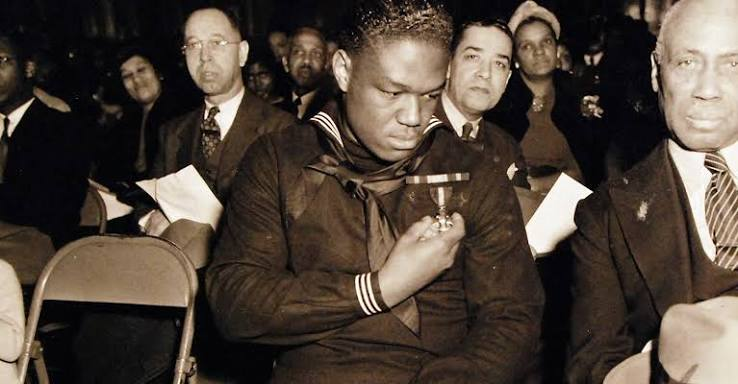
Six months later, on May 27, 1942, Admiral Chester Nimitz stood aboard the USS Enterprise and pinned the Navy Cross on Miller’s chest. He was the first Black sailor to receive the Navy’s second-highest honor. He was twenty-three years old. Eighteen months after that, on November 24, 1943, Miller was killed when a Japanese torpedo sank the USS Liscome Bay during the Battle of Makin. He never saw his name on a ship. He never knew a carrier would one day carry it.
The Pentagon Won’t Say His Name Anymore. Just CVN-81. Four Characters Erasing a Man.
Here’s the detail that stops you cold: nobody at the Pentagon calls it the USS Doris Miller anymore. Internally, in memos and briefings, the carrier is referred to only by its hull number, CVN-81. A White House executive order signed on August 13, 2026, addressing naval shipbuilding, referred to the vessel exclusively as CVN-81, making no mention of Miller. The Navy has effectively stopped saying the name aloud.
That’s not speculation. It’s documented usage. And it’s the kind of bureaucratic tell that precedes a final decision. The keel-laying ceremony — the formal moment when construction begins in earnest — is scheduled for the end of 2026. Whatever name goes on the steel needs to be decided before then, or it doesn’t get decided the easy way at all. The ship isn’t expected to be delivered until 2034 due to shipbuilder constraints, but the keel-laying imposes a hard deadline.
“Whoever is talking about trying to rename this ship for President Trump is doing him a real disservice.” — Senator Jack Reed
The Offer: A Lesser Ship and a Medal — If They Can Take the Carrier Back
The Navy’s reported proposal, according to CNN’s sources, involves a swap: Miller would get a different, unnamed warship named after him, and the administration would recommend him for the Medal of Honor — the military’s highest decoration, one step above the Navy Cross he already earned. Final approval would require both Congress and the president. The same president whose name is reportedly being considered for the carrier that was supposed to belong to Miller.
For the family, the Medal of Honor recommendation is “very positive.” Thomas Bledsoe, Miller’s great-nephew, said the family has been working for years to secure the higher honor. But he also said the family was not informed of the potential name change. The news “comes as a shock.” The Navy’s proposal, on its face, sounds like a generous upgrade. A higher medal. A ship of some kind. But the arithmetic changes when you sit with it: a medal in exchange for a name that had already been announced, already celebrated, already entered into the official register. A smaller vessel in exchange for the one that already had a plaque, a ceremony, and six years of institutional memory built around it.
No Sitting President Has Ever Had a Warship Named for Him. Trump Would Be First.
Every outlet covering this story reaches for the same word: unprecedented. It’s one of those journalistic clichés that usually signals “unlikely.” Here it means something closer to “untested.”
Aircraft carriers have been named for presidents before — USS Abraham Lincoln, USS George H.W. Bush, USS Ronald Reagan, USS George Washington, USS Theodore Roosevelt, USS Harry S. Truman, USS Gerald R. Ford. But none of those ships were named while their namesakes were in office. The USS Nimitz was named for the admiral who presented Miller with the Navy Cross. The USS Carl Vinson honors a Georgia congressman who chaired the House Naval Affairs Committee. There’s no legal prohibition against naming a carrier for a sitting president. There’s just no precedent.
The renaming commission convened in 2025 under former Secretary of the Navy John Phelan had a particular view. Phelan believed aircraft carriers should be named only after presidents, admirals, and consequential Navy battles. He requested a study from the Naval History & Heritage Command on the issue, but was removed before the review was complete. The commission came amid broader Pentagon efforts under Defense Secretary Pete Hegseth to remove names selected for what the administration considers diversity, equity, and inclusion purposes. In 2025, Trump ordered the Navy to rename the USNS Harvey Milk, which honored the Navy veteran and gay rights activist.
To Be Fair: The Sources Are Anonymous. Nothing Is Official. The Navy Says “Nothing to Announce.”
It’s fair to acknowledge the strongest counter-argument to this entire story: nothing has been finalized. The Department of Defense told CNN they had “nothing to announce at this time.” Snopes examined the CNN reporting and left the claim “unrated,” noting it could not independently verify the anonymous sourcing. Three unnamed officials telling a reporter something isn’t a signed order. The carrier might keep Miller’s name. The internal conversations might stay internal and die there. The keel-laying could happen with the name USS Doris Miller still on the steel, and the controversy would recede into a footnote about discussions that never materialized.
The Navy has also offered what looks like a genuine upgrade for Miller’s legacy: the Medal of Honor recommendation. If approved, Miller would receive the decoration he arguably deserved all along, and a different ship would carry his name. For some, that might feel like a fair exchange — one that rectifies a historical oversight while also adhering to what they see as the proper naming tradition for aircraft carriers. The tradition of naming carriers for presidents isn’t arbitrary; it reflects the symbolic weight of the vessel. Miller’s name could still be honored, just on a different hull. The outrage, from this perspective, might be premature.
But the quiet removal of the name from internal Navy documents and the White House executive order suggests the conversation is further along than a casual rumor. And the decision to strip Miller’s name — after it was already given, already announced, already celebrated — is not a matter of tradition. It’s a reversal. Traditions are about consistency. This is something else.
The Steel Gets Cut This Year. The Name Gets Decided Before Then. Or It Doesn’t.
The carrier has been reduced to four characters and two numbers in official communications: CVN-81. It’s a bureaucratic shorthand that does its work silently. A name carries a story. A hull number carries nothing. The NAACP released a statement condemning the potential change. “Doris Miller earned his place in American history through courage, sacrifice, and service,” said President and CEO Derrick Johnson. “This is a slap in the face to every war hero and to every service member who has worn the uniform.” Senator Jack Reed, the top Democrat on the Senate Armed Services Committee, weighed in: “Whoever is talking about trying to rename this ship for President Trump is doing him a real disservice and making him look like he’d be willing to seize a World War II hero’s honor.”
Doris Miller spent thirty seconds behind a gun he’d never touched, protecting men who, six years earlier, wouldn’t have let him eat in their mess hall as an equal. He was a mess attendant in a Navy that saw him as a servant. He became the first Black sailor to receive the Navy Cross. He died at 24, in the Pacific, on a ship that sank beneath him. The Navy gave him the honor of a carrier name in 2020. The same administration that announced the name might now strip it off.
The keel-laying is scheduled for the end of 2026. The ship is still in a shipyard, unfinished. Names are not permanent until the steel is laid. But the steel has been cut. The plaque has been made. The name is in the register. And nobody at the Pentagon is using it.