

Charlie Kirk’s Banner at U.S. Education Department Sparks Debate

Share
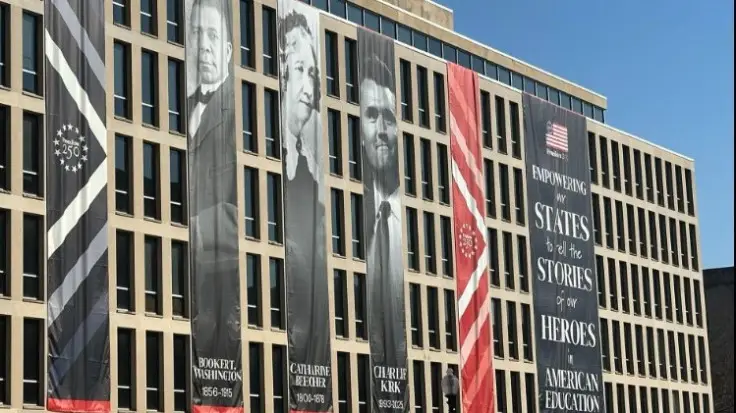
A large banner featuring the late conservative commentator Charlie Kirk now hangs prominently from the façade of the U.S. Department of Education headquarters in Washington, D.C. This has ignited a fierce public debate about political symbolism and the role of government institutions in shaping national narratives.
The display was installed on March 1 as part of the federal government’s America’s 250th anniversary celebration. It places Kirk’s image alongside those of historically significant figures. These include Benjamin Franklin, Martin Luther King Jr., Catharine Beecher, Booker T. Washington, and Anne Sullivan. A nearby banner reads, “Empowering Our States to Tell the Stories of Our Heroes in American Education.”
Kirk was a 31‑year‑old and the founder of Turning Point USA. The suspect, a 22‑year‑old Tyler Robinson, had shot and killed him while speaking at a campus event at Utah Valley University. This happened in September 2025. The court charged Robinson with aggravated murder and other offenses, with prosecutors seeking the death penalty.
The placement of Kirk’s image on the Department of Education building has drawn both praise from conservative allies and sharp criticism from opponents. Many question the appropriateness of honoring a contemporary political activist on the exterior of a federal agency.
In a statement to USA TODAY, Education Department Press Secretary Savannah Newhouse defended the initiative. It says it is part of a broader effort to celebrate individuals. These are those “whose contributions have shaped the future of education for generations.”
But outside the department, online backlash has met with the decision. According to reports, critics on social media pointed to Kirk’s own record and to remarks he made during his career. Such is what opponents describe as incendiary, sexist, and racist. “He dropped out of community college,” one commenter wrote. He added, “that’s the guy that has a banner on the Department of Education?”
Some critics have also highlighted what they see as an ironic contradiction. They stated Kirk was, in recent years, a vocal critic of the Department of Education, calling for its abolition. This is a stance that many see as undermining the institution now bearing his likeness.
Supporters of the tribute frame it differently. To conservative allies, Kirk was more than a commentator. He was a transformative figure in American political engagement, especially among young voters. Turning Point USA, which he launched while still a teenager, became a major force in campus politics. It championed fiscal conservatism, free markets, and what he described as free speech for dissenting viewpoints.
The episode comes amid a broader pattern of controversial banner installations on federal property. Earlier this year, a large portrait of President Donald Trump hangs at the Department of Justice. It underscores how visual tributes on government buildings have become fodder for political contention.
As debate over Kirk’s image on the Education Department persists, many observers say the incident highlights deeper tensions in American politics over who gets to define the nation’s heroes. Also, how government institutions should engage with contemporary figures whose legacies people are still contesting.