In 2015, the fitness apparel market was a bloodbath. Nike and Adidas dominated with massive advertising budgets, while Gymshark was a struggling UK startup with £8 million in revenue and a problem: traditional customer acquisition was eating their margins alive. The digital landscape was shifting—social media was becoming the new town square—but most brands treated it as a vanity metric department, a place to post pretty pictures and hope for engagement.
Elf Samba bet everything on an unproven strategy: building a community-first growth engine instead of buying customers through paid ads. If he failed, Gymshark would remain a niche player, outspent and outmaneuvered by incumbents. The probability of failure was real—most startups that tried to “build community” ended up with nice Instagram feeds and empty bank accounts.
Samba rejected the transactional influencer marketing playbook. Instead of paying for one-off sponsored posts, he built long-term ambassador relationships with fitness creators, giving them affiliate codes and making them genuine stakeholders in Gymshark’s success. He shifted content from polished brand advertisements to raw, high-frequency lifestyle posts that felt authentic. He mapped every piece of community engagement to a five-tier commercial funnel: Awareness → Consideration → Conversion → Retention → Advocacy.
The numbers speak for themselves. Under Samba’s leadership, Gymshark’s digital community exploded from 1.5 million to over 20 million followers across platforms. Revenue scaled from £8 million to a £1.4 billion valuation. The brand didn’t just grow—it created a self-sustaining ecosystem where customers became unpaid marketers, driving organic growth that paid advertising couldn’t touch.
The Code Behind the Growth Engine
Rule One: Trust Compounds Attention Evaporates
Paid advertising temporarily rents consumer attention; when the ad spend stops, the traffic disappears. Build owned community assets that create permanent relationships with consumers.
“Attention is rented. Trust is owned.” – Elfried Samba
Application: At Gymshark, Samba shifted budget from traditional advertising to long-term creator partnerships. Instead of renting an influencer’s audience for a single campaign, he integrated Gymshark into creators’ actual lifestyles through multi-year contracts and affiliate commissions. This turned content creators into genuine brand stakeholders who promoted Gymshark because it benefited them financially, not because they were paid a one-time fee.
Rule Two: Strip the Corporate Jargon, Keep the Human
Enterprise communication must abandon transactional pitching and corporate buzzwords in favor of entertainment, shared cultural values, and genuine human connection.
People don’t connect with logos, they connect with people. The moment a brand starts sounding like a corporation, you’ve already lost the room.” – Elfried Samba
Samba’s personal LinkedIn presence exemplifies this rule. With 415,000+ followers and 500 million lifetime impressions, he writes exactly how he speaks—no artificial fluff, no walls of text, no buzzwords. His content uses single-sentence lines, generous line breaks, and conversational tone. This approach earned him the #2 global ranking for B2B engagement on LinkedIn, proving that human communication outperforms corporate polish every time.
Rule Three: Map Community to Commerce
Reject isolated social media metrics (likes, shares) and map every community investment directly to a five-tier commercial funnel that ends in revenue.
Samba built Gymshark’s entire content strategy around a strict funnel: Awareness (get discovered) → Consideration (build trust) → Conversion (drive transaction) → Retention (lower churn) → Advocacy (turn customers into marketers). Every piece of content, every creator partnership, every community initiative was measured against its position in this funnel—not by vanity metrics but by commercial impact.
The Scar That Shaped the Strategy
Before Gymshark, Samba watched countless SMEs pour money into paid advertising, trying to compete with corporate giants on their terms. He saw them rent attention through ads, only to watch their traffic evaporate the moment budgets tightened. The failure wasn’t his own—it was an industry-wide blind spot he witnessed repeatedly: brands building on rented land instead of owning their audience relationships.
In 2012, while still in university, Samba authored a thesis detailing how SMEs could weaponize organic social media architectures to steal market share from massive corporate incumbents. This wasn’t academic theory—it was a battle plan. He learned that paid acquisition was a trap for resource-constrained companies. The specific behavioral change: he stopped measuring marketing success by reach or impressions and started measuring it by owned audience growth and commercial funnel progression. At Gymshark, this meant rejecting short-term sponsored post deals in favor of building long-term creator equity—a strategy that took patience but created defensible competitive advantage.
The Power Players in Elfried’s Corner
The Backers: Samba’s primary capital and board support come from blue-chip enterprise clients who trust him with their most valuable asset: their community. Netflix, Bumble, McDonald’s, Meta, Formula E, and Square have all entrusted Butterfly Effect with building their proprietary community infrastructure. These aren’t just clients—they’re validation that his methodology scales beyond fitness apparel into any consumer-facing industry.
The Protégés: Through Butterfly Effect’s decentralized team operating across London, Manchester, New York, Atlanta, Los Angeles, and Dubai, Samba has mentored a new generation of community architects who reject traditional marketing orthodoxy. His podcast partnership with Rory Sutherland—legendary advertising veteran and Vice Chairman of Ogilvy—positions him as a thought leader shaping how enterprises think about behavioral economics and community building.
The Access This network grants Samba something rare: real-time intelligence on how the world’s largest brands are navigating the shift from paid to organic growth. He sees patterns across industries—what works for Netflix’s community strategy, what fails for McDonald’s, how Meta approaches creator partnerships. This cross-industry visibility gives him predictive insight into market shifts that single-industry operators miss.
The Playbook You Can Use Today
Stop measuring your social media success by likes and follower counts. Start mapping every piece of content to a specific stage in your commercial funnel. Ask yourself: Does this post drive Awareness, build Consideration, push Conversion, improve Retention, or spark Advocacy? If you can’t answer that question, don’t publish it.
Then, audit your creator partnerships. Are you renting influencers for one-off campaigns, or are you building long-term relationships where creators have skin in the game through affiliate commissions or equity? The former gives you temporary reach; the latter builds a self-sustaining marketing army.
Finally, strip the corporate jargon from your next LinkedIn post or email campaign. Write like you speak. Use single sentences. Break up walls of text. Sound human. The data is clear: conversational tone outperforms polished corporate communication every single time.
Visualizing The Growth Trajectory
The Gymshark Community Growth Engine (2015-2022)
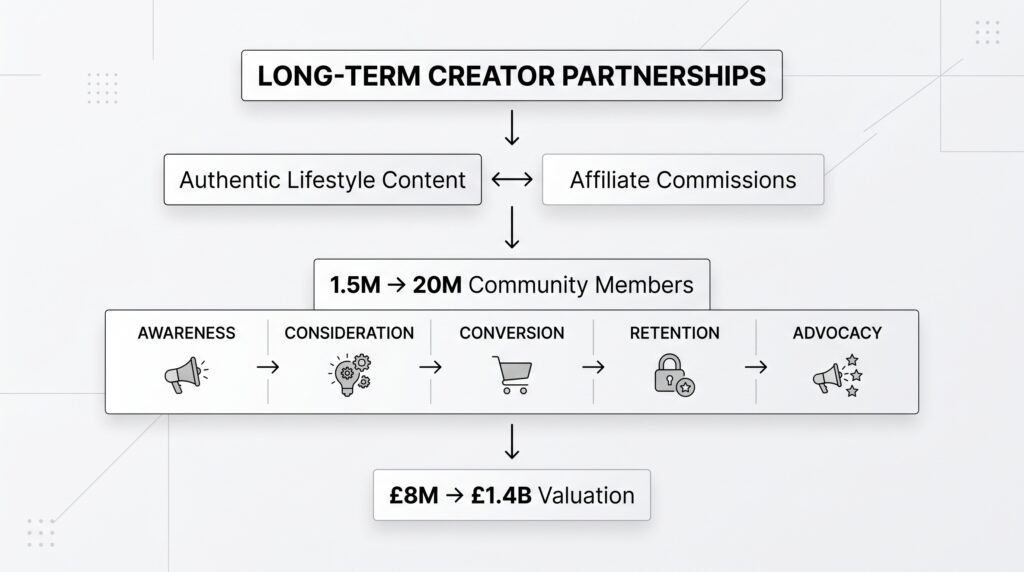
Key Insight: The chart works because each stage feeds the next. Creators drive awareness → community builds consideration → commercial funnel converts → retention keeps customers → advocacy turns them into marketers who attract new creators. It’s self-reinforcing.
Frequently Asked Questions
Is Elfried Samba’s strategy just “influencer marketing”?
No. Traditional influencer marketing is transactional—you pay for a post, and the relationship ends. Samba’s model is structural. He builds long-term equity partnerships where creators have financial skin in the game (via affiliate commissions) and are integrated into the brand’s lifestyle. This turns them from temporary advertisers into permanent stakeholders who drive organic growth even when the brand isn’t paying for a specific campaign.
How does he measure success if not by likes and shares?
Samba rejects vanity metrics. He uses a five-tier commercial funnel: Awareness, Consideration, Conversion, Retention, and Advocacy. Every piece of content or community initiative is mapped to one of these stages. Success is measured by how effectively the community moves people down this funnel toward revenue and long-term loyalty, not by how many times a post was liked.
Can this “community-first” approach work for boring B2B industries?
Yes. While Samba made his name in fitness (Gymshark), his agency, Butterfly Effect, currently applies this same framework to enterprise giants like Netflix, Meta, and McDonald’s. The core principle—shifting from transactional pitching to genuine human connection and owned trust—is industry-agnostic. It works anywhere there is a human on the other side of the screen.
What is the biggest mistake brands make when trying to copy his playbook?
The biggest mistake is treating community as a “vanity metric” department rather than a core growth driver. Brands often try to “buy” community through short-term ad spend or one-off influencer posts. Samba’s data shows that attention is rented, but trust is owned. If you stop paying for ads, the traffic stops. If you build genuine trust, the community sustains itself.
Why is Elfried Samba ranked #2 globally on LinkedIn?
His ranking isn’t an accident; it’s the result of a repeatable content engine. He uses a strict 4-point checklist: a thumb-stopping hook, high skimmability (no walls of text), logical flow from problem to solution, and a conversational tone that strips out all corporate jargon. He writes exactly how he speaks, which resonates more with professionals than polished, artificial corporate PR.