
Christopher J. Williams recognized an opportunity where others saw a closed market. In 2001, he founded The Williams Capital Group with a strategy focused on institutional transactions, with expertise in fixed income, and building trust one deal at a time.
Instead of competing on size, the firm aimed to provide reliable performance and develop relationships with major corporations, government agencies, and institutional investors.
Over the years, this approach positioned the firm to participate in corporate debt and equity offerings worth more than $330 billion, a milestone that showed how a minority-owned investment bank could carve out a place in one of finance’s toughest fields.
The Strategy: Turning Small Size Into an Advantage
Williams took his biggest risk in 1994 when he left the security of established Wall Street firms to start Williams Capital with three former Lehman Brothers colleagues. The founding team grew to five employees within weeks, but even one of the earliest hires doubted whether a small, client-focused investment firm could compete.
The structural disadvantage was obvious. Williams Capital couldn’t match the balance sheet, product range, staffing, or distribution power of major investment banks. Williams later said he spent almost six months developing the business plan, focusing on one question: where could a smaller firm compete without suffering because of its size?
The financial risk became clear right away. The firm initially focused on complex transactions involving derivatives, but that business weakened when interest rates rose in 1994. Williams reportedly had to use his own money to keep the company afloat. He chose to change the model instead of sticking to it.
Williams Capital moved into brokerage, asset management, fixed-income underwriting, and other simpler services that generated lower margins but produced more consistent revenue.. It emphasized senior attention and objective advice—rather than financial size—as its competitive edge. Williams noted that the firm sometimes advised clients against going through with a proposed transaction, even if it meant giving up a potential fee.
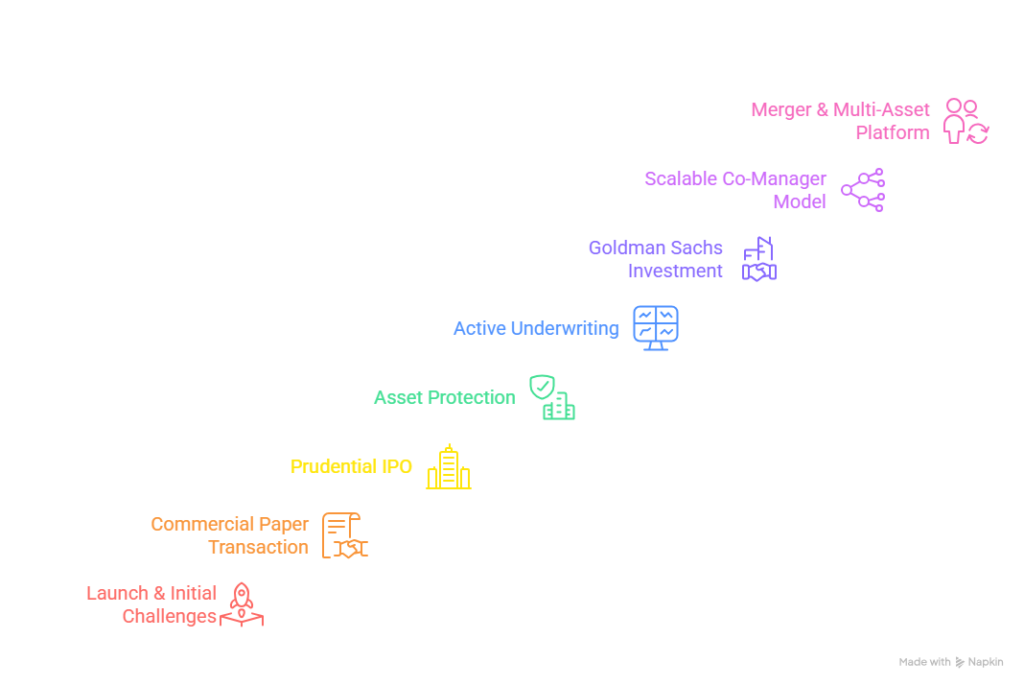
The first significant proof of this approach was a $100 million financing for Sallie Mae. Williams had worked with the organization at Lehman, and its finance executives agreed to continue working with him if his independent firm could deliver the same quality of execution. This transaction gave Williams Capital the institutional credibility to approach other large issuers.
The model then expanded into mainstream corporate finance. Williams Capital worked on a commercial-paper transaction for Colgate-Palmolive in 1996 and served as senior co-manager of Prudential Financial’s $3.5 billion initial public offering in 2000. In 2008 alone, the firm led or co-managed over $320 billion in corporate debt, agency, and equity offerings.
Strategy: The Small-Firm Operating System
Compete Where Size Becomes an Advantage
Do not imitate a competitor whose capital and infrastructure you cannot replicate. Identify areas where speed, senior attention, specialization, or flexibility matter more than size. During his interview with Pathway to Success, Williams mentioned, “I had to pick and choose where, by being a small firm, I am not at a competitive disadvantage?”
Williams Capital did not aim to offer everything that Lehman offered. It focused on transactions where customized structuring, relationships, and direct access to senior professionals could set it apart. The $100 million Sallie Mae financing demonstrated that a smaller institution could land large-company mandates without having a big-bank balance sheet.
Protect the Downside Before Pursuing the Upside
Avoid risks that could destroy the organization, even if that conservative stance limits profits during good markets. During his interview with LEADERS, he said,
We have managed our downside risk to limit exposure to significant swings in the market.
In June 2008, Williams moved 100% of Williams Capital Management’s assets into government money-market funds. The move lowered potential returns but shielded shareholders when the financial crisis worsened in September and helped maintain the top credit ratings of the funds.
Williams also avoided financing very large trading positions with debt. This cut down the firm’s ability to profit aggressively during favorable market movements but made it less vulnerable to market downturns.
Optimize for the Relationship, Not One Transaction
A long-term client relationship is often worth more than the margin or fee from a single transaction.. Williams said, “We’ll eat that loss,” while discussing a trade impacted by a miscommunication between the firm and a client.
Williams Capital accepted the entire loss rather than split responsibility with the client. According to Williams, this approach led the client to direct more business to the firm, showing that its interests came first.
This principle also shaped the company’s willingness to take on smaller, lower-margin projects that major banks might dismiss as unimportant. Every successful transaction strengthened trust and increased the chances of securing larger jobs later.
The Rate Shock That Broke the First Model
Williams Capital’s original strategy did not withstand its first major market test. The firm entered the market with a specialized, high-margin derivatives business. However, when interest rates rose in 1994, demand decreased, and the business suffered. Williams had to inject personal funds to keep the company operating.
The lesson was not that complex financial products were inherently flawed. The issue was revenue concentration: the firm relied too heavily on a specialized service whose economics could change quickly.
Williams changed three elements of the operation:
– Revenue frequency: The firm added lower-margin services that provided more regular business.
– Business diversification: It expanded into brokerage, underwriting, and asset management.
– Risk exposure: It adopted a cautious balance-sheet stance and avoided high-leverage positions.
This failure transformed Williams Capital from a transaction-dependent specialist into a diversified financial services platform.
The Power Network
Institutional Backers
Sallie Mae provided the first major validation through its $100 million financing deal. In 2009, Goldman Sachs allocated $1 billion to Williams Capital Management for investment in US Treasury and agency securities, roughly doubling the firm’s assets under management.
By 2019, Williams Capital had participated in more than 900 debt and equity offerings over the past five years and had collaborated with more than 65 Fortune 100 companies.
Operator Bench
Williams built an employee-owned organization and developed a group of senior operators who later owned equity in the merged business. The 2019 merger documentation listed executives such as Janice Savin Williams, Sean P. Duffy, David Coard, and David Finkelstein among the equity holders of the combined organization.
Strategic Access
Williams’ network provided three forms of leverage:
– Corporate access: Relationships with treasury teams and finance executives created repeat deal flow from large issuers.
– Institutional distribution: Connections with asset managers and investors improved the firm’s ability to place securities and show demand.
– Management intelligence: Williams’ board experience at companies like Walmart, Clorox, Ameriprise Financial, Cox Enterprises, and Union Pacific gave him direct insights into corporate strategy, governance, audit, and capital-allocation decisions. He currently serves as chairman of Siebert Williams Shank following Williams Capital’s 2019 merger with Siebert Cisneros Shank.
The network was not valuable just because it included influential names. It connected Williams Capital to both sides of a financing transaction: corporations looking for capital and institutions that could provide it.
Strategic Takeaway: Write a Small-Firm Advantage Memo
Before entering a market dominated by larger competitors, create a one-page memo addressing four questions:
– Structural disadvantage: What can the incumbents do that your company cannot realistically match?
– Small-company advantage: Where do their size, bureaucracy, or junior staffing create a weakness?
– Anchor transaction: Which reputable first client could eliminate the market’s biggest objection to trusting you?
– Risk ceiling: What single exposure could ruin the company, and what limit will prevent it?
Do not enter the market until the second answer is more detailed than “better service.” Williams Capital’s advantage was operational: senior bankers remained involved, advice could be customized, smaller transactions received attention, and the firm carried less balance-sheet risk.