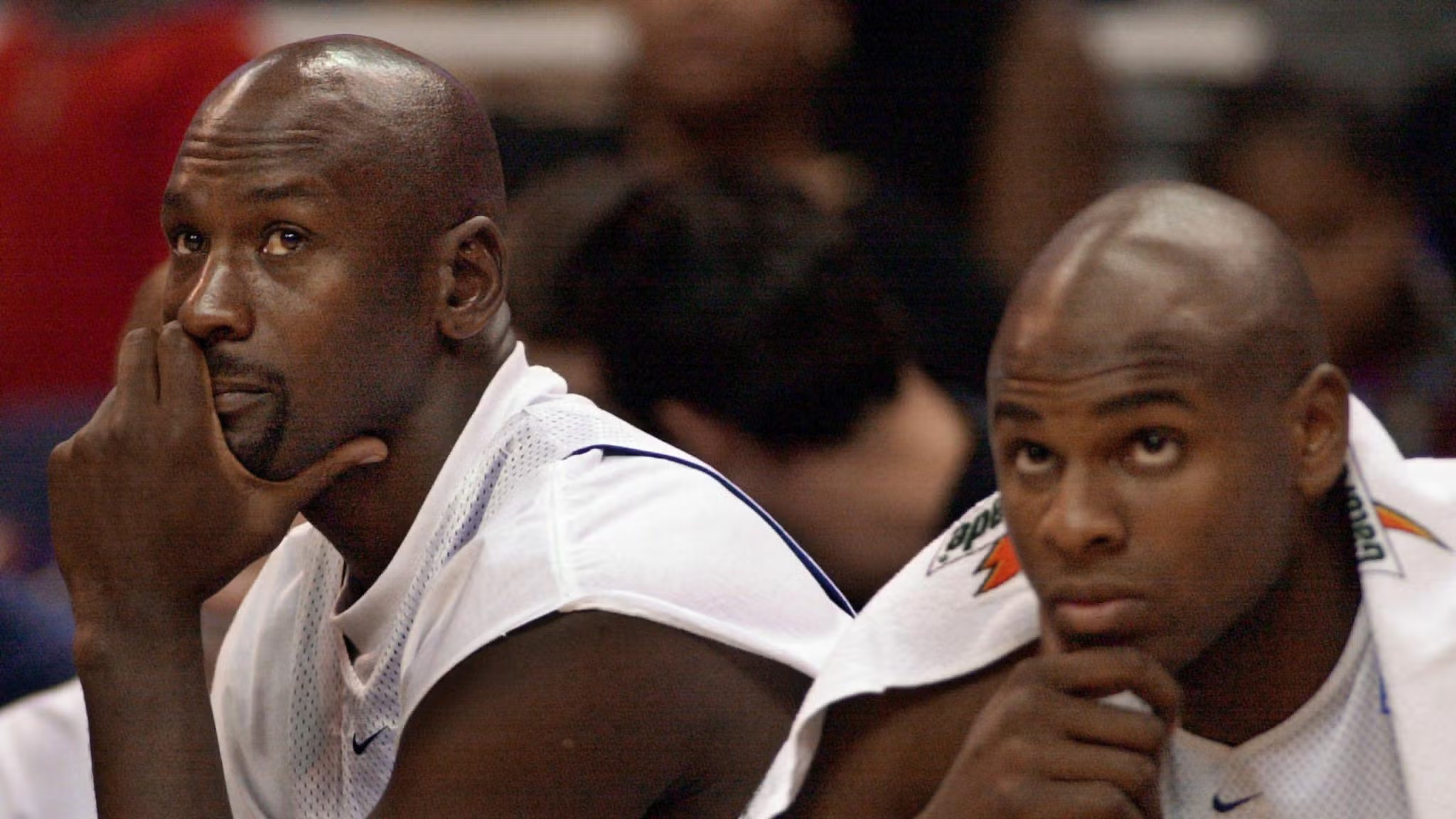
By the time Michael Jordan put on a Washington Wizards uniform, his legend was already complete. Six championships, two retirements, a highlight reel that needed no help. The two Wizards seasons, 2001 to 2003, have mostly been remembered as a late victory lap — an older superstar putting up good numbers on a bad team while the league moved on.
For the young players sharing that locker room, it was something else entirely. Brendan Haywood, then a young center trying to establish himself, spent those seasons watching the machinery behind the mythology up close. The stories he tells about it years later went viral for a simple reason: they show what greatness actually costs on a random Tuesday, not in Game 7.
“Why’d I beat you here?”
The one Haywood tells most isn’t about a shot. It’s about an empty gym.
He arrived at the facility around 10 a.m. for an 11 o’clock practice, early enough that he expected the place to himself. Instead he found Jordan — forty years old, on a scheduled day off — already drenched, finishing a full workout that had started hours earlier.
Haywood asked him what he was doing there on his day off. Jordan’s answer is the part that stuck to the whole roster: “You’re asking the wrong question. The question isn’t ‘what am I doing here?’ The question is ‘why’d I beat you here?'”
“The question isn’t ‘what am I doing here?’ The question is ‘why’d I beat you here?'”
You can argue about whether the line was mentorship or psychological warfare. Haywood’s telling suggests it was both, and that the distinction didn’t matter to Jordan. The message landed the same way either way: the oldest player in the building, with two bad knees that regularly needed fluid drained and nothing left to prove to anyone, had beaten the twenty-somethings to work. After that, nobody on the roster had a convenient excuse again.
The standard Jordan practiced by was strange to watch precisely because the stakes were so low. These were winter games against teams like Chicago and Cleveland, in a lost season. He treated the shootarounds like they had a trophy attached anyway. Young players learn fast when the example is that consistent, and Haywood says the group recalibrated within weeks — not because anyone gave a speech, but because the alternative was getting visibly outworked by a man twice their age.
He Studied You Too
The gym was only half of it. The other half was preparation that most veterans had long stopped bothering with.
Haywood says Jordan still devoured scouting reports at an age when he’d earned the right to wing it, and he used them in a very specific way: he knew every young player’s weakness and attacked it on purpose, forcing right-handed defenders to their left on every possession until they fixed it or disappeared from the rotation. In practice, he’d pick at a player’s pride deliberately, day after day, to find out what the baseline was. Some guys folded. The ones who didn’t got better and knew exactly why.
It’s a less flattering picture than the motivational-poster version of Jordan, and that’s what makes it credible. This wasn’t a man generously passing down wisdom. It was a competitor who happened to be forty, testing people the only way he knew how.
The $15,000 tab
Then there’s the story that proves the aura wasn’t only about work.
Jordan invited the young guys out to a club one night — a rare event. For about forty-five minutes he stood there while the entire venue stared at him, and then, without ceremony, he slipped out through the back. The check landed on Haywood and fellow young big man Jared Jeffries: fifteen thousand dollars, on rookie-scale salaries.
Haywood’s negotiation with the promoter has become the punchline of the whole saga. “Have you ever tried to get blood from a turnip?” And then two seven-footers did the fastest exit of their professional careers.
“Have you ever tried to get blood from a turnip?”
Why the Stories Stick
Documentaries like The Last Dance give you the Finals, the trophies, the curated version. What Haywood’s accounts give you is the Tuesday morning — the empty gym, the drained knee, the tab that never got paid. That’s why they keep traveling. There’s no PR polish on a story where the greatest player alive sticks two rookies with a dinner bill.
Strip the polish out and what’s left is almost boring, which is the point. The best player who ever lived was forty years old and still got to the gym first, still read the scouting report, still competed in games that didn’t count. None of that is talent. Habits like that compound the same way money does, quietly and then suddenly — the same engine that got Jordan to the facility at eight in the morning is the one that later made him a billionaire long after the sneakers were hung up.
Haywood’s takeaway from two seasons of all this wasn’t inspiration. It was arithmetic. If the forty-year-old with nothing to prove is beating you to work, the gap between you and him isn’t ability. It’s the morning.
Common Questions About Michael Jordan’s Wizards Years
Did Michael Jordan really stick Brendan Haywood and Jared Jeffries with a $15,000 club tab?
That’s the story as Haywood tells it, and he’s told it more than once with the same details: Jordan invited the young guys out, stood around for about 45 minutes while the club stared at him, slipped out the back, and left the bill to the rookies. Haywood’s famous reply to the promoter — “have you ever tried to get blood from a turnip?” — and the subsequent sprint out the door are the parts that made it legend. Worth remembering it’s a locker-room anecdote told for laughs two decades later, not a court record. Nobody has ever disputed it, including Jordan.
Why did Jordan even play for the Wizards?
Officially: he came out of retirement as president of basketball operations, then returned as a player because the competitive itch never left and he wanted to rebuild the franchise he partly ran. Unofficially, per everyone who watched those seasons: the man simply couldn’t stand not competing. He was 38 going on 39, sold his stake back to play (league rules required it), and took real punishment on his knees for two seasons on a team that never made the playoffs. Nobody’s ideal career move — unless what you wanted was more basketball, which was always the answer with him.
How old was Jordan during the Wizards years?
He was 38 when he returned in 2001, 39 for most of the second season, and turned 40 in February 2003 — his final NBA game came at 40, a few months before Haywood’s gym story takes place in the timeline of those late-season practices. The age matters because it’s the whole engine of these stories: the oldest player in the building outworking everyone is only impressive if the oldest player is genuinely old, and he was.
Was Jordan actually good with the Wizards, or just old?
He was genuinely good. Averaged about 23 points a game across the two seasons, dropped 51 in a game at age 38, and had a stretch in early 2002 where he looked like himself for weeks at a time. The team around him was thin — that’s why the record stayed mediocre — but the individual level was real. The myth that he was a shell is mostly hindsight; contemporaneous accounts describe a still-elite scorer with limited mobility.
Did Jordan ever acknowledge the “why’d I beat you here” exchange?
Not specifically, as far as anyone’s found — which fits the pattern. Jordan has rarely bothered confirming locker-room lore about himself, and the story’s power doesn’t depend on his sign-off. Haywood has been consistent on the details across tellings, and several other Wizards-era teammates have told versions of the same dynamic: Jordan setting impossible standards and treating reaction to them as information about a player’s character.
What did the Wizards era do to Jordan’s legacy?
Less than people predicted, which is itself interesting. The numbers were respectable, the knees were a story, the team losing was a story, and for a few years it was treated as a weird epilogue. What’s survived is the opposite: the era’s best stories — the morning gym, the tab, the daily tests of young teammates — are now among the most-shared Jordan anecdotes of the internet age, precisely because they’re unpolished. The victory lap turned out to contain the most human footage anyone ever got of him.
Is there footage of Haywood telling these stories?
Yes — they come from interviews and podcast appearances Haywood has given over the past few years, and clips circulate regularly on YouTube and sports social media whenever a Jordan anniversary rolls around. Search “Brendan Haywood Michael Jordan story” and you’ll find the primary tellings within two clicks. Reading the summary is one thing; hearing him do the promoter’s voice is another.