
Vivien Thomas: Janitor Turned Surgical Genius

Share
Behind one of the most significant breakthroughs in medical history is a figure whose story was hidden for decades by segregation and prejudice. Vivien Theodore Thomas is a Black American surgical technician without a formal medical degree. He helped develop life-saving heart surgery techniques for children while being classified and paid as a janitor.
Born on August 29, 1910, in Louisiana and raised in Nashville, Tennessee, Thomas graduated with honors from Pearl High School in 1929. He wanted to become a doctor, but the Great Depression wiped out his college savings and ruined his plans for medical school.
Thomas was determined to stay true to his passion and found work at Vanderbilt University in 1930. He was employed as a lab assistant to Dr. Alfred Blalock. Initially, he swept floors and maintained labs.
However, Thomas’s skills told a different story. What began as janitorial work soon turned into something much more significant. His incredible dexterity and quick understanding of surgical methods impressed Blalock. He began teaching Thomas laboratory and experimental techniques.
In a short time, Thomas was performing tasks that rivaled those of postdoctoral researchers. Although his paycheck and title did not reflect this.
In 1941, when Blalock became Chief of Surgery at the Johns Hopkins School of Medicine, he insisted that Thomas come along. At Johns Hopkins, Thomas faced one of the country’s most segregated institutions.
Black employees were primarily janitors, and Thomas, despite wearing a white lab coat, fell into this category. He entered the hospital through the back door, which would later display his portrait alongside Blalock’s.
A Breakthrough Against the Odds
At Johns Hopkins, pediatric cardiologist Dr. Helen Taussig challenged Blalock to find a surgical solution for tetralogy of Fallot, commonly known as “blue baby syndrome.” This condition limits oxygen in the bloodstream. It was often fatal for infants at the time.
Thomas was assigned to develop and refine the corrective procedure. After nearly two years and more than 200 dog experiments, he mastered how to connect the subclavian artery to the pulmonary artery.
The procedure significantly improved blood flow to the lungs. His work laid the foundation for what became known as the Blalock-Thomas-Taussig shunt.
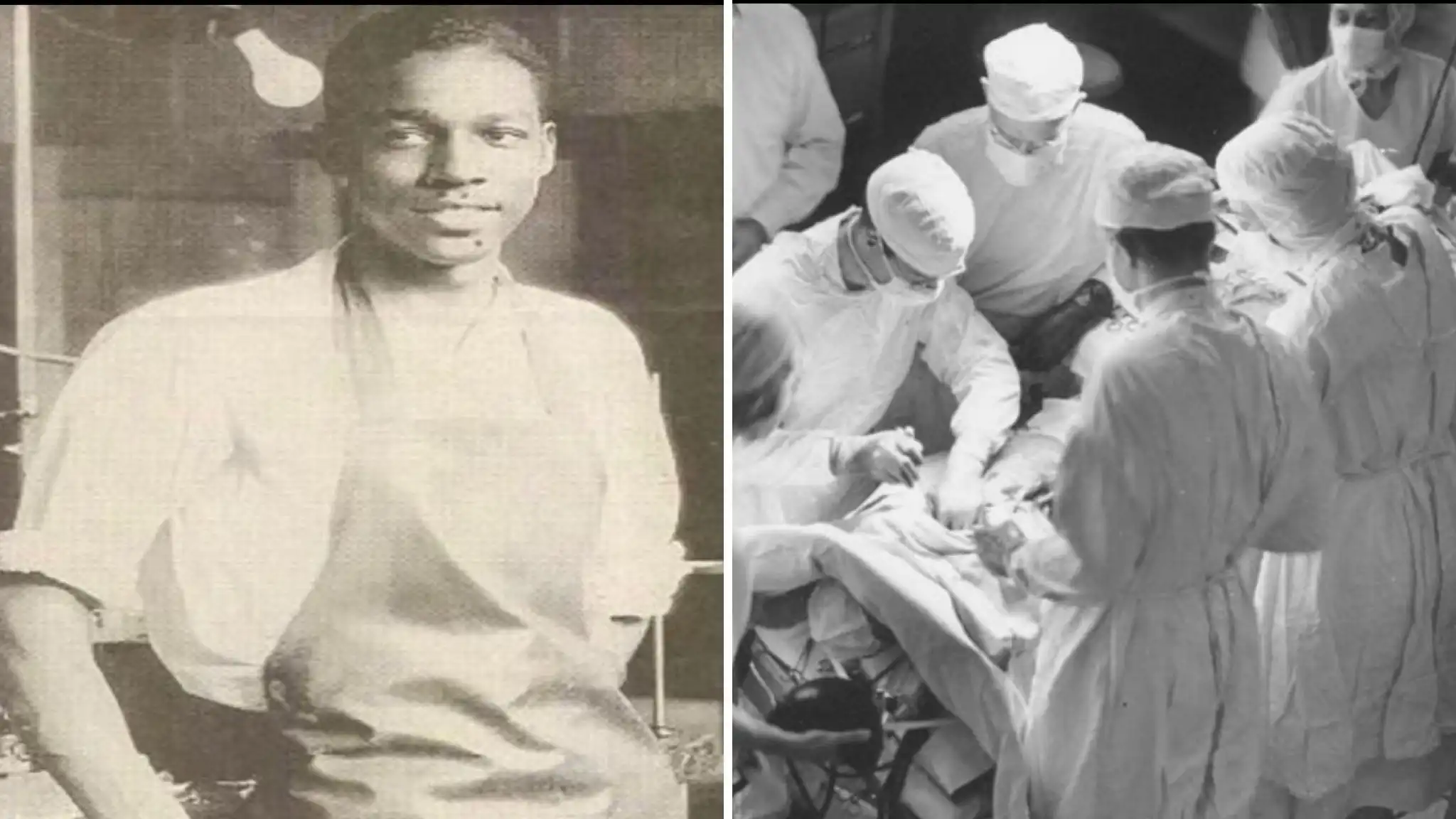
On November 29, 1944, history was made. During the first operation to correct blue baby syndrome on 15-month-old Eileen Saxon, Thomas stood on a step stool behind Blalock. He guided him through each step of the technique he had conceived and perfected.
“This looks like something the Lord made,” Blalock reportedly said, acknowledging Thomas’s technical genius.
Unseen Lab Genius, Unsung for Years
Even after this pivotal moment, Thomas’s contributions, although respected among surgical trainees, went uncredited in formal medical publications, textbooks, and the broader history of cardiac surgery. For decades, he continued to direct surgical research labs, train generations of surgeons, and innovate new techniques.
This included helping develop the automatic defibrillator with protégés like Dr. Levi Watkins, Jr. He maintained the title of lab technician throughout his career.
Despite his remarkable work, true recognition came late. In 1968, a group of surgeons he trained commissioned a portrait of Thomas to hang next to Blalock’s at Johns Hopkins.
In 1976, the university awarded him an honorary doctorate, allowing students and staff to finally address him as “Doctor,” although he never earned a medical degree. That same year, he became an Instructor of Surgery, solidifying his place in the institution’s history.
Legacy Beyond Medicine
Thomas passed away on November 26, 1985, without fully witnessing the public acknowledgment of his story. However, the tide turned after the 1989 Washingtonian article “Like Something the Lord Made.” This article received major journalism awards and led to a PBS documentary and an Emmy-winning HBO film about his life and work.
Today, his legacy lives on through educational initiatives named in his honor. These ensure that his perseverance and innovation for excellence will inspire future generations.
From janitor to a medical pioneer, Vivien Thomas’s life shows us that brilliance does not wait for permission; it demands recognition.