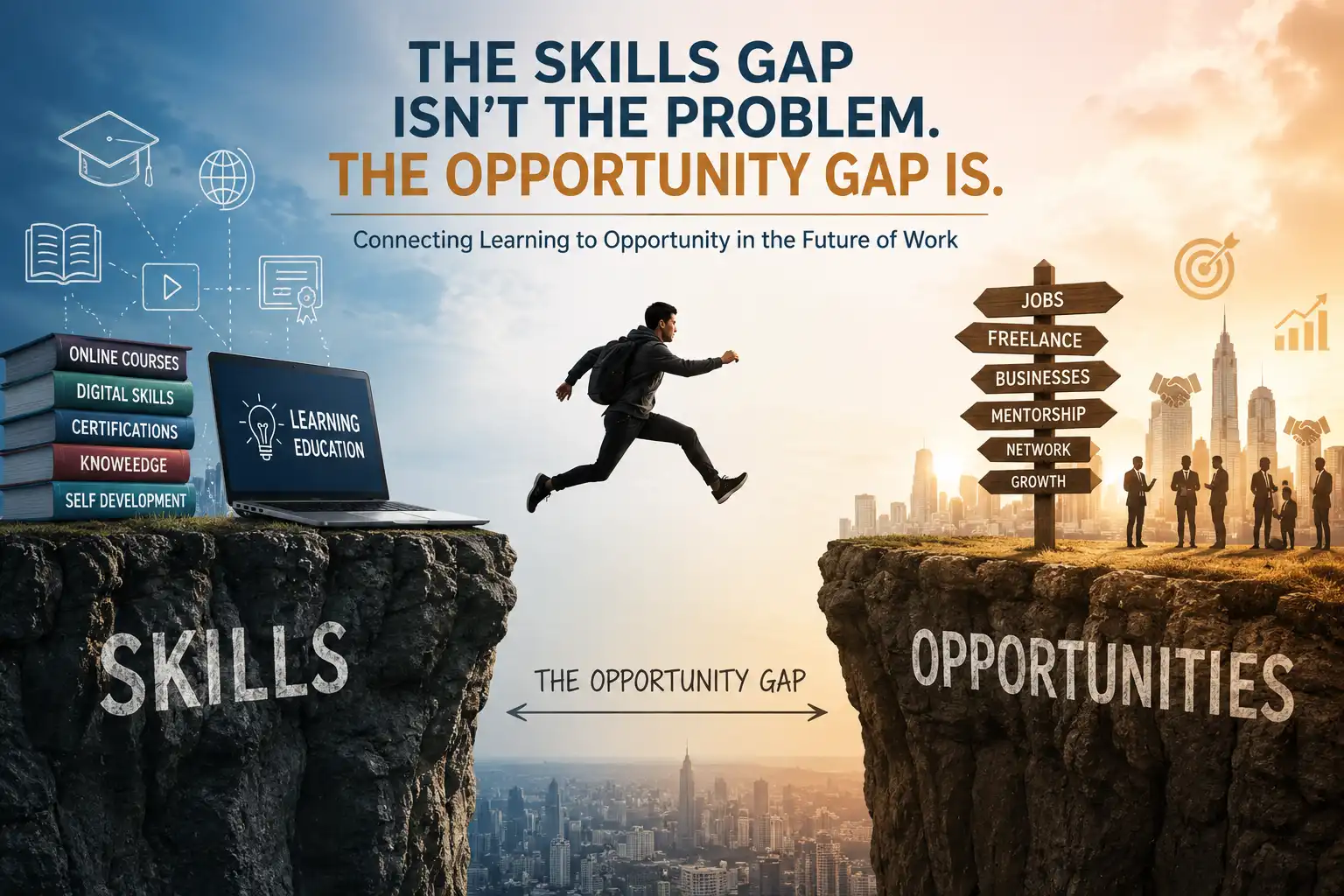
For years, governments, educators, employers, and technology companies have focused on solving what has been described as the skills gap. Billions of dollars have been invested in online education, workforce development, and digital skills training. Millions of learners have completed online courses, earned certifications, and developed valuable technical abilities.
Yet despite this unprecedented access to education, one question continues to surface across the world:
Why are so many skilled people still struggling to find meaningful opportunities?
The answer may not be a lack of skills.
It may be something far more significant.
It is the opportunity gap.
Today, millions of talented people possess the knowledge to succeed but remain disconnected from employers, communities, mentors, clients, and projects that could transform their careers. Learning has become more accessible than ever before, but opportunity remains unevenly distributed.
As the global workforce evolves, addressing the opportunity gap may become one of the defining challenges of the digital economy.
The Rise of a Highly Skilled Generation
Never before has learning been so accessible.
With a smartphone and an internet connection, someone can study artificial intelligence, software development, digital marketing, graphic design, cybersecurity, data analytics, project management, or content creation from almost anywhere in the world.
Online learning platforms have transformed education by making high-quality knowledge available beyond traditional classrooms. Professionals can upgrade their skills, students can prepare for future careers, and career changers can reinvent themselves through self-paced learning.
This democratization of education is one of the internet’s greatest achievements.
But learning alone is no longer enough.
Why Learning Doesn’t Automatically Lead to Opportunity
Completing a course does not guarantee employment.
Obtaining a certification does not automatically attract clients.
Creating a portfolio does not ensure visibility.
Many talented professionals experience the same frustrating reality after finishing their training.
They ask themselves:
- Where do I find clients?
- How do employers discover me?
- How do I build professional credibility?
- How do I connect with mentors?
- How do I turn my skills into income?
These questions reveal the growing divide between education and opportunity.
Knowledge without visibility often remains invisible.
The Opportunity Gap Is Growing
The modern workforce is becoming increasingly competitive:
- Remote work has expanded the global talent pool.
- Freelancers now compete internationally.
- Businesses can recruit professionals from virtually any country.
- Employers have access to thousands of applicants for a single role.
While this creates exciting possibilities, it also means standing out has become significantly more difficult.
Success today depends on more than technical expertise. Professionals increasingly need:
- Strong professional networks
- Personal credibility
- Continuous learning
- Community engagement
- Demonstrated experience
- Meaningful collaboration
- Digital visibility
Opportunity often follows trust, and trust is built through consistent participation, contribution, and reputation, not simply through credentials.
The Problem with Fragmented Digital Platforms
Today’s professional journey is surprisingly fragmented.
A learner might study on one platform.
Network on another.
Search for jobs somewhere else.
Offer freelance services on a different website.
Join discussions inside unrelated communities.
Manage a separate professional portfolio.
Each platform solves one problem while creating another.
The result is a disconnected experience where professionals spend more time switching between tools than building meaningful careers.
This fragmentation slows career growth and creates unnecessary barriers between learning, networking, collaboration, and employment.
The Future Belongs to Connected Opportunity Ecosystems
The next evolution of digital platforms may not focus solely on teaching people new skills. Instead, they will focus on connecting those skills to real opportunities.
Imagine an ecosystem where someone can:
- Learn new capabilities.
- Join professional communities.
- Build a trusted reputation.
- Share knowledge.
- Collaborate with others.
- Discover freelance projects.
- Apply for jobs.
- Continue learning.
All within a connected environment.
This model recognizes an important reality: Careers are not built through isolated actions, they are built through continuous engagement.
Community Is Becoming a Competitive Advantage
Communities have become one of the most valuable assets in the modern economy:
- People increasingly discover opportunities through conversations rather than advertisements.
- Recommendations often matter more than resumes.
- Professional relationships frequently outperform cold applications.
Communities create environments where people can:
- Learn from experienced professionals.
- Receive feedback.
- Develop confidence.
- Discover hidden opportunities.
- Form partnerships.
- Share expertise.
- Expand their networks organically.
As artificial intelligence automates repetitive tasks, human connection becomes even more valuable.
The future of work will reward those who can combine technical expertise with meaningful professional relationships.
Why Integrated Platforms Matter
Professionals no longer want separate platforms for every stage of their journey.
They want environments where learning naturally leads to networking.
- Where networking leads to collaboration.
- Where collaboration leads to employment.
- Where employment leads to growth.
This integrated approach removes friction and creates stronger professional ecosystems that benefit learners, employers, freelancers, entrepreneurs, and businesses alike.
A New Generation of Platforms
This shift is inspiring a new generation of platforms designed around opportunity rather than isolated functions.
Instead of focusing only on courses, job listings, or networking, these ecosystems aim to connect people with the relationships, resources, and experiences that help careers develop over time.
Kominiti is one example of this emerging approach.
Rather than serving a single purpose, Kominiti brings together professional communities, digital learning through KLearning, career opportunities through KJobs, freelance collaboration through its Marketplace, and business networking within one ecosystem.
The goal is simple: reduce the distance between learning a skill and finding an opportunity to apply it.
By combining these experiences, platforms like Kominiti seek to make career development more connected, practical, and community-driven.
Looking Ahead
The future of work will not be defined solely by who learns the fastest.
It will belong to those who can transform learning into meaningful opportunities.
Closing the skills gap remains important, but closing the opportunity gap may prove even more impactful.
Because education changes what people know.
Opportunity changes what people become.
As digital careers continue to evolve, the platforms that thrive will likely be those that help individuals do more than acquire knowledge. They will help them build relationships, gain visibility, collaborate with others, and turn their skills into lasting careers.
In an increasingly connected world, success is no longer measured only by what you know.
It is measured by what your knowledge enables you to achieve, and by the opportunities you can access along the way.